In most cases, you shouldn't put references on your resume. Instead, you should prepare a separate reference list and share it only when an employer asks, usually after a successful interview. Including contact details on your primary resume wastes valuable space that belongs to your work history and skills.
However, specific exceptions apply for government, academic or international roles where employers request references upfront. In this guide to references on resume, you'll learn exactly when to include references, how to format a standalone reference sheet, how many contacts to pick and who to ask. You'll also get a ready-to-use email template to request permission politely.
Should you put references on your resume?
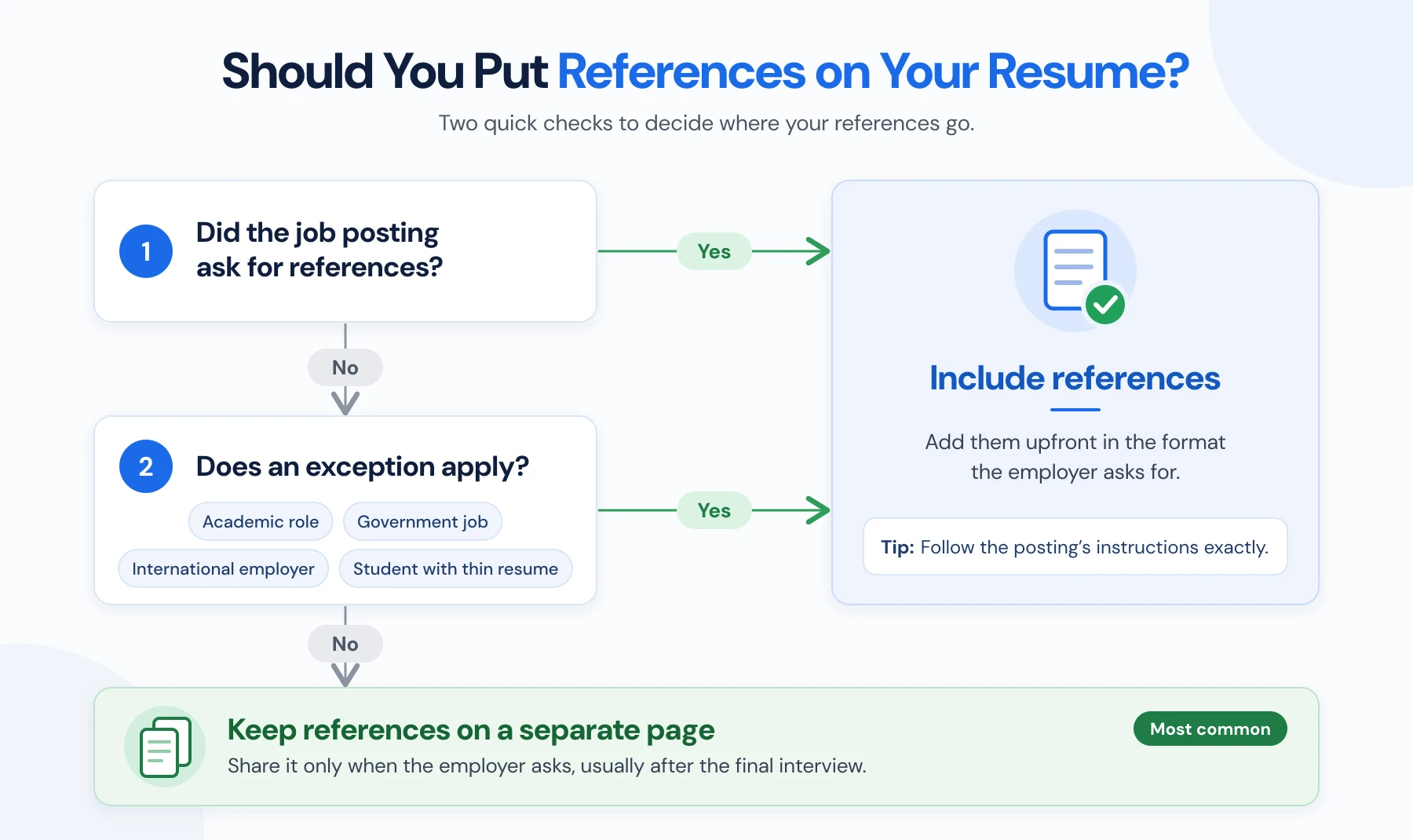
By default, you shouldn't put references on your resume. Your resume space is valuable. Focus on your work history, as shown in our guide on essential resume elements. Listing contact details creates too much space on a resume instead of showcasing your core achievements.
You should also drop the outdated line saying references are available upon request. Hiring managers already know you can provide names if they ask. Including this filler phrase wastes precious lines. Modern HR standards view this line as redundant.
A few clear exceptions apply where you must include references on your resume upfront. If the job posting explicitly asks for them, follow those instructions. Academic roles, government applications and international employers often require references immediately. Students with very thin resumes may also add them.
Hiring teams wait until the final interview stage to check references because calling contacts takes time. They don't want to bother your former managers until they're serious about sending an offer. Sharing contact details too early also risks exposing your network to cold recruiting calls.
Some older career guides still recommend adding a "references available upon request" line at the bottom. Modern hiring practices have dropped this rule completely. Recruiters assume you have people ready to vouch for your work, so saving that line for another bullet point about your achievements gives you a much stronger advantage.
Expert Insight: "We rarely contact references during the initial screening phase. We only reach out after a candidate passes final interviews and we're ready to make an offer" [Recruitment guidance from UC Davis Human Resources].
How to format a reference list
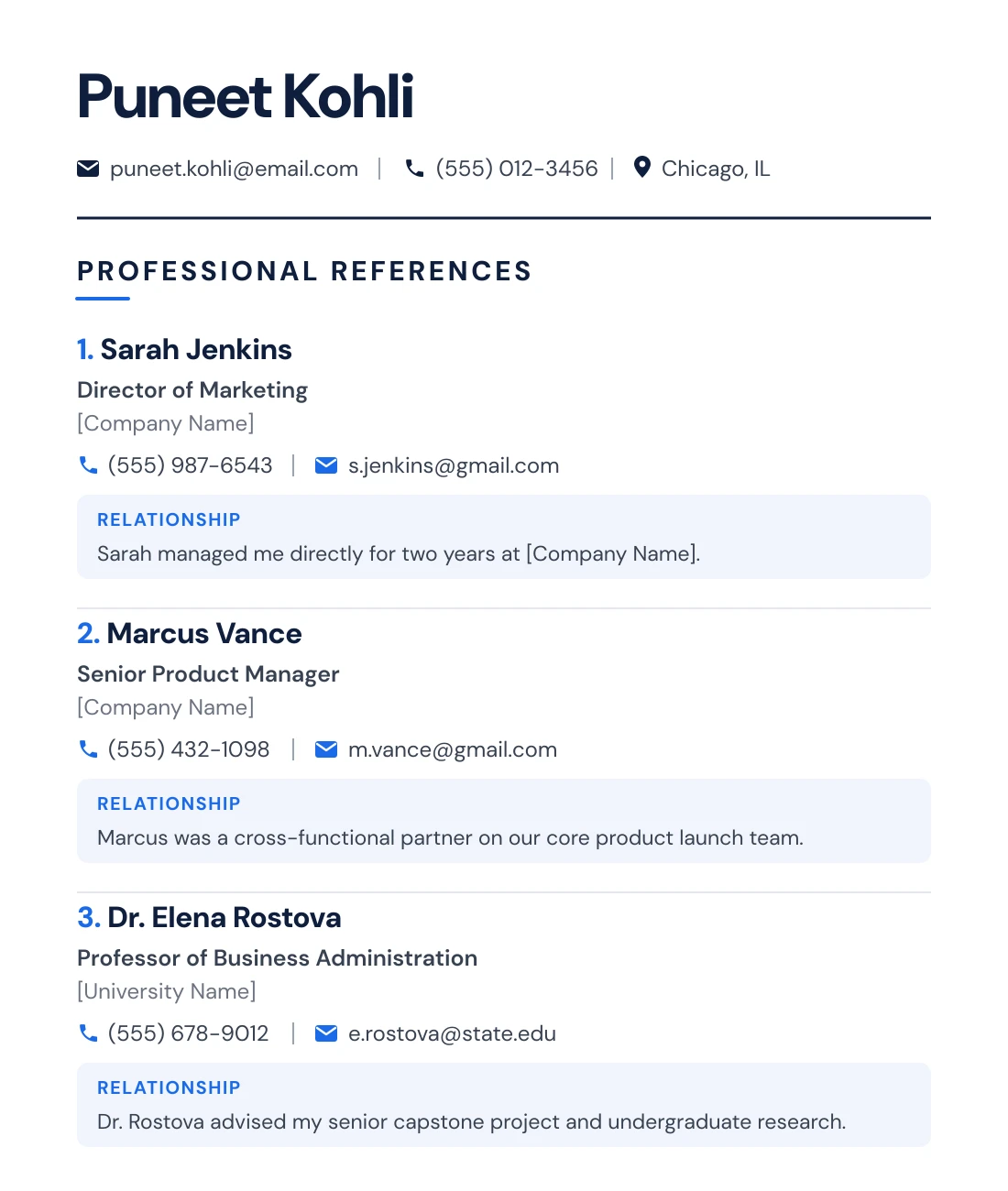
Format your reference list on a separate, standalone page that matches the exact visual header style of your resume. Using identical fonts and margins keeps your application package looking professional and consistent.
List each reference clearly with all necessary contact details so recruiters can reach out without hustle. For every person, include:
Full name and current job title
Company name
Phone number
Professional email address
A single sentence explaining your professional relationship
Here is a complete example of how your reference page should look:
How many references to include on your resume
Most employers expect three professional references. This number gives hiring managers enough perspectives without overwhelming them.
For senior executive positions or academic roles, you'll need up to five references. Always check the job description for specific instructions.
Order your references by relevance to the role you want. Put the person who can speak best about your core qualifications at the top of the list.
Who to ask (and who not to)
Choosing the right references makes a big difference. Pick people who know your professional capabilities and can speak to your recent work ethic.
Who to ask
Former managers and supervisors: They know your daily work habits, reliability and key accomplishments best.
Clients or cross-functional partners: They can speak to your communication skills and how well you collaborate under pressure.
Professors or academic advisors: Students can check our guide on how to make a resume with no experience for tips on selecting mentors who know their academic work ethic.
Who to avoid
Family members and close friends: Their personal bias makes their feedback unhelpful to hiring managers.
Outdated contacts: Avoid listing supervisors from over five years ago who haven't seen your recent growth.
How to ask someone to be a reference
Always ask someone before you list them as a reference. Surprising a manager with a cold call creates an awkward situation. Reach out early and confirm they feel comfortable speaking for you.
Share details about the target job and send your resume. This helps them prepare specific talking points. If you need a formal endorsement, read our guide on how to ask for a letter of recommendation.
Example 👇
Subject: Quick question regarding a reference / [Your Name]
Hi [Name],
I hope you are doing well. I am currently applying for [Job Title] roles at companies focused on [Industry/Goal].
Given my time working with you on [Project/Team], would you be open to serving as a professional reference for me? If so, I would love to send over my updated resume and a brief overview of the role details so you have context.
No pressure at all if your schedule is too full right now. Thank you for your support.
Best regards,
[Your Name]
How to prepare your references after they agree
Once someone agrees to vouch for you, set them up with all details before the recruiter calls. Send them a quick message with:
The job description: Highlight two or three core skills the employer wants most.
Your updated resume: Make sure the dates and job titles match what you submitted.
A quick reminder of your wins: Mention one or two projects you worked on together so they have fresh examples ready.
After you send your reference sheet to the hiring team, send a quick note to let them know. You can use our guide on how to follow up on a job application to keep your message polite and professional.
How to do this with Careerflow
A polished reference list should be in perfect pace with your core application package. Keeping your materials organized will help you avoid mix-ups when you’re actively job searching and have multiple companies at once. Making sure your resume is perfectly complementary from day one will make this entire workflow much more streamlined.
Match your formatting: The reference list should match the resume it goes with, and our resume builder helps you build the resume the reference list goes with using clean templates.
Monitor your outreach: Staying organized across multiple interview rounds is simple when our job tracker keeps notes on which references were shared with which employer.
Puneet Kohli
Co-founder
Puneet left a senior engineering role at Apple to co-found Careerflow, an AI-powered job search platform backed by Techstars and used by over 1 million job seekers worldwide. He brings more than a decade of hands-on experience in AI and machine learning, built across Apple, Amazon, and Leia Inc. As CEO, he leads the product and engineering behind the tools he wished existed during his own career transitions. You can connect with him on LinkedIn
FAQ: References on Resume
Should I put "references available upon request" on my resume?
No, you should not include this line on your resume. Hiring managers already know you can provide references if they ask. This outdated phrase wastes valuable space that belongs to your core work history and achievements. Modern recruiters prefer you use that space to highlight your actual skills.
How many references should I have?
Three professional references are the standard for most job applications. Senior executive positions or academic roles often require up to five references. Always check the specific instructions in the job posting to ensure you provide the exact number of contacts the hiring organization requests from candidates.
Who should I use as a reference if I have no work experience?
If you lack formal work experience, use academic mentors, professors, internship supervisors, or leaders of student organizations. Choose individuals who have witnessed your dedication, work ethic and ability to complete complex projects. Their positive endorsements will validate your potential and reliability to prospective employers.
Do employers actually call references?
Yes, employers do call references, but usually near the final stages of the hiring process. Hiring teams reach out to verify your past performance, work style and professional reliability right before making a formal job offer. Because companies rarely check references early, you only need to share them when requested.
Can I use a friend as a reference?
No, you should avoid using personal friends as professional references. Hiring managers expect objective evaluations from people who have managed your work or partnered with you in a professional setting. Personal friends cannot provide the credible performance insights that employers need to make confident hiring decisions.
Recommended Articles
Here are some of the recommended articles from our team