Interviews


When an interviewer asks, "Why should we hire you?" they want a short, specific case for why your skills and background fit this exact role better than other candidates. A strong answer highlights the two or three things the employer needs most, proves one of those skills with a concrete result and explains the value you’ll deliver during your first few months on the job. Knowing how to prepare for job interview questions like this helps you speak with natural confidence under pressure.
In this blog, you'll learn what hiring managers look for when they ask this question, a reliable three-step formula to build your response and five real-world sample answers for different career stages. We'll also cover common mistakes to avoid and how to refine your delivery.
What the interviewer is really asking
When an interviewer asks, "Why should we hire you?" they aren't looking for a summary of your resume or a long list of positive personality traits. What they're really evaluating is whether you understand their specific problems and whether you're qualified to solve them.
Behind this question, hiring teams want three things to hear from you:
- You understood the role: You've analyzed the job posting, understand the team's primary goals and recognize what challenges the person in this role must solve.
- You have proof: You don't just claim to possess key skills; you back up your claims with specific accomplishments, metrics or past project outcomes.
- You’ll add value soon: You can explain how your current skills will transfer directly into their workflow, allowing you to get up to speed quickly and contribute during your first few months.
Why generic answers fail
Many candidates default to vague claims like, "You should hire me because I'm a hard worker, a fast learner and really passionate about this industry."
While these traits sound positive, generic answers fail for three reasons:
- They lack differentiation: Almost every candidate claims to be dedicated, motivated and adaptable. Broad self-descriptions don't help hiring teams distinguish you from the rest of the candidate pool.
- They provide zero evidence: Stating that you're a "problem solver" doesn't prove that you can solve problems. Without concrete examples or data, claims carry little weight with experienced interviewers.
- They miss the employer's perspective: Generic answers focus on who you are rather than what you can do for the company. Interviewers care less about abstract qualities and more about how your skills directly address their business needs.
Instead of positioning yourself as a great worker in general, target your answer directly to the core requirements of the job opening.
How to answer "Why should we hire you?" in 3 steps
Building a compelling response doesn't require a long story. You can structure a clear, focused answer using a simple three-step formula that links your qualifications directly to the employer's needs.
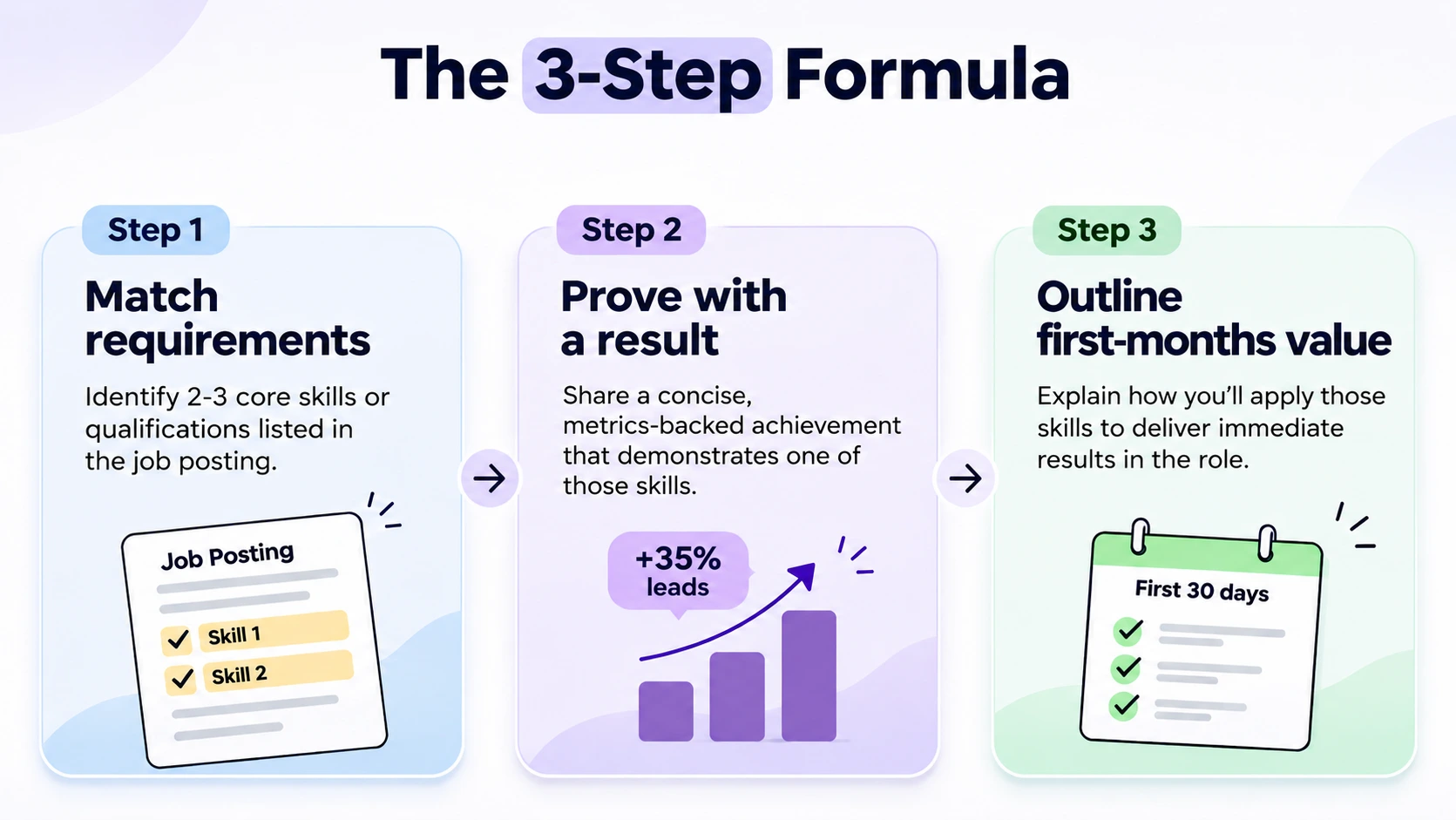
Step 1: Match the top requirements from the job posting
Start by picking two or three essential requirements highlighted in the job description. These should be core technical skills, functional experiences or domain knowledge that the company considers non-negotiable.
Instead of talking about your career in broad terms, state clearly how your background matches the core needs of the position right away.
Step 2: Prove one requirement with a short result
Once you state your key qualifications, support at least one of them with a concrete accomplishment. Use a short metric, data point or outcome from your recent work history to provide instant credibility.
A brief result changes your answer from an unverified opinion into clear evidence of your capability.
Step 3: Close with what you’ll deliver in the first months
Finish your answer by explaining what you plan to accomplish during your onboarding period. Connect your past experience directly to their forward-looking priorities, showing that you can hit the ground running without needing extensive supervision.
How to build your answer from a real job posting
To master this question, you need to stop guessing what employers want and start translating their exact job description. Let's look at a live example using a “Digital Marketing Manager, Web Strategy role at Amazon Web Services (AWS)” to see how this works in practice.
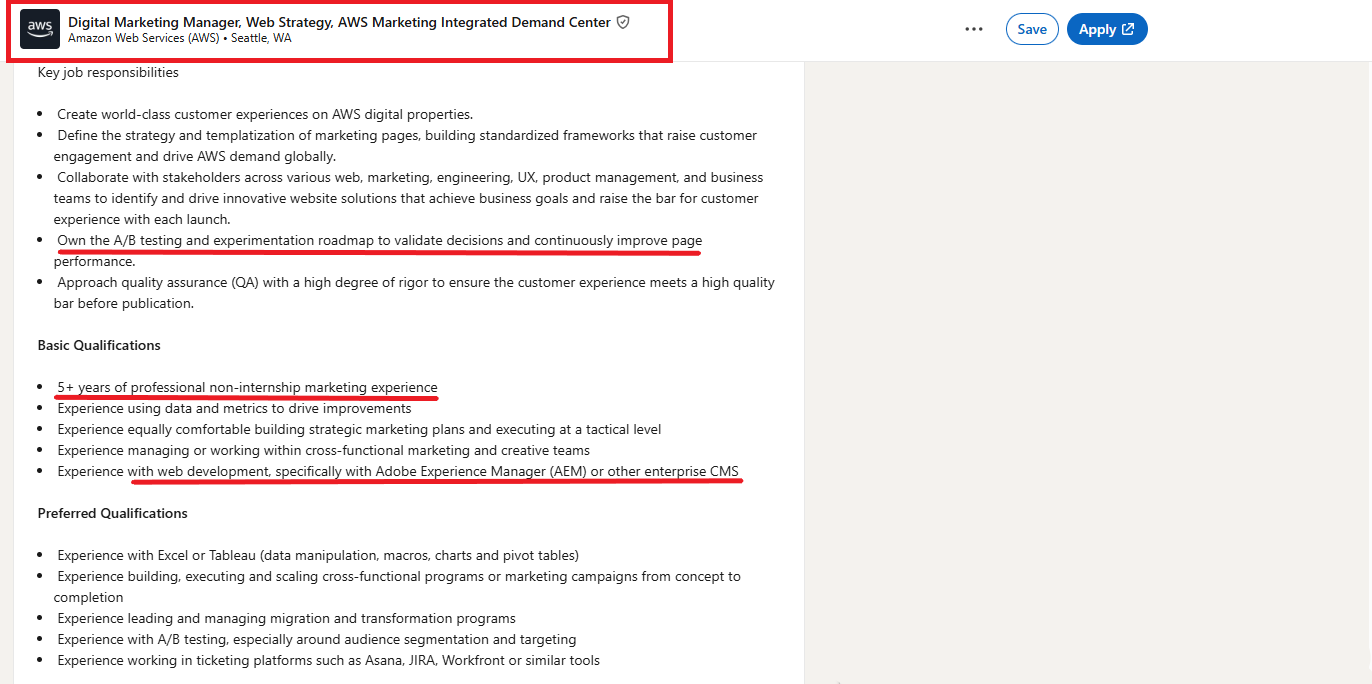
Step 1: Scan the job description for core requirements
When you open a complex job description like the AWS posting, ignore the general fluff and look at the basic qualifications and primary responsibilities. For this AWS role, the non-negotiables stand out immediately:
- Experience level: Five plus years of professional marketing experience.
- Technical stack: Experience with enterprise content management systems like Adobe Experience Manager (AEM).
- Execution skills: Running A/B tests, driving cross-functional alignment across engineering and UX, and scaling global web pages.
These bullet points give you the exact keywords and skills the hiring manager cares about most. Your answer must address these elements directly.
Step 2: Extract the employer's main pain point
Beyond the basic skills, look for the underlying business problem the hiring manager needs solved. In the AWS description, the team notes they need someone to turn ambiguous, cross-functional problems into structured, repeatable solutions and standardize the web experience.
The core pain point is clear: the current web strategy lacks global scale and consistency across teams. If you can show you’ve solved a similar scaling problem, you instantly prove you can relieve their specific headache.
Step 3: Mapping the AWS job description to the 3-step formula
Before building your spoken answer, break down the AWS job posting to isolate their core expectations:
- Core skills: Scaling web page strategy and templatization across global markets while collaborating with engineering, UX and product marketing teams.
- Technical requirement: 5+ years of marketing experience with enterprise CMS platforms like Adobe Experience Manager (AEM), plus a strong background in A/B testing and data-driven optimization.
- Execution goal: Turning ambiguous cross-functional problems into structured, repeatable frameworks that improve customer engagement.
Step 4: Translate the posting into your spoken answer
Here is how that looks when spoken out loud:
"You should hire me because I bring over five years of digital marketing experience specializing in enterprise web strategy, AEM template scaling and cross-functional alignment. In my previous role leading global web operations, I owned our experimentation roadmap and ran targeted A/B tests that increased user engagement across product pages by 32% while reducing regional launch friction. Because this AWS role requires uniting engineering, UX and product marketing teams to build repeatable web frameworks, I'm ready to step in on day one to standardize your global page experiences and drive measurable demand."
Why This Answer Works for AWS
- It addresses the exact tech stack: It highlights enterprise CMS and AEM experience right away, directly answering the basic qualifications.
- It proves the claim with data: Mentioning a 32% increase in engagement gives tangible proof rather than just stating you're good at marketing.
- It speaks to Amazon's scale: Focusing on global web operations and cross-functional alignment shows you understand the complexity of managing digital demand across multiple regional markets at AWS.
Sample answers by situation
Entry-level or recent graduate
"You should hire me because I bring strong foundational skills in digital marketing and a proven ability to turn academic projects into real results. During my university capstone, I led a student team to run local social campaigns that grew engagement by forty percent in three months. I know this role requires someone who learns quickly and handles data with care. Because I'm already certified in key analytics tools and eager to support your launch goals, I can step in on day one and help your department hit its targets."
📢 Note: If you want to prepare for early career hurdles, our guide on mock interview questions for freshers offers great tips.
Experienced professional
"You should hire me because I bring over six years of experience building and scaling enterprise web strategies that directly lower acquisition costs. In my current role at [Company Name], I led a cross-functional migration project that reduced system downtime by thirty-five percent and saved one hundred twenty thousand dollars in annual server expenses. I know your team is focused on expanding global page templates this quarter. Because I'm already an expert in AEM workflows and agile deployment, I can take ownership of your upcoming product launches immediately and help your team drive higher user conversion rates."
Career changer
"You should hire me because I bring seven years of operational leadership and project management experience that translates directly into tech operations. While managing multi-unit retail networks, I oversaw complex budgets of over eight hundred thousand dollars and streamlined inventory logistics to cut waste by eighteen percent. I'm bringing that same rigor, cross-functional coordination and problem-solving mindset to this operations role. Because I've already mastered rapid process improvement in fast-paced environments, I can step into your team and help organize your workflow systems from day one."
Internal promotion
"You should hire me because I already know our product ecosystem, our core audience and the specific bottlenecks our regional marketing teams face. Over the past two years on the campaign analytics team, I automated our weekly reporting workflows and helped increase regional qualified leads by twenty-five percent. I've built strong working relationships with our engineering and UX partners across departments. Because I don't need time to learn company systems or brand guidelines, I can step into this senior role tomorrow and lead your next product launch without any onboarding lag."
Someone returning to work
"You should hire me because I bring a decade of project management experience combined with refreshed, up-to-date technical skills in digital campaign coordination. Before taking a planned career break to care for my family, I managed multi-channel marketing budgets and led cross-functional teams that delivered campaigns on strict deadlines. Over the past six months, I've completed updated certifications in modern web analytics and content tools. Because I already possess deep professional maturity alongside modern technical skills, I'm ready to bring immediate stability and high-level execution to your projects from day one."
What not to say
Some mistakes can destroy a good interview performance. Don’t make these common mistakes when answering why you’re the right fit:
- Comparing yourself to other candidates: Don't speak about what other applicants lack or try to tear down the competition. You can stand out strongly without naming or criticizing anyone else in the competition.
- Repeating your resume line by line: The interviewer already read your work history. Use this moment to connect your past achievements directly to their future business needs instead.
- Talking about salary or perks: Keep your focus entirely on the value you'll bring to the team. Save discussions about compensation, bonuses and benefits for later stages of the interview process.
- Sounding overly rehearsed: Memorizing a script word for word makes you sound robotic and stiff. Aim for a natural, conversational delivery that shows your genuine personality.
- Going over two minutes: Keep your answer punchy and focused. Speaking past the two-minute mark loses the interviewer's attention and eats up time meant for a two-way conversation.
How to practice your answer
A great response sounds effortless because you've refined it beforehand. For a broader look at common interview prompts, check out our guide on mock interview questions and answers.
To enhance your answer delivery, follow these four simple preparation steps:
- Write your draft: Write down your targeted job requirements, your proof point and your first-months value statement.
- Trim the length: Cut your text down until it takes less than 90 seconds to speak at a normal, steady pace.
- Speak out loud: Practice saying your response in front of a mirror until it feels conversational rather than memorized.
- Record and adjust: Use our AI mock interview tool to record your practice session, check your clarity and refine your pacing.
How to do this with Careerflow
Delivering a persuasive pitch under pressure requires deliberate practice because you'll want to sound completely natural. When you're ready to test how well your background matches an open role, our skill match analyzes your resume against the job description instantly. To refine your spoken delivery and build confidence before your meeting, our AI mock interview tool lets you practice out loud while providing actionable feedback on your clarity and relevance. Once the interview is over, a short thank-you email after the interview keeps the conversation going.
- Evaluate your resume alignment: Use our skill match to check how closely your professional background satisfies the core requirements of the posting.
- Refine your spoken delivery: Practice answering key questions with our AI mock interview tool to ensure your pitch sounds conversational and compelling under pressure.