Job search
.avif)
.webp)
Ask someone who knows your work well for a letter of recommendation. Give them at least two weeks' notice and provide specific details about your target role. A clear request makes writing the letter easy for your recommender.
You aren't just asking for a favor when applying for jobs, internships or graduate programs. You're giving your recommender the context they need to highlight your top strengths. Framing your request thoughtfully sets both of you up for success.
This guide shares who to ask, when to reach out and ready-to-use email scripts. Following these steps helps you secure strong recommendations quickly without awkward back-and-forth messaging.
What is a letter of recommendation?
A letter of recommendation is a written endorsement from someone who can vouch for your skills, character and professional potential. Recommenders detail your work ethic, academic performance and accomplishments for hiring teams or admissions committees. It provides concrete proof of your abilities from a credible source who knows your work well.
A reference is simply a contact person an employer calls to verify your background. In contrast, a recommendation letter is a written document submitted directly with your application.
Who should you ask for a letter of recommendation?
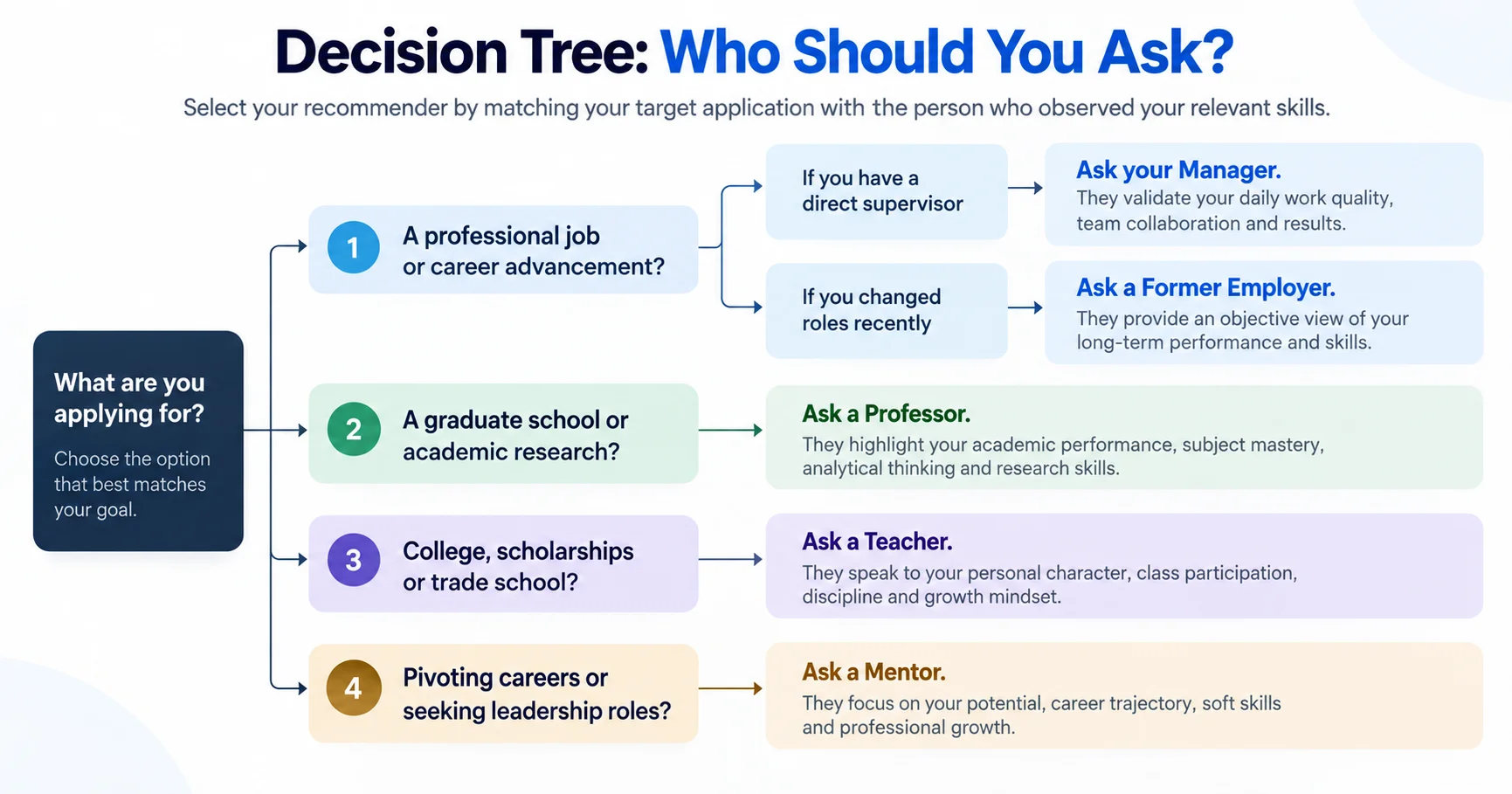
Ask someone who directly supervised your work and can share specific examples of your achievements.
Choose a manager, professor, internship supervisor, mentor, project lead or client. These individuals observed your growth firsthand and can highlight your specific strengths. Their direct experience allows them to speak convincingly about your daily work.
Don't choose a recommender just because they have an impressive job title. A detailed letter from a close supervisor carries more weight than a vague note from a senior executive. Specific proof of your impact matters much more than an executive's name.
When to ask for a letter of recommendation
Ask for a letter of recommendation as early as possible. According to Union College's Becker Career Center, an ideal time of five to six weeks in advance. Giving early notice shows respect for your recommender's time and leads to a much stronger letter.
For academic applications, request letters several weeks early to avoid the peak application season rush. Professors often handle dozens of requests during fall deadlines, so early outreach helps yours stand out.
For job applications, reach out before deadline pressure becomes urgent. Asking early prevents your recommender from guessing what the target role requires.
If your request is last-minute, acknowledge the tight deadline honestly and offer a polite way out. Send all required background materials in your initial message so they can write the letter quickly.
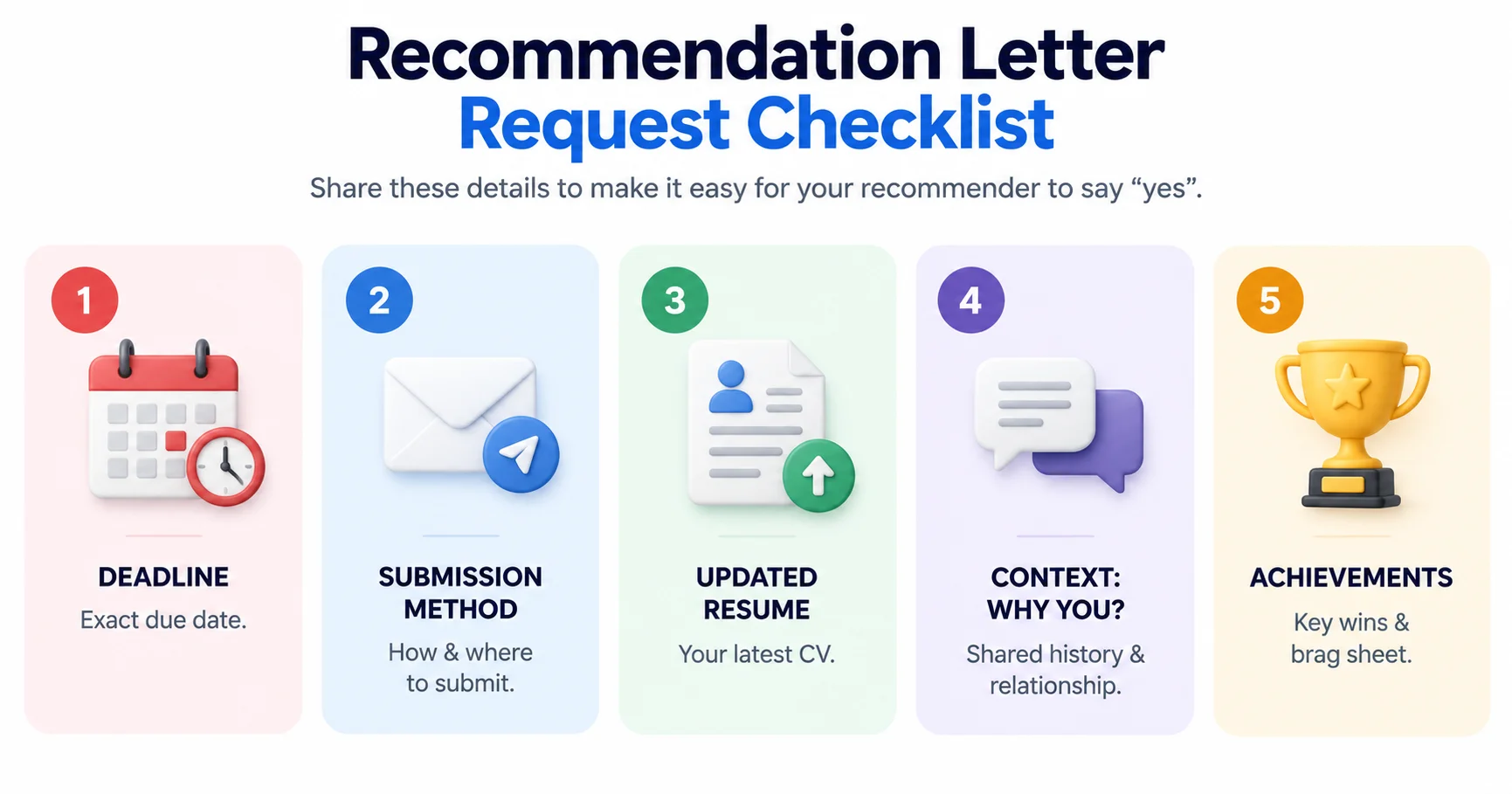
What to include in your request
Prepare your request details before drafting your email. Gathering these materials upfront makes writing the letter easy for your recommender.
The deadline and submission instructions
State the exact due date clearly in your message. Provide submission details like online portal links, forms or direct email addresses. Giving exact instructions removes confusion and prevents missed deadlines.
Why you're asking this person
Remind your recommender of your shared work history. Mention specific projects, team wins, internships or courses you completed together. Reestablishing this connection helps them recall your best accomplishments quickly.
A current resume or short background summary
Attach your current resume, LinkedIn profile or a brief brag sheet. Including a project summary or transcript gives your recommender instant access to relevant dates and achievements.
📢 To Know More: Importance of Endorsements and Recommendations on LinkedIn
What the letter should support
Share the job title or academic program you're pursuing. Request that they highlight two or three key qualities relevant to the opportunity. Give context and background details rather than a pre-written script.
How to ask for a letter of recommendation step by step
Follow these seven steps to request a recommendation letter professionally and secure a strong endorsement.
Step 1: Choose the best recommender for your target opportunity
Pick someone who directly supervised your work. Match their experience directly to your target role.
- Example: Applying for a Data Analyst role? Ask the Engineering Manager who led your SQL project instead of a distant executive.
Step 2: Confirm the deadline and submission process
Identify exact dates and submission formats before reaching out to your contact.
- Example: "The application portal closes October 15 at 5 PM EST, requiring a direct PDF upload through an email link."
Step 3: Ask politely with a clear option to decline
Give your contact a graceful way to opt out. An enthusiastic recommendation carries far more weight than a rushed endorsement.
- Example: "Do you feel comfortable writing a strong recommendation letter for my application to the Product Lead position?"
Step 4: Explain why you chose them specifically
Remind your contact of shared achievements and specific skills.
- Example: "I chose you because our work on the Q3 cloud migration highlights the leadership skills needed for this role."
Step 5: Provide a complete preparation package
Send your background materials in a single organized email. Providing key details makes writing your letter fast and effortless.
- Example: "I attached my updated resume, the job posting, the portal link and a summary of my top three project wins."
Step 6: Send a polite reminder as the deadline approaches
Nudge your recommender gently 7 to 10 days before the due date.
- Example: "Hi Sarah, following up on my recommendation letter due next Friday. Let me know if you need any additional details!"
Step 7: Send a prompt thank-you note and update them
Express genuine gratitude right after submission and share your application results later.
- Example: "Thank you so much for submitting my recommendation letter today! I appreciate your support and will share updates soon."
How to ask for a letter of recommendation by email
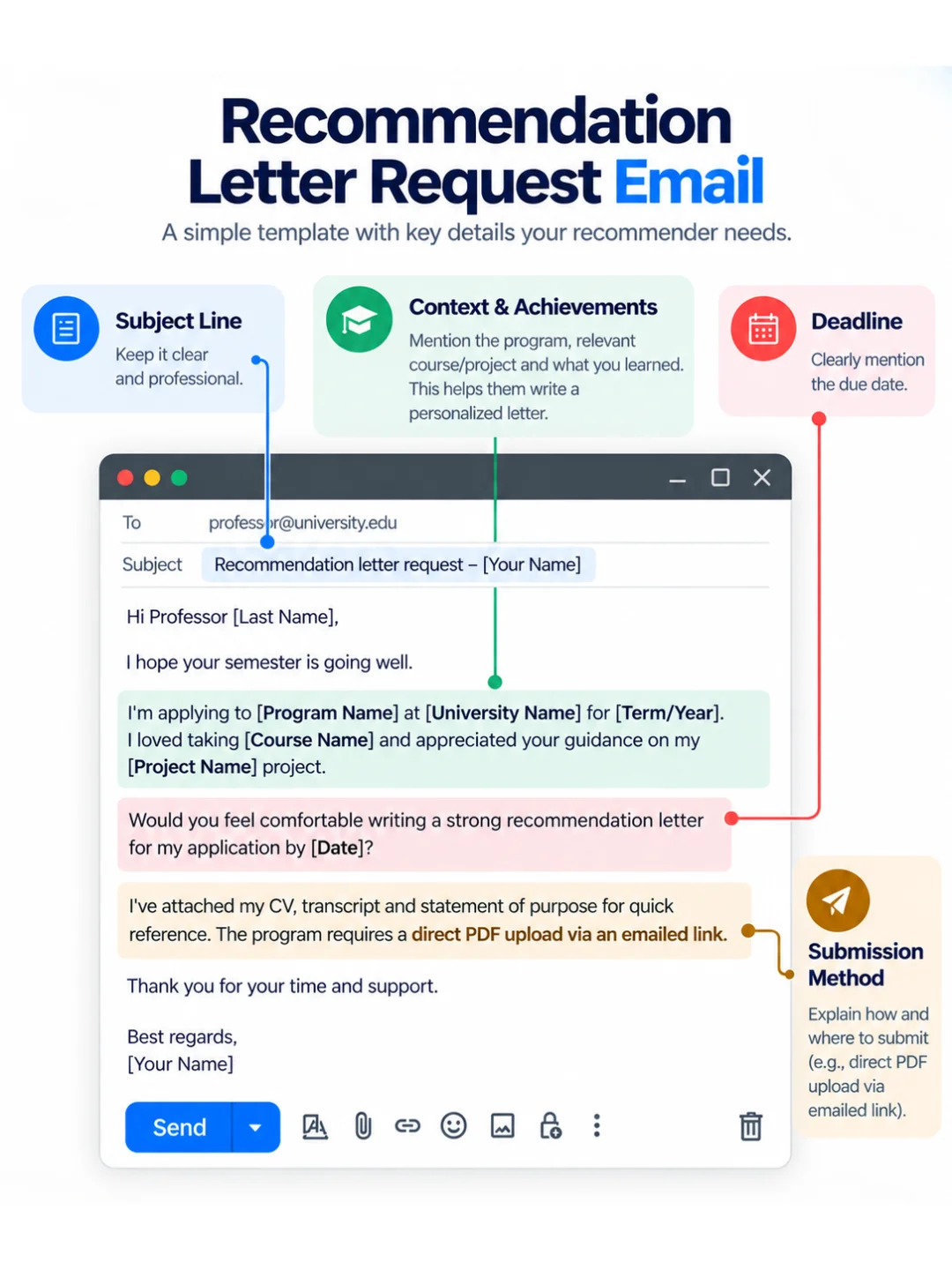
Frame your email request clearly to get a fast positive response. A well-structured message gives your recommender every detail they need upfront.
Include these core elements in your email structure:
- Clear subject line: State your full name and application intent immediately.
- Polite opening: Start with a warm professional greeting.
- Direct ask: Ask early if they can write a strong recommendation letter.
- Reason for asking: Explain why their perspective fits this specific application.
- Deadline and links: State the exact due date and submission process clearly.
- Attached materials: Attach your resume, brag sheet and job description.
- Graceful exit: Give them permission to decline politely if their schedule is full.
Recommendation letter email templates and examples
Use these customizable templates to request recommendations for different scenarios.
Ask a professor for a letter of recommendation
When to use: Use this template for academic programs, research roles or early-career internships.
Subject: Recommendation letter request – [Your Name]
Hi Professor [Last Name],
I hope your semester is going well.
I'm applying to [Program Name] at [University Name] for [Term/Year]. I loved taking [Course Name] and appreciated your guidance on my [Project Name] project.
Would you feel comfortable writing a strong recommendation letter for my application by [Date]?
I've attached my CV, transcript and statement of purpose for quick reference. The program requires a direct PDF upload via an emailed link.
Thank you for your time and support.
Best regards,
[Your Name]
Ask a teacher for a letter of recommendation
When to use: Use this template for college admissions, scholarships or trade school applications. If you're building your application materials, check out our guide on how to write a resume for a college application.
Subject: College recommendation letter request – [Your Name]
Hi [Teacher Name],
I hope you're having a great week.
I'm preparing my applications for [College/Program Name] and would love your support. I really enjoyed your [Subject Name] class, especially working on [Specific Project].
Are you open to writing a recommendation letter for me before [Date]?
I've attached my student brag sheet and application checklist. The letter can be submitted directly through [Common App / Portal Name].
Thanks so much for considering my request!
Best,
[Your Name]
Ask a manager or employer for a letter of recommendation
When to use: Use this template for job applications, internal promotions or industry programs.
Subject: Recommendation letter request – [Your Name]
Hi [Manager Name],
I hope you're doing well.
I'm applying for a [Job Title] role at [Company Name] and would value your endorsement. I loved working together on [Project/Team Name] and leading our [Key Result] initiative.
Would you be comfortable writing a strong recommendation letter for me before [Date]?
I've attached the job description, my resume and a summary of our team achievements. Please let me know if you have any questions.
Best regards,
[Your Name]
Ask someone you haven't spoken to recently
When to use: Use this template when reaching out to former managers, mentors or supervisors after months without contact.
Subject: Catching up & recommendation request – [Your Name]
Hi [Name],
I hope you're doing well!
I was thinking recently about our time working together on [Project/Company Name]. I wanted to share that I'm currently applying for a [Job Title] role at [Company Name].
Given our work on [Specific Accomplishment], I'd be honored if you felt comfortable writing a letter before [Date].
I've attached my updated resume and details about the target role. I'd also love to catch up over a brief phone call if you're free!
Best regards,
[Your Name]
Last-minute recommendation letter request
When to use: Use this template when deadlines are short. Acknowledge the tight timeline and offer an easy exit.
Subject: Urgent recommendation request – [Your Name]
Hi [Name],
I hope you're having a good week.
I'm applying for a [Role/Program Title] with a deadline of [Date]. I apologize for the short notice regarding this request.
Would you be open to writing a brief recommendation letter if your schedule permits? I completely understand if the timeline is too tight.
I've attached my resume, brag sheet and submission link so you have everything ready in one place.
Best regards,
[Your Name]
Recommendation letter reminder email
When to use: Send this gentle nudge 7 to 10 days before the submission deadline.
Subject: Gentle reminder: Recommendation letter for [Your Name] – due [Date]
Hi [Name],
I hope you're having a great week!
I'm following up on the recommendation letter for my [Program/Role Name] application, which is due on [Date].
I've included the submission link and my background materials below for easy access. Please let me know if you need any additional details.
Thank you again for your time and advocacy!
Best,
[Your Name]
Thank-you email after a letter of recommendation
When to use: Send this immediately after your recommender submits their letter.
Subject: Thank you for the recommendation letter!
Hi [Name],
Thank you so much for submitting my recommendation letter today!
I truly appreciate your time, effort and ongoing advocacy for my career. Your support means a lot to me.
I'll keep you posted as I hear back on my application status!
Warmly,
[Your Name]
What not to do when asking for a recommendation letter
Avoid critical missteps that jeopardize your professional relationships and recommendation letter quality.
- Don't ask someone who barely knows you: Choose contacts who observed your daily work directly. A generic letter from an unfamiliar contact carries little weight with hiring teams.
- Don't send vague requests: Always include exact deadlines, target role details and background materials. Missing context forces your contact to guess what to write.
- Don't assume an immediate yes: Frame your request politely and give them a clear exit option. Recommenders need the freedom to decline if their schedule is full.
- Don't wait until the last minute: Reach out at least five to six weeks early. Rushed requests stress your contact and yield weaker endorsements.
- Don't ask for exaggerated claims: Let your actual achievements speak for themselves. Never push a recommender to inflate titles, metrics or skills.
- Don't forget to send a thank-you note: Always send prompt appreciation after submission. Failing to express gratitude damages your professional relationship for future opportunities.
How Careerflow helps you manage recommendation requests
Careerflow streamlines your recommendation process by helping you organize deadlines, polish your resume and draft clear outreach messages.
Preparing high-quality materials before reaching out ensures your recommender has everything they need. You can refresh your application details using our ai resume builder to showcase your latest achievements. Clear background documents make writing a strong endorsement easy for your contact.
Track your application deadlines and follow-ups in one place with our job tracker. Set timely reminders so you never miss a submission date or forget to send a thank-you note.
When you're ready to reach out, draft customized outreach messages with our ai email writer. Careerflow helps you prepare materials and communicate clearly so you can secure strong endorsements with confidence.
.webp)