Resumes


A resume objective is a concise two or three sentence statement at the top of your resume that states the role you want and the value you bring. It works best if you're a student, transitioning to a new field or returning to work after an extended break. If you already have years of relevant experience, a resume summary does the job much better.
In this blog, you'll learn whether you actually need an objective, how it differs from a summary and the exact three-step formula to write your own. You'll also get practical objective examples grouped by real-world situations, common mistakes to avoid and simple tools to build your resume quickly.
Do you need a resume objective in 2026?
Many job seekers wonder if the resume objective is outdated or still effective in 2026. Harvard FAS career services state that a resume must immediately highlight your relevant skills and potential value you bring to an employer. While experienced professionals often opt for a summary, an objective statement still serves an important role when your work history doesn't tell the full story on its own.
Deciding whether to include an objective comes down to your current professional background and application strategy.
When to use a resume objective
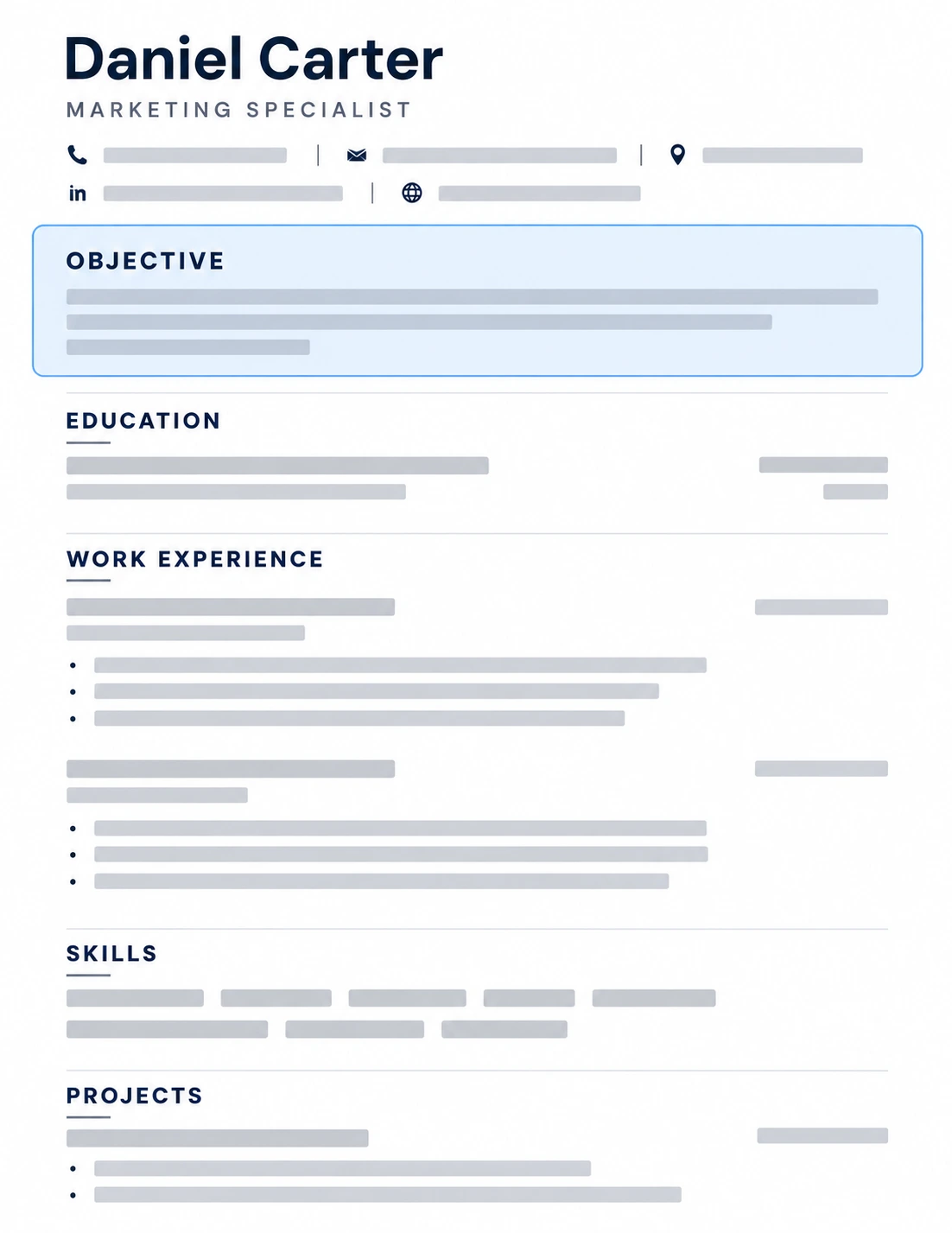
Including an objective statement works best when you need to bridge the gap between your past background and your future target role:
- First job or internship: When you're a student or recent graduate without direct work history, an objective can explain how your academic training and foundational skills align with the open role.
- Career change: If you're switching industries, your past job titles might confuse a recruiter; an objective can instantly clarify your target role and highlight transferable skills.
- Return to the workforce: When you're re-entering the job market after a career gap, an objective can set a fresh focus on your readiness to contribute.
- Cold applications: When submitting an unsolicited resume to a target company without a specific posting, an objective can state exactly where you fit within the organization.
When to skip a resume objective
In many standard job searches, writing an objective wastes valuable space at the top of your page:
- You have relevant industry experience: If your recent job titles match the position you're applying for, recruiters already know what role you want by reading your employment history.
- The job posting is specific: When an employer lists exact technical qualifications and direct experience requirements, a resume summary matches those criteria far better than an objective.
📢 Expert insight: "When a candidate has a non-traditional background or is changing fields, a clear objective helps me connect the dots immediately. But if you have five years of direct experience in the exact same role, an objective feels redundant. Skip it and lead with your top achievements instead."
~Nikita Gupta
Co-Founder, Careerflow.ai & Ex-Senior Technical Recruiter
The golden rule: Use a resume objective to explain where you're going when your past experience doesn't explicitly show it; otherwise, lead with a summary that highlights what you've already accomplished.
Resume objective vs resume summary
Understanding the difference between an objective and a summary comes down to direction and focus.
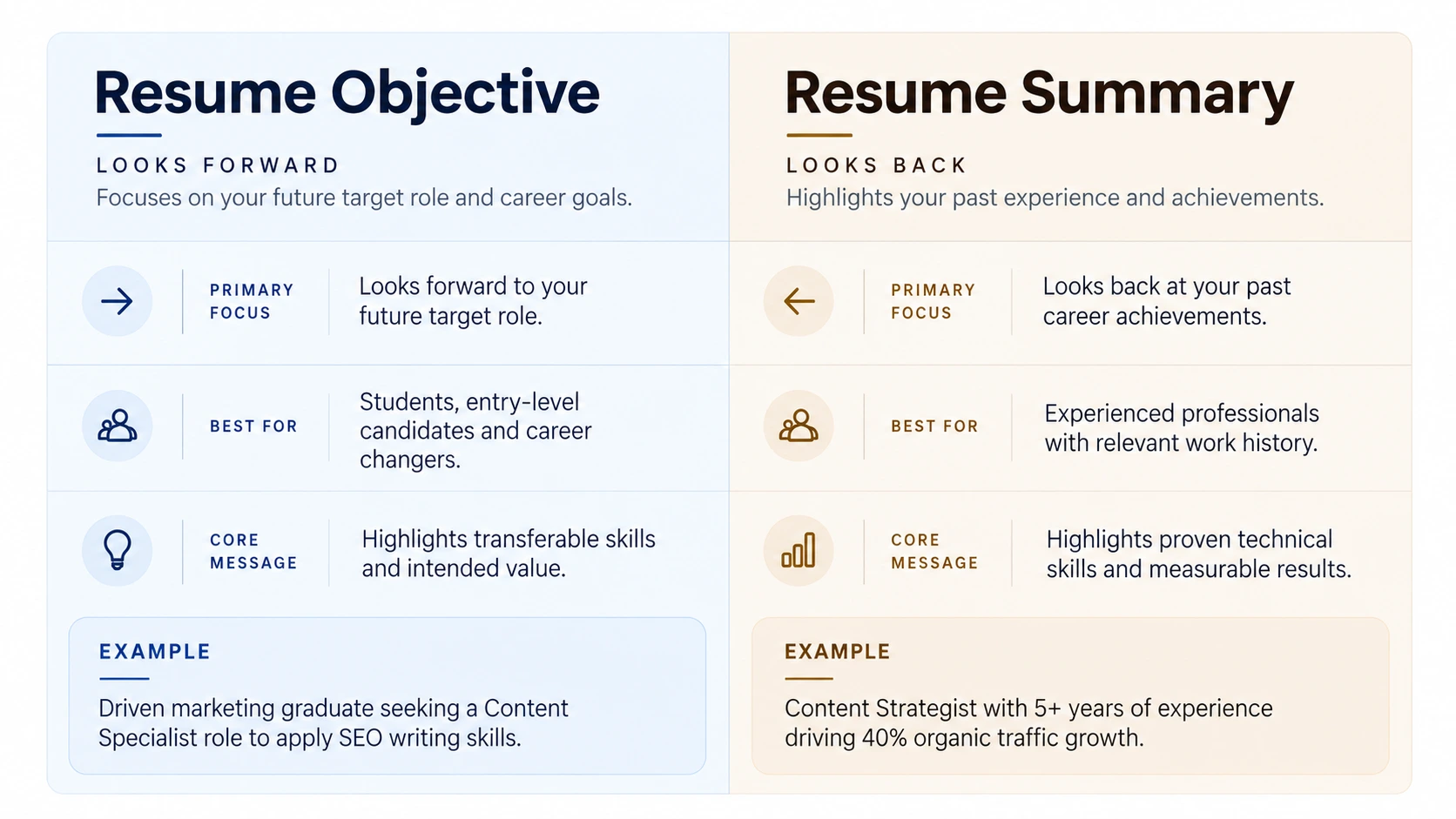
✔️ A resume objective looks forward by stating the specific role you want and how you plan to contribute.
✔️ A resume summary looks back by showcasing your past achievements, years of experience and key industry wins.
If you already have a good experience record in your target field, explore our guide to resume summary examples to write a high-impact summary instead.
Resume Objective
Resume Summary
Primary focus: Looks forward to your future target role.
Primary focus: Looks back at your past career achievements.
Best for: Students, entry-level candidates and career changers.
Best for: Experienced professionals with relevant work history.
Core message: Highlights transferable skills and intended value.
Core message: Highlights proven technical skills and measurable results.
Example: Driven marketing graduate seeking a Content Specialist role to apply SEO writing skills.
Example: Content Strategist with 5+ years of experience driving 40% organic traffic growth.
How to write a resume objective in 3 steps
Writing a strong resume objective isn't complicated when you follow a simple 3-step formula. Instead of writing big and broad statements about your career goals, you should focus on how your background fits the specific position you're applying for.
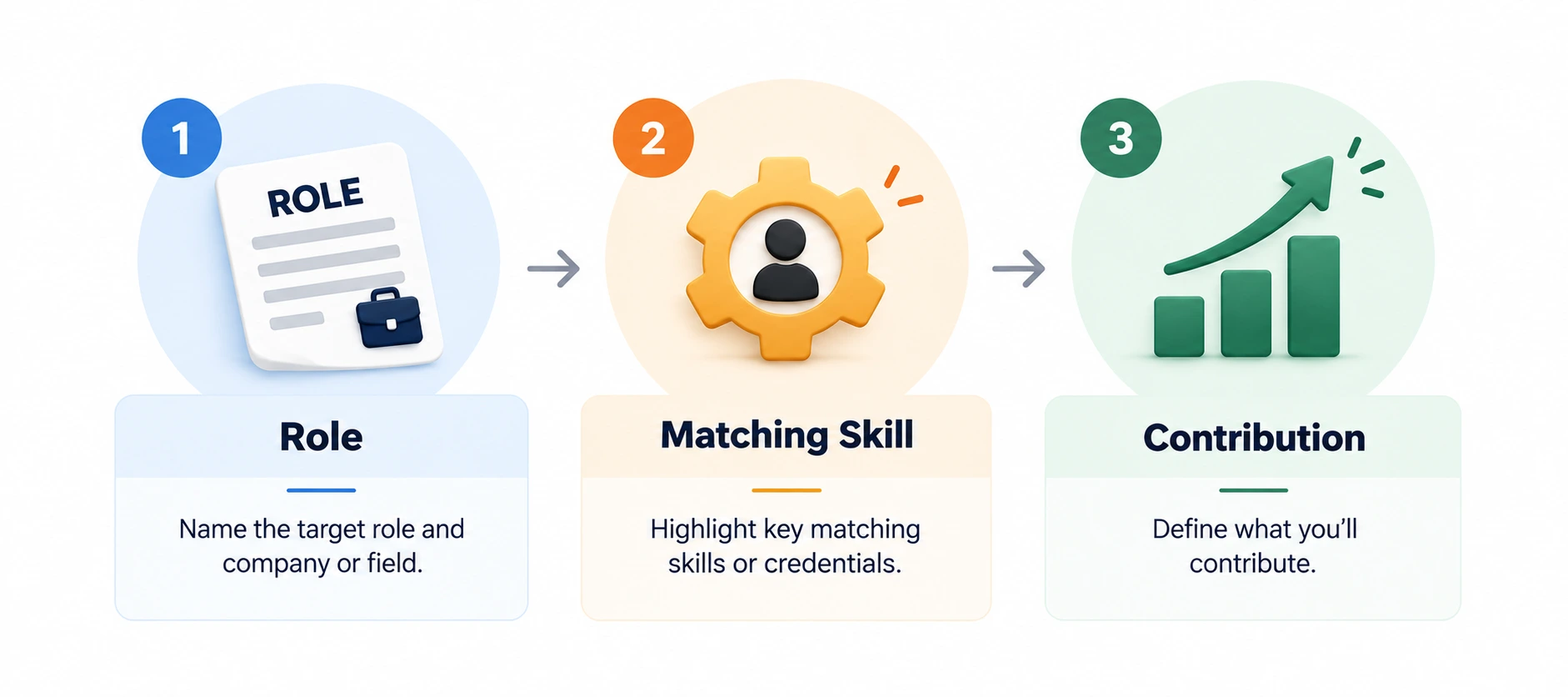
Follow these three simple steps to draft your resume objective:
✅ Step 1: Name the target role and company or field: State the specific job title and company name directly so the employer knows you tailored your resume specifically for their opening.
✅ Step 2: Highlight key matching skills or credentials: Select one or two relevant technical skills, certifications or soft skills from the job description that prove you're qualified.
✅ Step 3: Define what you'll contribute: Explain the value, efficiency or fresh perspective you plan to deliver to the team.
Real-life resume objective examples
To understand how this simple formula improves your resume objective, compare a vague, weak objective with a targeted, strong revised one:
Weak objective:
“Seeking a challenging position at an innovative company where I can grow professionally and use my communication skills.”
- Why it fails: This statement focuses entirely on what the applicant wants rather than what the company needs. It lacks a specific job title, mentions no technical skills and offers zero concrete value.
Strong objective:
“Detail-oriented computer science graduate seeking the junior software engineer role at [Company Name] to apply Python programming and analytical skills toward developing efficient backend applications.”
- Why it works: It clearly states the candidate's background, names the exact target job title and company (Step 1), highlights core programming skills (Step 2) and defines the immediate contribution (Step 3).
Resume objective examples by situation
Adjusting your resume objective to your unique situation ensures it conveys your point directly to a recruiter. The following examples demonstrate how to apply our three-step formula across different career stages and goals.
Students and internships
If you're currently in school or applying for your first practical experience, your objective should highlight relevant coursework, academic projects and eagerness to learn. Check out our internship resume guide and our guide on resume summary examples for a fresh graduate for additional formatting tips.
Example 1: Marketing Intern
“Motivated marketing student with coursework in digital analytics seeking the Social Media Internship at [Company Name] to leverage content creation and data tracking skills to boost brand engagement.”
Example 2: Data Analyst Intern
“Detail-oriented statistics major proficient in Python and SQL seeking the Data Intern role at [Company Name] to assist with dataset cleaning, reporting and exploratory analysis.”
Example 3: Human Resources Intern
“Organized psychology major with strong interpersonal skills seeking the HR internship at [Company Name] to support recruitment scheduling, candidate onboarding and administrative workflows.”
Entry-level jobs
When entering the workforce full-time, showcase your foundational skills and willingness to contribute to team goals immediately. Read our detailed guide on how to make a resume with no experience to craft the rest of your application.
Example 1: Junior Business Analyst
“Analytical finance graduate proficient in Excel modeling and process mapping seeking the junior business analyst position at [Company Name] to support project documentation and workflow optimization.”
Example 2: Junior Graphic Designer
“Creative design graduate skilled in Adobe Creative Suite and branding layout seeking the entry-level graphic designer role at [Company Name] to deliver high-quality marketing assets.”
Example 3: Junior Copywriter
“Engaging English graduate with strong editorial and proofreading skills seeking the junior copywriter role at [Company Name] to produce clear product descriptions and blog content.”
Career changers
Transitioning into a new industry requires highlighting transferable skills that directly apply to your target position.
📢 Expert insight: "A career changer's first sentence must state the exact target role alongside the core transferable skill they're bringing over. If you used to manage retail operations and now want to do project management, tell me right away how your scheduling and budgeting experience carries over."
~Nikita Gupta
Co-Founder, Careerflow.ai & Ex-Senior Technical Recruiter
Example 1: Project Manager (from Retail Management)
“Experienced retail manager skilled in team scheduling and budget management seeking the assistant project manager role at [Company Name] to streamline project timelines and resource allocation.”
Example 2: Digital Marketer (from Teaching)
“Former educator proficient in curriculum design and audience engagement seeking the content marketer role at [Company Name] to create compelling instructional marketing campaigns.”
Example 3: Sales Representative (from Hospitality)
“Customer-focused hospitality manager skilled in conflict resolution and client communication seeking the account executive role at [Company Name] to expand client acquisition.”
Returning to work
Re-entering the job market after a career break works best when you emphasize updated skills and your readiness to deliver results. For more strategies on presenting gaps, see our guide on how to write a resume when returning to the workforce.
Example 1: Operations Associate
“Adaptable professional re-entering the workforce with refreshed certifications in Google Workspace seeking the operations associate role at [Company Name] to streamline daily office administration.”
Example 2: Financial Accountant
“Detail-oriented accountant with an active CPA license re-entering the field to fill the staff accountant position at [Company Name], bringing five years of tax compliance experience.”
Example 3: Event Planner
“Resourceful coordinator re-entering hospitality seeking the event planner role at [Company Name] to manage vendor relationships, venue logistics and budget tracking.”
Specific industries
Tailoring your objective to key sector demands shows hiring managers you understand industry-specific expectations:
Example 1: Customer Support Specialist
“Empathic support representative proficient in Zendesk and active listening seeking the technical support specialist position at [Company Name] to resolve user tickets efficiently.”
Example 2: Registered Nurse (Healthcare)
“Compassionate certified nursing assistant seeking the staff RN position at [Hospital Name] to apply patient triage skills and clinical care training in a fast-paced emergency department.”
Example 3: Software Developer (Tech)
“Focused computer science graduate skilled in JavaScript and React seeking the frontend developer role at [Company Name] to build responsive, accessible web applications.”
Internal promotion
Applying for an elevated role within your current company requires focusing on company-specific knowledge and leadership readiness:
Example 1: Senior Account Manager
“Dedicated account associate with two years of tenure seeking promotion to senior account manager at [Company Name] to apply deep client account knowledge toward driving account expansion.”
Example 2: Customer Service Team Lead
“Top-performing representative proficient in workflow routing and team mentoring seeking the team lead position at [Company Name] to improve team response times.”
Example 3: Lead Operations Analyst
“Proactive analyst with extensive knowledge of internal ERP systems seeking the lead analyst role at [Company Name] to drive cross-departmental process automation.”
Common resume objective mistakes
Even a well-written objective can weaken your application if it includes clichés or shifts focus away from the employer's needs. Avoid these common pitfalls when drafting your statement:
- Focusing on what you want instead of what you offer: Employers want to know how you will solve their problems. Focus on the skills you bring and what you can do in the role, not on what you want from the company.
- Repeating your resume summary: If you have a professional summary, adding an objective is unnecessary; just choose the one that best fits your career stage.
- Making it longer than three lines: An objective statement should be a short header statement. If you extend it beyond three lines, you will bury your key qualifications and clutter the top of your page.
- Sending the same objective to every job: Broad statements fail to grab attention; tailor every objective to match the specific job title and company requirements, or read our guide on how to write a targeted resume to customize your entire application.
How to do this with Careerflow
Drafting your objective statement becomes much simpler once the core sections of your resume are fully structured. When your work history, education and skills are clearly outlined, pinpointing your main value proposition takes only a few minutes. You can build your full document and position your objective right at the top with our AI resume builder, or quickly craft a tailor-made overview using our AI resume summary writer if your background calls for a summary instead.
- Build your complete resume: Use our AI resume builder to pick a clean, ATS-friendly layout and place your objective statement in the proper header section.
- Generate a targeted summary: If you have relevant work experience, try our AI resume summary writer to highlight your career achievements automatically.