A standard cover letter is one single page containing three to four paragraphs in the exact same font as your resume. It includes your contact details, the date, the employer's details, a professional greeting, an opening paragraph, one or two body paragraphs, a closing paragraph and a formal sign-off. Even if you're wondering is a cover letter necessary, using a clean design helps your application stand out to hiring teams immediately.
In this blog, you'll see a complete annotated template so you know what each section looks like. We'll walk through the formatting rules for every block step by step, cover what changes for email applications and provide three ready-to-use examples for different career stages.
At a Glance: Cover Letter Format
One page.
Three to four paragraphs and 250 to 400 words.
Same look as the resume.
Same font, size and header.
Name the file with your name and the role.
PDF unless told otherwise.
The standard cover letter format at a glance
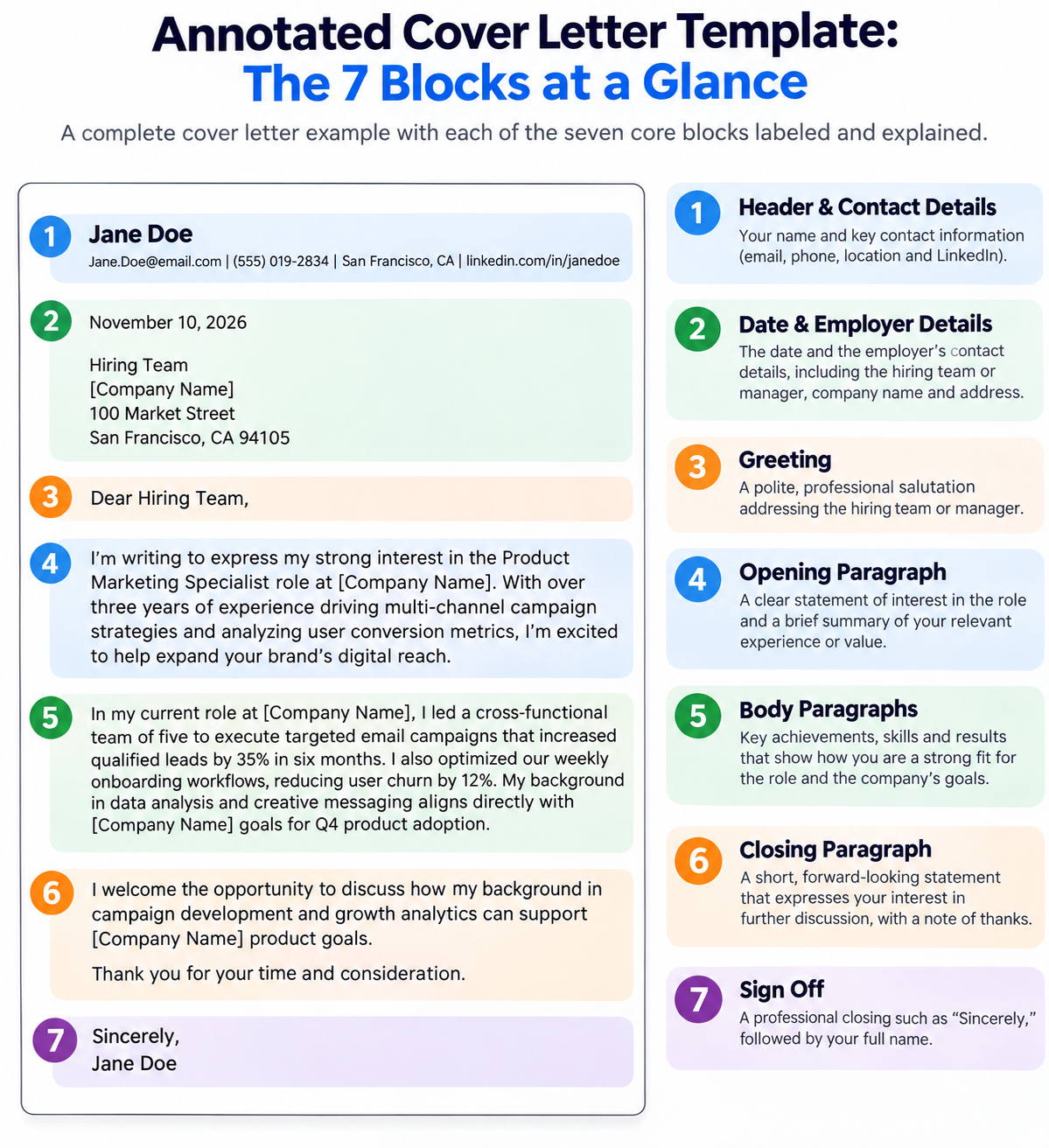
Before writing your letter, review how a properly formatted cover letter looks on the page. Each of the seven core blocks sits in a specific order to create a balanced, easy-to-read document for recruiters.
Global formatting rules
To keep your document polished and legible across Applicant Tracking Systems (ATS) and recruiters, follow these core technical specifications:
Page length: Exactly one page. To make sure your text fits properly without looking crowded, check out our guide on how long a cover letter should be.
Word count: Keep the entire letter between 250 and 400 words.
Font selection and size: Use standard body fonts like Arial, Calibri, Times New Roman or Helvetica set at 10.5 to 12 points. Match the exact font style used in your resume for visual consistency across your application, or choose from our clean resume templates.
Margins: Set standard 1 inch margins on all four sides of the document.
Line spacing: Use single line spacing within paragraphs and insert one blank line between each section.
Alignment: Left align all body text; never justify text, as justified alignment creates irregular spacing gaps between words.
📢 Expert Insight: Clean formatting, standard margins and a professional font that matches the rest of your application are the basics recommended by the University of Michigan Career Center.
How to format each part of a cover letter
A standard cover letter consists of seven distinct structural blocks, as shown in the previous section. Following a consistent format for each part ensures recruiters can scan your contact details and evaluate your application quickly.
Header and contact details
✔️ What goes in it: Your full name, city and state, phone number, professional email address and an updated LinkedIn profile link or portfolio URL. Align this section with the header design used on your resume.
Example line:
Jane Doe | San Francisco, CA | (555) 019-2834 | jane.doe@email.com | linkedin.com/in/janedoe
❌ Common mistake: Including full physical street addresses, outdated landline numbers or unprofessional email addresses.
Date and employer details
✔️ What goes in it: Write out the full current date, followed by the specific hiring manager's name, their job title, the company name and the company's city and state.
Example line:
November 10, 2026 Sarah Chen, Director of Marketing [Company Name] San Francisco, CA
❌ Common mistake: Using numeric short dates (like 10/23/26) or skipping the hiring manager's name and company title altogether.
Greeting
✔️ What goes in it: A formal, professional salutation that addresses the hiring manager directly by name whenever possible. If you can't find a name, address the specific department or hiring team.
Example line:
“Dear Ms. Chen, or Dear Marketing Hiring Team,”
❌ Common mistake: Using outdated, impersonal greetings like "To Whom It May Concern" or "Dear Sir or Madam."
Opening paragraph
✔️ What goes in it: The exact title of the role you're applying for, how you found the posting and a brief thesis statement highlighting your top qualification or excitement for the role.
Example line:
“I'm writing to apply for the Product Marketing Manager role at [Company Name]. With four years of experience leading B2B SaaS growth campaigns, I'm excited to support your expanding product line.”
❌ Common mistake: Starting with broad, weak phrases like "My name is Jane and I'm applying for the job I saw online."
Body paragraphs
✔️ What goes in it: One or two targeted paragraphs detailing concrete achievements, core skills and metrics that directly match the key requirements listed in the job description.
Example line:
“In my previous position at [Company Name], I managed a $50,000 monthly ad spend that generated a 40% increase in qualified sales leads within six months while reducing acquisition costs by 15%.”
❌ Common mistake: Summarizing your entire work history line by line instead of focusing on two or three relevant highlights.
Closing paragraph
✔️ What goes in it: A brief, proactive call to action expressing your interest in an interview, accompanied by a genuine thank-you to the reader for their time and consideration. Read our guide on how to end a cover letter for more ending strategies.
Example line:
“I welcome the opportunity to discuss how my background in growth marketing can help [Company Name] reach its user acquisition goals. Thank you for your time and consideration.”
❌ Common mistake: Ending passively with weak phrases such as "I hope to hear from you soon" or failing to thank the reader.
Sign off
✔️ What goes in it: A standard, professional closing phrase followed by your typed full name. If submitting a printed letter, leave extra space for a written signature.
Example line:
Sincerely, Jane Doe
❌ Common mistake: Using informal sign-offs like "Cheers," "Thanks," or "Best," which sound too casual for a formal job application.
Cover letter format for email and online applications
While a traditional cover letter uses a formal document layout, applying via email or online portals requires specific formatting adjustments. Knowing when to paste your cover letter into the email body versus attaching a PDF keeps your application clean and easy for hiring managers to read.
What changes in an email cover letter
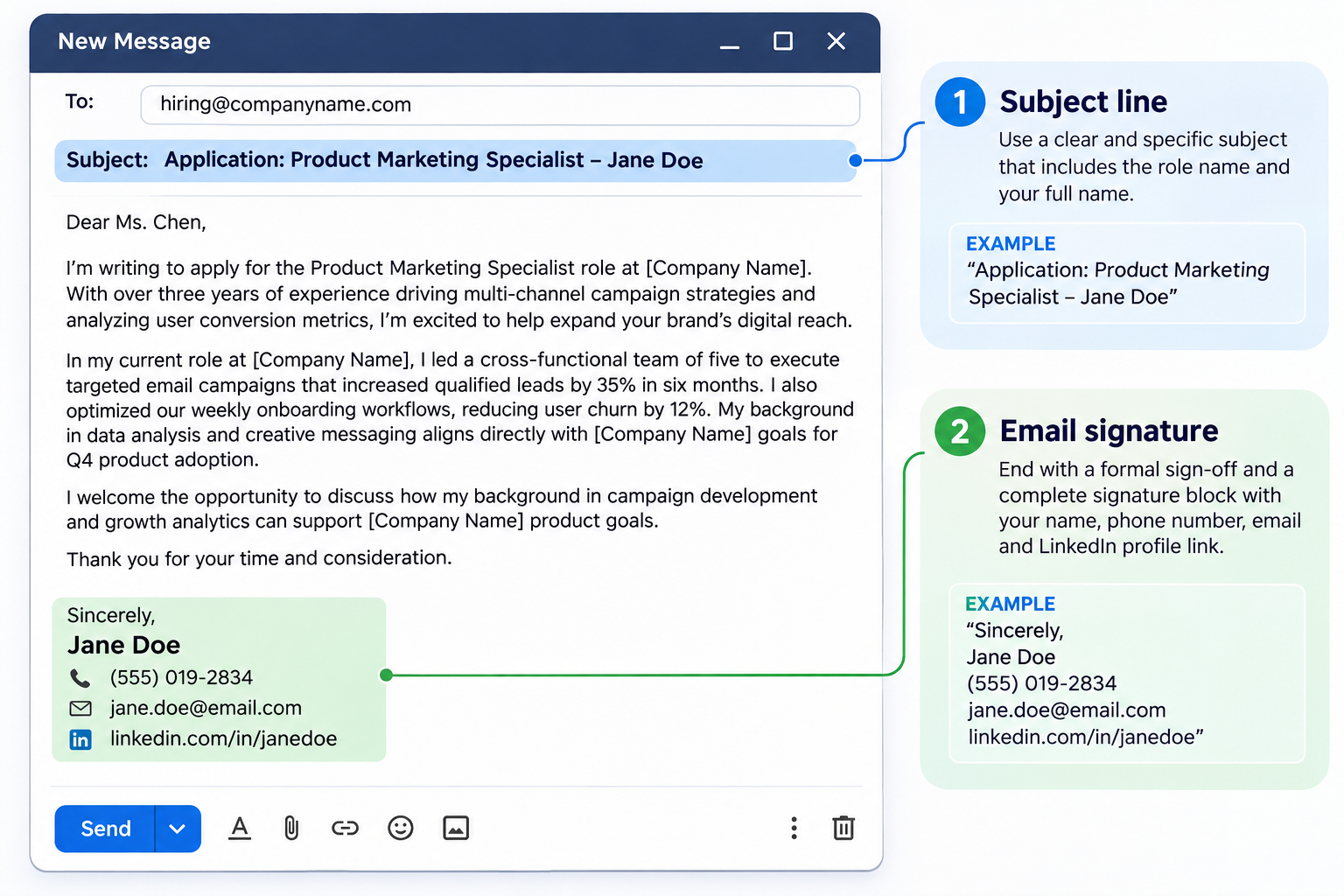
When you send your cover letter directly in the body of an email or paste it into a job portal text box, simplify the header to avoid unnecessary clutter:
Include a clear subject line: Write a direct subject line that includes the role name, job ID (if applicable) and your full name (for example, Application: Product Marketing Specialist - Jane Doe).
Remove formal addresses: Skip the top contact block, current date and company address. Start directly with the professional greeting (e.g., Dear Ms. Chen).
Shorten the body text: Keep email cover letters concise, ideally under 250 words, so the recruiter can read your key qualifications without scrolling extensively.
Update your email signature: End with a formal sign-off followed by a comprehensive signature block containing your full name, phone number, professional email address and LinkedIn profile link.
When to attach a PDF instead of pasting text
Deciding whether to send an email body cover letter or attach a formatted document depends on how the employer requests your letter.
Application
Method recommended
Format action required
Email application (general)
PDF attachment + short email note
Attach your cover letter as a PDF (e.g., Jane_Doe_Cover_Letter.pdf) and write a brief 2–3
Email application (explicit request)
Email body text
If the job posting asks you to "send your cover letter in the body of the email," paste your formatted text directly into the email and omit top addresses.
Applicant Tracking System (ATS)
PDF attachment
Upload a standard PDF document to preserve your custom layout, margins and typography formatting across ATS software.
Cover letter format examples
Reviewing real-world examples helps you visualize how the seven-block format works in practice. The following templates show how to adapt the standard layout for different career stages while keeping your letter under 300 words.
Entry-level application example
If you're launching your career, highlight academic accomplishments, foundational skills and enthusiasm for the position. If you're building your first job search strategy, read our guide on how to write a cover letter with no experience.
Jane Doe
jane.doe@email.com | (555) 012-3456 | Chicago, IL | linkedin.com/in/janedoe
November 10, 2026
Sarah Chen, Hiring Manager
[Company Name]
456 Commerce Street
Chicago, IL 60601
Dear Ms. Chen,
I'm writing to express my strong interest in the Assistant Marketing Coordinator role at [Company Name]. As a recent Communications graduate from State University skilled in digital analytics and social media strategy, I'm excited to contribute to your team's upcoming brand campaigns.
During my senior capstone project, I led a team of four to redesign a local business's social media presence, increasing their organic Instagram engagement by 45% over three months. Additionally, my coursework in Google Analytics and market research prepared me to track campaign metrics and turn raw performance data into actionable marketing insights. [Company Name]'s reputation for innovative digital campaigns aligns perfectly with my professional goals.
I welcome the opportunity to discuss how my analytical skills and creative copywriting background can support your client accounts.
Thank you for your time and consideration.
Sincerely,
Jane Doe
Experienced professional example
For mid-career candidates, focus heavily on quantifiable achievements, leadership wins and direct industry experience.
I'm writing to apply for the Senior DevOps Engineer position at [Company Name]. With over six years of experience managing multi-region cloud infrastructure and automating CI/CD pipelines, I'm eager to help scale [Company Name]'s enterprise platform capabilities.
In my current role at Enterprise Tech, I architected a Kubernetes deployment workflow that reduced system downtime by 35% and cut annual server operational costs by $120,000. I also mentored a team of five junior engineers, establishing security protocols that improved deployment compliance across all active software builds. [Company Name]'s focus on high-availability cloud architecture directly mirrors my core technical expertise.
I look forward to discussing how my background in infrastructure automation and team leadership can support your growth targets this year.
Thank you for your time and consideration.
Sincerely,
Jane Doe
Career changer example
When switching fields, connect your past professional accomplishments to your target industry using transferable skills.
Jane Doe
jane.doe@email.com | (555) 014-9876 | Denver, CO | linkedin.com/in/janedoe
November 10, 2026
Sarah Chen, Operations Director
[Company Name]
321 Innovation Way
Denver, CO 80202
Dear Ms. Chen,
I'm writing to express my interest in the Operations Associate position at [Company Name]. Bringing seven years of experience in retail store management, I'm eager to leverage my background in cross-functional coordination, inventory logistics and process optimization to streamline your operational workflows.
Throughout my retail management career, I oversaw daily store operations, managed quarterly budgets of over $800,000 and reduced inventory shrink by 18% through improved audit procedures. These experiences equipped me with strong problem-solving and resource allocation skills that carry over directly into tech operations management. [Company Name]'s commitment to operational efficiency makes this role an ideal match for my background.
I welcome the opportunity to discuss how my leadership experience and workflow management skills can add value to your team.
Thank you for your time and consideration.
Sincerely,
Jane Doe
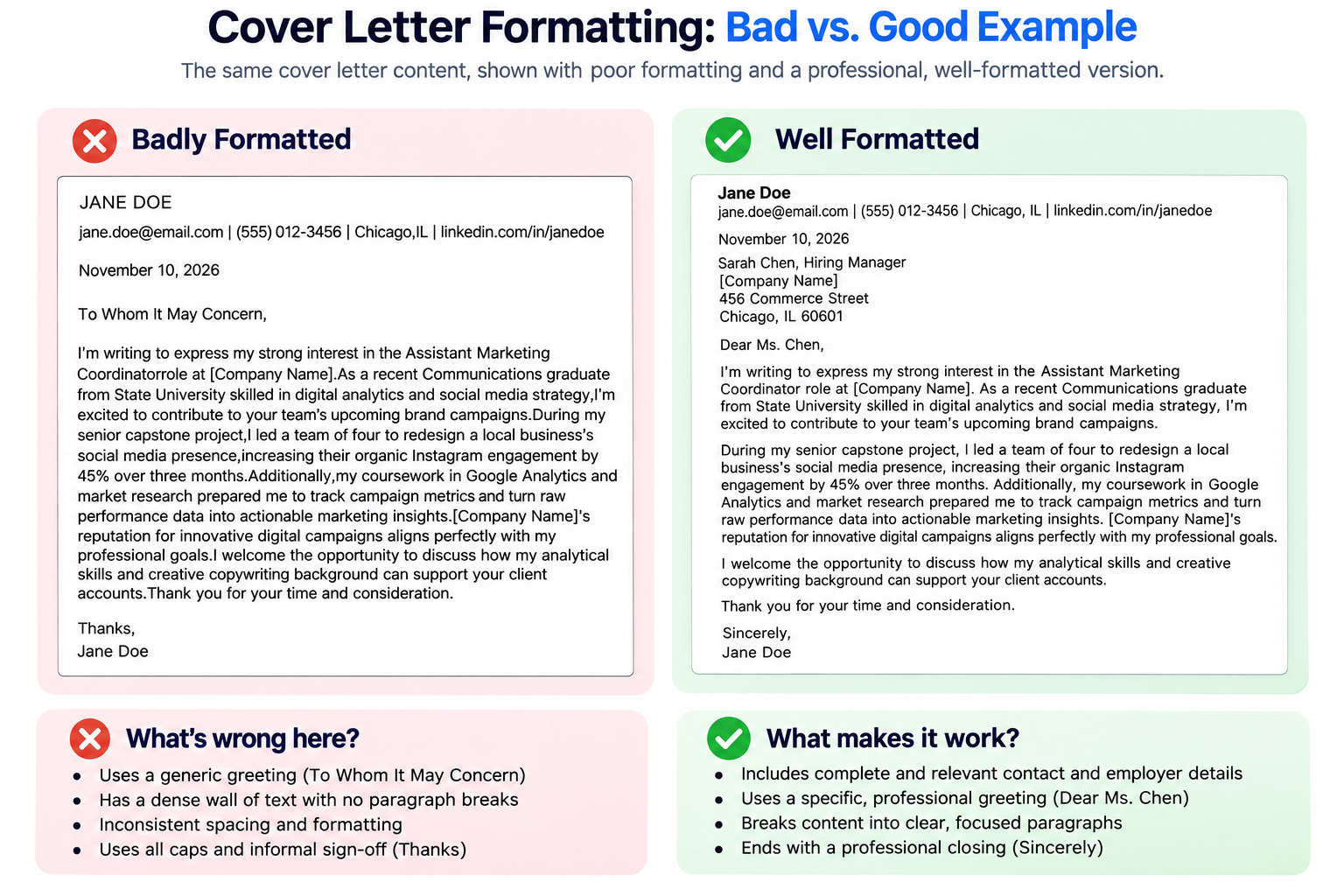
Formatting mistakes that make a cover letter look unprofessional
Even a well-written letter can be dismissed immediately if visual design errors make it difficult to read. Avoid these common formatting mistakes to maintain a clean, polished appearance:
Using different fonts from your resume: Switching font styles between application documents creates a disjointed look; use the exact same font family and point size hierarchy across both files.
Creating walls of text: Unbroken, dense blocks of text strain the reader's eyes; split your letter into three or four distinct paragraphs separated by clear blank lines.
Exceeding one page: Stretching your letter past a single page signals poor editing skills; trim your word count to keep your content between 250 and 400 words.
Using generic greetings: Addressing hiring managers with outdated salutations like "To Whom It May Concern" shows a lack of research; address the specific recruiter or hiring team directly.
Omitting the date: Leaving out the current date makes your application look reused or outdated; always include the full date above the employer details block.
Saving files with unprofessional names: Submitting files named document1.pdf or Untitled.pdf makes your documents hard to track; name your export cleanly using your name and the target role (for example, Jane_Doe_Cover_Letter.pdf).
How to do this with Careerflow
Formatting your document correctly becomes much easier when you let automated software handle spacing, margins and block alignment. Once you have your targeted work history ready, our cover letter generator converts your resume details and the target job description into a perfectly formatted, single-page draft in seconds. If you want to review tailored layouts for your specific industry before writing, explore our cover letter examples for role-specific inspiration.
Generate a formatted draft instantly: Use our cover letter generator to align your contact header, spacing and structure automatically to ATS-friendly standards.
Review role-specific templates: Check our cover letter examples to see how successful candidates format letters across technical, creative and entry-level positions.
Puneet
Co-founder
Puneet left a senior engineering role at Apple to co-found Careerflow, an AI-powered job search platform backed by Techstars and used by over 1 million job seekers worldwide. He brings more than a decade of hands-on experience in AI and machine learning, built across Apple, Amazon, and Leia Inc. As CEO, he leads the product and engineering behind the tools he wished existed during his own career transitions. You can connect with him on LinkedIn
FAQ: Cover Letter Format
What is the standard format for a cover letter?
The standard cover letter format is a single-page document divided into seven structured blocks. It includes your header and contact details, date, employer details, a formal greeting, an opening paragraph, one or two body paragraphs, a closing paragraph and a sign-off. Keep line spacing single with blank lines between paragraphs.
How long should a cover letter be?
A cover letter should be exactly one page long, containing between 250 and 400 words across three to four paragraphs. Keeping your document concise ensures hiring managers can review your key accomplishments quickly without feeling overwhelmed by unnecessary details. For a full breakdown of word counts, check out our detailed guide on how long a cover letter should be.
What font and size should a cover letter use?
A cover letter should use a clean, standard body font set between 10.5 and 12 points. Professional font choices include Arial, Calibri, Times New Roman and Helvetica. Maintaining uniform font sizing and standard 1 inch margins ensures optimal readability and keeps your document looking structured and readable across all scanning devices.
Should a cover letter have the same format as my resume?
Yes, your cover letter should match the visual styling of your resume. Using the exact same font family, font size hierarchy, margin width and header design across both documents creates a cohesive, professional application package. To align your design assets quickly, select matching layouts from our clean collection of resume templates.
How do I format a cover letter in an email?
To format a cover letter in an email, place your text directly in the email body, omit the top contact blocks and date, start with a direct salutation and end with an expanded email signature containing your phone number and LinkedIn link. Include a clear subject line with your name and target job title.
Recommended Articles
Here are some of the recommended articles from our team