Cover Letter


End your cover letter with a short paragraph. Restate why you fit, ask for the next step and thank the reader. Follow this with a professional sign-off like "Sincerely" above your full name. If you're deciding whether to send a cover letter, then read our guide on “Is a cover letter necessary” to make up your mind. This cover letter ending matters because it's the final thing a manager reads before opening your resume. In this blog, you'll learn a closing formula, see rewritten examples and find sign-offs to use and avoid.
What a strong cover letter ending does
A powerful closing paragraph performs three specific jobs in just a few sentences. First, it reminds the reader of the single core reason you're the right person for the job. Second, it makes the next step simple by inviting an interview or a conversation. Third, it closes the message with professional courtesy. Keeping your final block to two to four sentences ensures you leave a sharp impression without dragging out your message.
A simple formula for your closing paragraph
You don't need creative writing skills to build a strong finish. You can use a simple three-part formula to structure your final paragraph:
1. Restate your fit: Remind them how your background solves their current problem.
- Example: My background in managing high-volume support queues makes me ready to help [Company] scale its operations.
2. Name the next step: Invite a conversation or an interview clearly and politely.
- Example: I'd welcome the chance to discuss how my technical troubleshooting skills align with your team's goals.
3. Thank them: Express genuine appreciation for their time and review.
- Example: Thank you for your time and consideration.
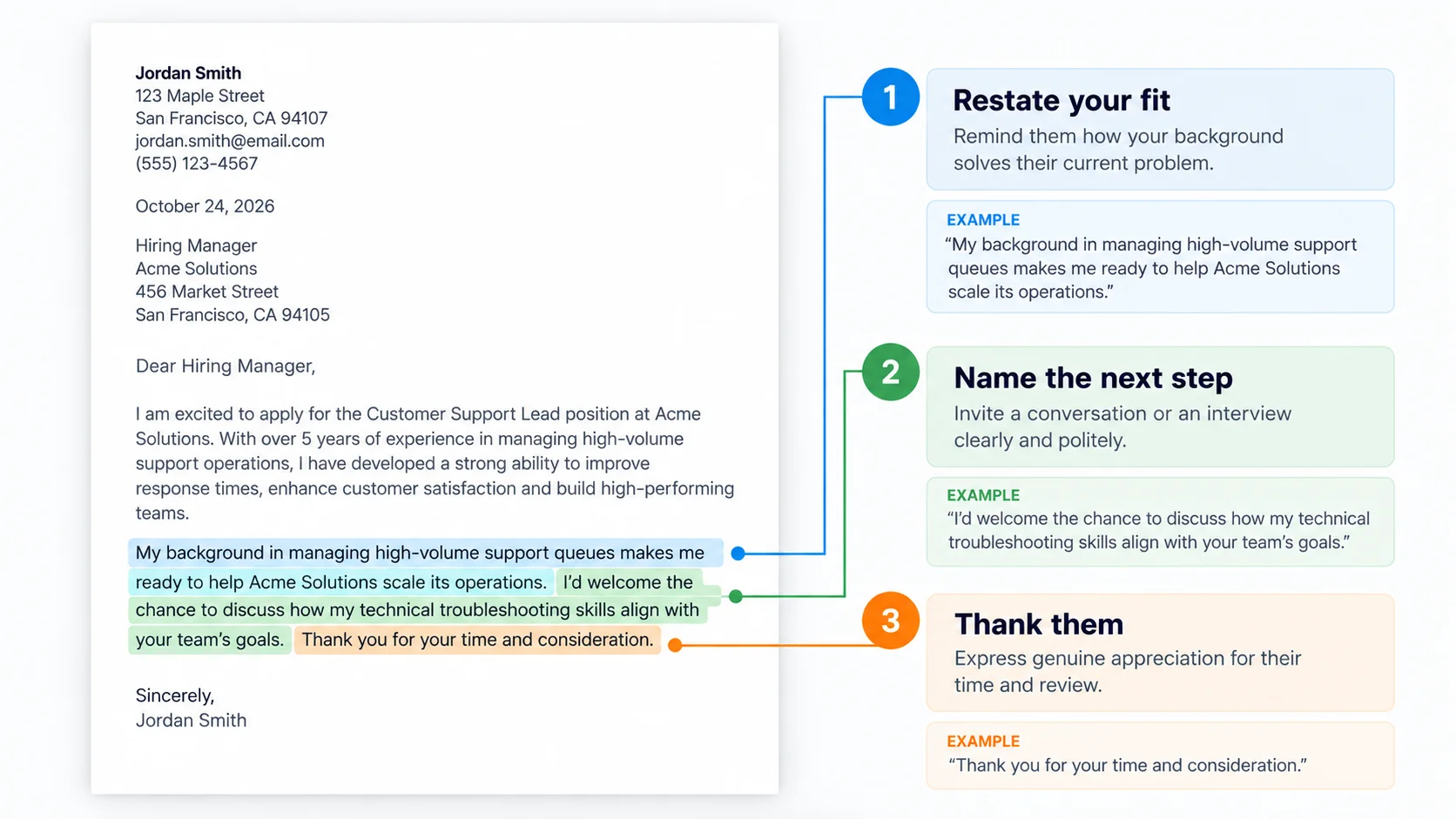
Here's how those three pieces look when combined into a complete closing paragraph:
"My background in managing high-volume support queues makes me ready to help [Company] scale its operations. I'd welcome the chance to discuss how my technical troubleshooting skills align with your team's goals. Thank you for your time and consideration."
Maintain the right balance by avoiding common traps at the end of your letter. Phrasing like "I hope to hear from you soon" sounds passive and apologetic, which weakens your professional stance. On the other hand, demanding an action like "I'll call you on Monday to schedule an interview" feels too pushy for most corporate roles. Keep your tone confident, polite and inviting.
Cover letter closing paragraph examples
Seeing real examples clarifies how to adapt the formula for different professional situations. The following closings cover standard openings, career shifts, referrals and more. For role-specific layouts, explore our full library of cover letter examples.
1. Standard job application (Software engineer)
Weak original:
"I hope to hear from you soon and I think I’m a good fit for this job. You can call me anytime."
Strong rewrite:
"My experience building scalable web applications makes me ready to contribute to your engineering goals. I welcome the opportunity to discuss how my backend skills align with your roadmap. Thank you for your time and consideration."
Explore a complete draft in our software engineer cover letter examples.
2. Customer-facing role (Customer service)
"My background in resolving high-volume technical support tickets positions me to help your team maintain high client satisfaction. I would welcome a conversation to review how my communication skills benefit your users. Thank you for your time and consideration."
Explore a complete draft in our customer service cover letter examples.
3. Email application (Teacher)
Weak original:
"Thanks for reading. Please check my resume and let me know if you want to interview me."
Strong rewrite:
"My background in student engagement and curriculum design prepares me to support your district's goals. I would welcome a conversation to discuss my teaching methods further. Thank you for considering my application."
Explore a complete draft in our teacher cover letter examples.
4. Career change
"My transferable project management skills and analytical background equip me to add immediate value to your operations team. I look forward to discussing how my cross-functional experience translates to this role. Thank you for your time and review."
5. Internship
"My coursework in digital marketing and experience managing student club campaigns give me a strong foundation to support your marketing team. I would love the chance to discuss how I can contribute to your summer projects. Thank you for your time and consideration."
Learn more about student formats in our guide on how to write a cover letter for an internship.
6. Referral
"Since Sarah Jenkins recommended that I apply for this position, I’m excited about the prospect of bringing my sales operations experience to your team. I welcome an interview to discuss how my background aligns with your growth targets. Thank you for your time and review."
How to sign off a cover letter
Your sign-off bridges the final sentence of your letter and your printed name. Choosing the right closing phrase keeps the tone professional and respectful.
Safe choices to use
- Sincerely: This remains the gold standard for professional communication and works for any industry.
- Best regards: This option is warm yet professional, making it ideal for standard corporate and startup roles.
- Kind regards: This offers a slightly softer professional closing while maintaining a respectful distance.
- Respectfully: This suits formal, academic or government applications where high formality is expected.
- Thank you for your consideration: This shows polite appreciation while cleanly concluding your text.
Choices to avoid
- Cheers: This is too casual for a job application and risks striking the wrong tone.
- Love: This is strictly for personal correspondence and is entirely inappropriate for professional hiring.
- Thanks!: This feels too brief and overly casual, lacking the polish required for a job search.
- Yours truly: This option is outdated and overly formal in most modern US corporate contexts.
- No sign-off at all: Leaving your name hanging abruptly makes the document look unfinished and careless.
Signature block
Your signature block should follow a clean, predictable layout depending on how you submit your materials:
- For attached documents: Place your sign-off followed by a comma, skip a few lines for your physical or electronic signature, and type your full name underneath.
Example:
Sincerely,
(Leave three blank lines here for your physical or electronic signature)
[Your Name]
- For email applications: Place your sign-off followed by a comma, add your full name on the next line, and include your phone number and LinkedIn profile URL underneath so the hiring manager can contact you instantly.
Example:
Best regards,
[Your Name]
Phone: [Your Number]
LinkedIn: [Your LinkedIn URL]
Common mistakes when ending a cover letter
- Repeating the opening: Retelling your introductory hook at the finish line wastes precious space.
- Adding new information at the end: Dropping a brand-new skill or project in your final sentence confuses the reader.
- Sounding unsure: Phrasing like "I think I could be a good fit" undermines your confidence.
- Demanding a reply: Ordering the hiring manager to call you by a specific date feels overly aggressive.
- A missing or misspelled name: Forgetting to type your full name or misspelling the hiring manager's name ruins a clean finish.
- Mismatched sign-off: Choosing an overly formal or casual closing phrase clashes with the company culture.
How to do this with Careerflow
Drafting a polished closing paragraph from a blank page can slow down your entire application process. You can use our AI cover letter generator to write the complete letter directly from a job description, ensuring your final paragraph follows a proven formula before you even start editing.
- Generate your draft: Let our AI cover letter generator build a full structured letter with a professional close instantly.
- Explore templates: Browse our cover letter examples to see how successful professionals finish applications in your specific industry.