Cover Letter
.avif)
.webp)
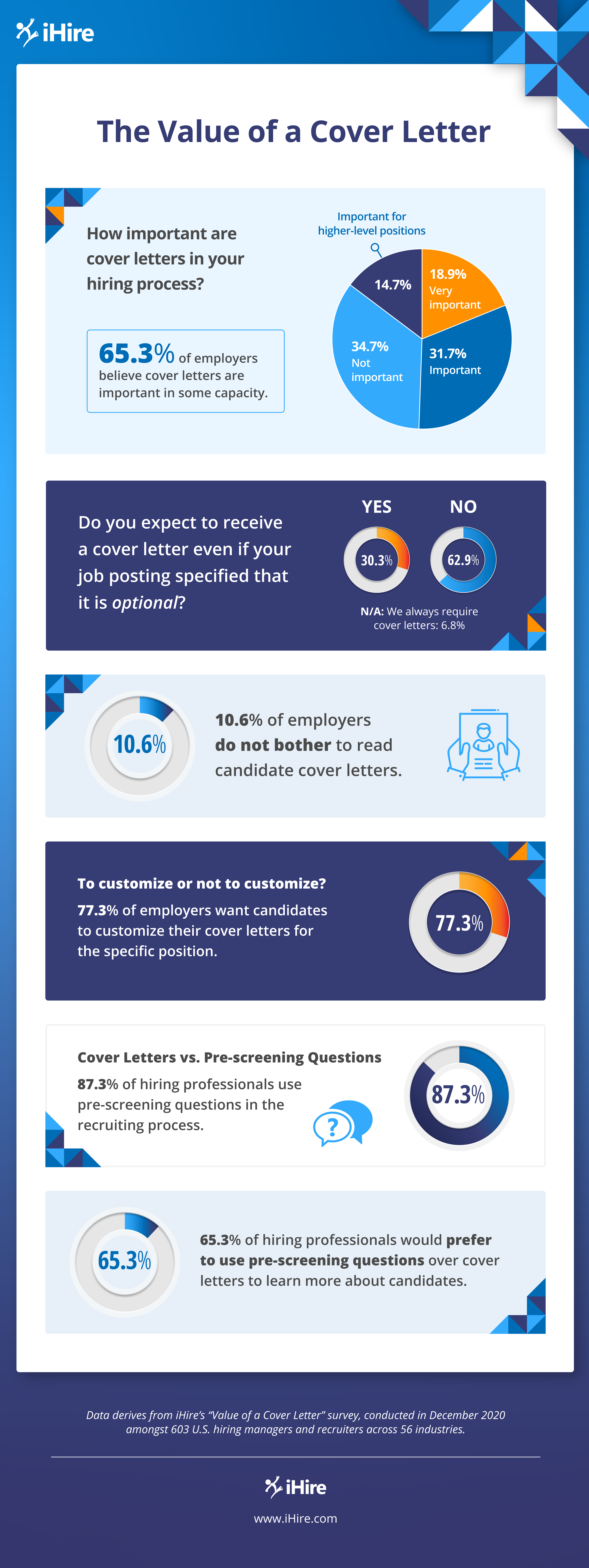
Cover letters aren't dead, but they're not always necessary either. Research shows that over 65.3% of employers believe cover letters are important…, despite the common belief that they are no longer necessary. In fact, cover letters can be crucial in influencing the outcome for candidates in competitive positions.
This guide covers when a cover letter is essential, when to skip it, and how to write one fast when you need it. We will also address scenarios such as career changes and employment gaps. Discover how to quickly determine whether a job requires a cover letter.
The current state of cover letters in 2026: What hiring managers actually think
As we can see from iHire’s study infographic below, cover letters are anything but obsolete in most cases. While some claim that ‘nobody reads cover letters in 2026’, their study suggests that’s true in just 10.6% of cases. In other words, failing to submit a cover letter may be hurting you almost 90% of the time!
When cover letters matter most
Cover letters are no longer a universal requirement for every job. Instead, they serve as a strategic tool to bridge gaps in your application. Use them when your resume alone does not tell your full professional story. Cover letters matter more in 2026 for specific scenarios like:
- Career changers: Use this space to explain how your transferable skills apply to a new industry.
- Employment gaps: Clarify periods of unemployment or unconventional backgrounds to provide context for recruiters.
- Competitive roles: Stand out in tech, consulting, or creative fields where applicant volume is high.
- Communication-heavy positions: Demonstrate your writing ability for roles in marketing, PR, or customer success.
- Culture fit: Show genuine interest in the company’s mission beyond just your technical qualifications.
When cover letters are absolutely required (don't skip these)
1. The job posting explicitly requests a cover letter
Looking at iHire’s study statistics, even when job ads say a cover letter isn’t required, 30.3% still expect one to be included!
Many companies use cover letter requirements to filter applicants and identify those who pay attention to details.
2. The application system has a dedicated cover letter upload field
A dedicated box for cover letters is a clear signal. It shows the company values this extra information.
Leaving this section blank raises several questions: Does the candidate lack interest? Did they fail to prepare adequately? Are they mass-applying without customization?
Even if the field says that a cover letter is "optional," submitting a tailored one showcases initiative and a genuine interest in the position.
3. You're applying via a personal referral or direct recruiter outreach
Professional courtesy requires a letter when someone refers you. This protects the reputation of the person who helped you. It also helps the manager understand why you are a good fit.
In cases of referrals, be sure to mention the referrer by name in the opening sentence and clarify your shared connection or how they recommended you.
When cover letters are strongly recommended (high ROI scenarios)
1. Career changers and industry switchers
A resume shows your past, but a cover letter explains your future. Use this space to show how your old skills fit a new role. Explain why you are making the switch now. This helps recruiters see your potential beyond your previous job titles.
Without this additional context, hiring managers might overlook your resume because they don’t immediately see how your background aligns with their role.
In your cover letter, clearly articulate your transition: "I'm moving from [old field] to [new field] because [compelling reason]. Here’s how my experience in [X] translates to the [Y] skill you need."
2. Employment gaps or unconventional career paths
Resumes often highlight gaps in employment in a negative way. A cover letter lets you control the story. Briefly explain your time away from work, such as for learning or family. Use a confident tone and focus on why you are ready to work again today.
When addressing gaps, use one to two sentences with a forward-looking tone.
For example: "After a health-focused sabbatical in 2024, I'm energized to return to product marketing with a fresh perspective and updated skills in AI tools and analytics."
3. Highly competitive or creative roles
Popular roles at top companies get hundreds of applications. A tailored cover letter is one of the few ways to set yourself apart when many candidates have similar qualifications.
Roles that require strong written communication skills, including content writing and public relations, often use cover letters as a writing sample. A poorly written letter can disqualify you, while a compelling one demonstrates your writing ability.
In creative fields like design, marketing, and branding, a cover letter provides an opportunity to showcase your voice, personality, and understanding of the company's brand. If you're applying for a design role, reviewing a design cover letter can help you understand how to highlight your creative skills and relevant experience. This extra effort can move your name to the top of the list.
4. When you have a specific reason for targeting this company
Use a cover letter if you have a personal connection to a company’s mission. Maybe you use their product every day or admire their recent projects. This level of detail shows genuine interest. Hiring managers value this culture fit as much as technical skills.
For example: "I've been a daily user of [product] for two years and have even developed a personal productivity system around it. I'd love to help shape the next version as part of your product team."
When cover letters are optional but still beneficial
1. Mid-level roles in traditional industries
Standard corporate roles like HR or sales often make letters optional. However, submitting a concise and well-crafted cover letter can still help you stand out, especially if there are many qualified candidates for the position.
Write one if you have a relevant project or mutual connection to share. If you have no extra context, focus on your resume instead.
2. When the job posting is ambiguous about cover letters
If a post does not mention cover letters, assume they are encouraged for serious candidates. Quality matters more than just having one. A generic template can hurt your chances. Only include a letter if you can make it specific and under 250 words.
3. Internal transfers or promotions
Applying for a new role at your current company is a unique situation. A cover letter helps clarify why you are ready for the next level. In your letter, explain why you're ready for the next level, what you've learned in your current role, and how you'll help the new team. This is important if the new manager doesn't know you.
When you can confidently skip cover letters
1. The job posting explicitly says "no cover letter"
Some companies want to reduce bias and speed up hiring. In these cases, it's important to respect their preference and refrain from including one.
Quick-apply platforms like LinkedIn Easy Apply and Indeed 1-Click Apply don't include a cover letter field by design. Inserting one into the "additional info" section signals you're not paying attention to how the process works.
2. You're mass-applying to entry-level or high-volume roles
Retail, warehouse, and entry-level service roles rarely require cover letters. These companies process hundreds of files and prioritize speed. Your time is better spent applying to more roles or tailoring your resume.
3. You don't have time to customize it properly
A generic letter with placeholder text is worse than no letter at all. Hiring managers can easily identify generic letters, which indicate that you are mass-applying without genuine interest in the position.
If you don't have 15 to 20 minutes to customize the letter with specific details about the company and the role, it’s better to skip it entirely and concentrate on tailoring your resume instead.
4. The company culture explicitly values efficiency and directness
Many startups and tech firms prefer directness over long documents. They often only care about your portfolio, GitHub, or LinkedIn profile. If the post asks for a link to your work and nothing else, they likely do not want a cover letter.
If you're unsure, check the company's careers page or Glassdoor reviews to see if they mention cover letters in their application process.
The 30-second decision framework: Do you need a cover letter for this job?
Use this quick checklist to decide your strategy in under 30 seconds. This framework helps you focus your effort where it generates the most impact.
Write a cover letter if ANY of these are true:
✅ Strict requirements: The job posting explicitly asks for one.
✅ Major transitions: You are changing careers or industries.
✅ Path clarity: You have an employment gap or unconventional path.
✅ Personal connections: You were personally referred or recruited.
✅ High stakes: The role is highly competitive with over 100 applicants.
✅ Skill proof: The role requires strong writing or communication skills.
✅ Specific passion: You have a compelling reason for wanting this specific job.
Skip the cover letter if ANY of these are true:
❌ Direct instructions: The posting says, "Do not include a cover letter."
❌ System limits: It is a quick-apply platform with no upload field.
❌ Time constraints: You do not have time to customize it properly.
❌ Volume hiring: It is a high-volume, entry-level service or labor role.

Still unsure? Ask yourself:
Ask yourself one final question: "Will my cover letter make a hiring manager more excited about my resume?"
✅ If the answer is yes, write the cover letter.
❌ If the answer is no, skip it. Spend that extra time on resume tailoring instead.
What hiring managers actually want in a cover letter (and common mistakes that get you rejected)
A great cover letter provides context that a resume cannot show. Recruiters look for specific details that prove you understand their needs. Focus on these elements to make a strong impression.
What good cover letters include:
- A strong opening: Explain why you want this specific role at this specific company. Avoid generic language that applies to any employer.
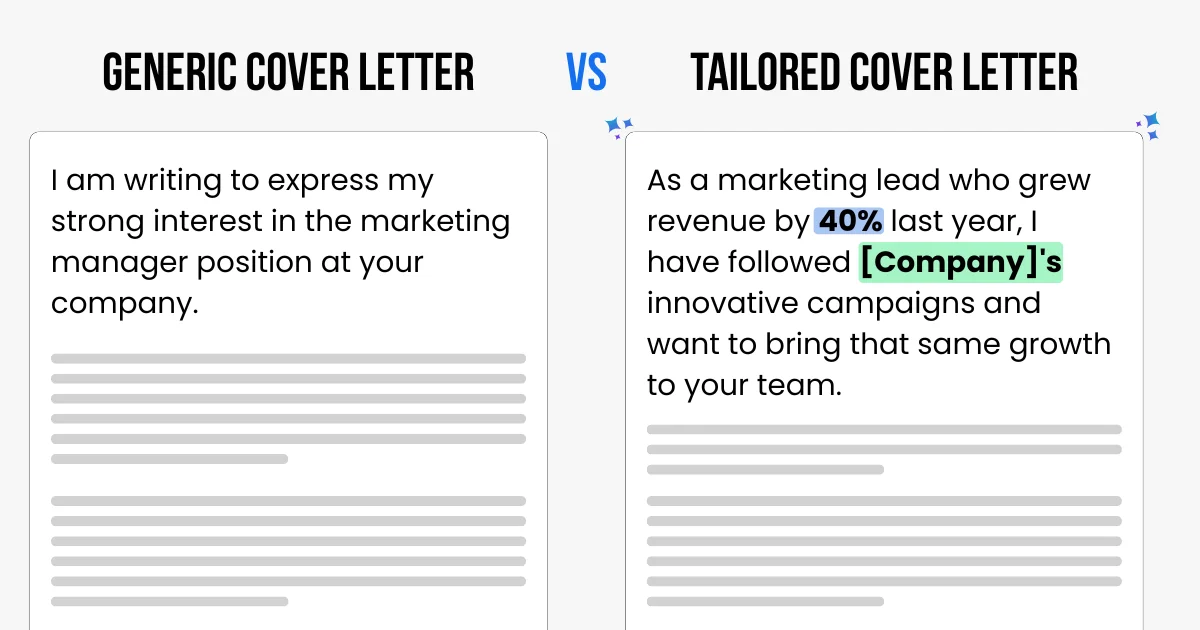
- Concrete examples: Share how your experience matches their needs with specific results. Mentioning you increased retention by 25% is better than saying you have leadership skills.
- Company research: Show that you studied their product, mission, or recent news. Mention a specific challenge you can help them solve.
- Real voice: Don't use corporate jargon or robotic AI fluff. Instead, be yourself.
- Clear connections: Link your past work directly to the future value you bring to their team.
Common mistakes that hurt your chances:
Avoid these red flags to stay in the interview pile. These simple mistakes get candidates rejected before anyone reads their resume.
- Standard openings: Do not start with "I am writing to express my interest." This wastes space and signals you used a template.
- Repeating your resume: Do not list your bullet points again. Provide a new narrative that adds context to your history.
- Focusing on yourself: Avoid talking only about your career growth. Instead, explain what you will contribute to the company.
- Grammar errors: Spelling mistakes are instant red flags for roles requiring attention to detail.
- Too much length: Keep your letter under 300 words. Hiring managers skim content and need you to get to the point quickly.
- Generic praise: Skip empty phrases like "commitment to excellence." These apply to any brand and show a lack of research.
How to write a strong cover letter quickly using our AI Cover Letter Generator
Writing a unique cover letter for every job is time-consuming. However, using the right tools can cut that to under five minutes. Careerflow offers a suite of AI features to help you create professional letters that get noticed.
AI Cover Letter Generator (tailored letters in 2 minutes)
The Careerflow AI Cover Letter Generator creates tailored cover letters in seconds. It uses your specific background and the target job description to build a strong foundation.
- Log in to your Careerflow account at: https://www.careerflow.ai/ai-cover-letter.
- Navigate to the Cover Letter dashboard.
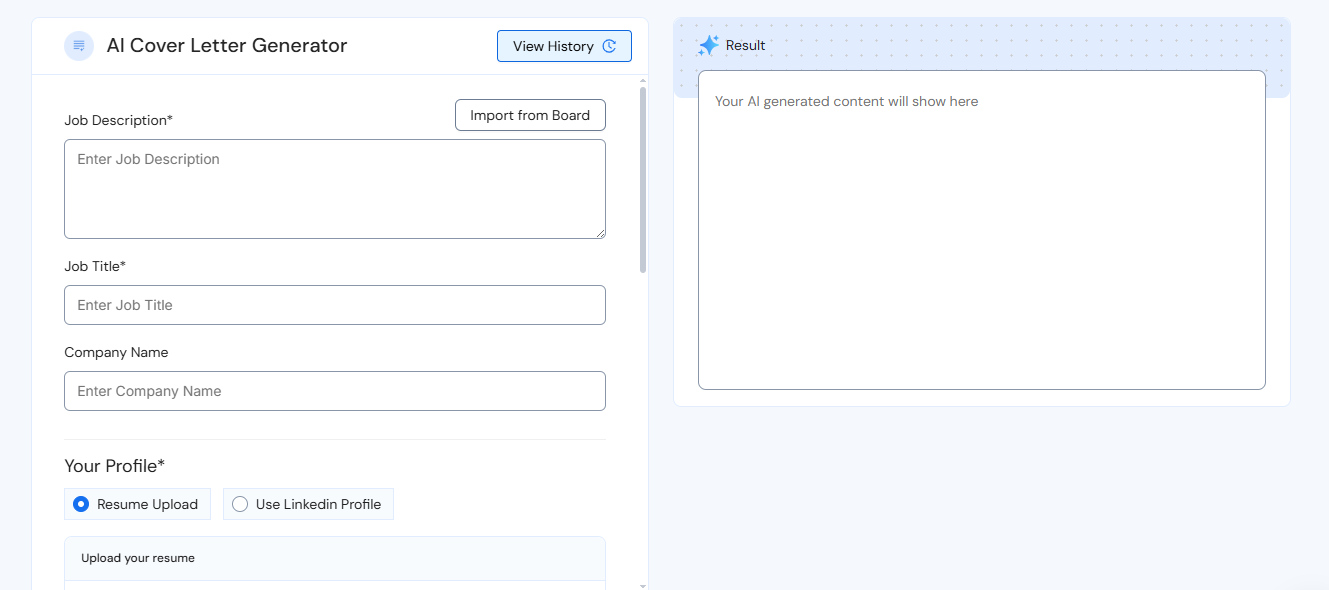
- Enter the job title, company name, and job description.
- Upload your resume or sync your LinkedIn profile to provide the AI with your achievements.
- Select your preferred tone and length to match the company culture.
- Review the draft and add 1-2 personalized sentences about a recent company launch or shared value.
Why this works:
- It cuts writing time from 30 minutes to 5, so you can write cover letters for every role worth applying to.
- You will effectively address key points from the job description without the need for manual cross-referencing.
- The tool offers a solid structural foundation that you can customize with 1-2 sentences of genuine detail.
- It helps job seekers get over the "blank page" paralysis that often keeps them from writing cover letters.
Resume Builder (align your talking points)
Consistency between your resume and cover letter is vital for building trust with recruiters. Use our Resume Builder to ensure your documents align perfectly.
- Quantify results: Identify your top achievements with specific metrics, such as "increased sales by 25%."
- Use the Skill Match tool: Identify missing keywords in your resume using the Skill Match feature.
- Mirror keywords: Weave these same high-priority keywords into your cover letter to prove your technical fit.
- Maintain branding: Use the same professional font and layout style for both documents to create a polished package.
This integrated approach helps your application get through ATS filters while showing genuine interest to hiring managers. You can now apply confidently to more roles without sacrificing quality.
.webp)
.webp)