Resumes
.avif)
.webp)
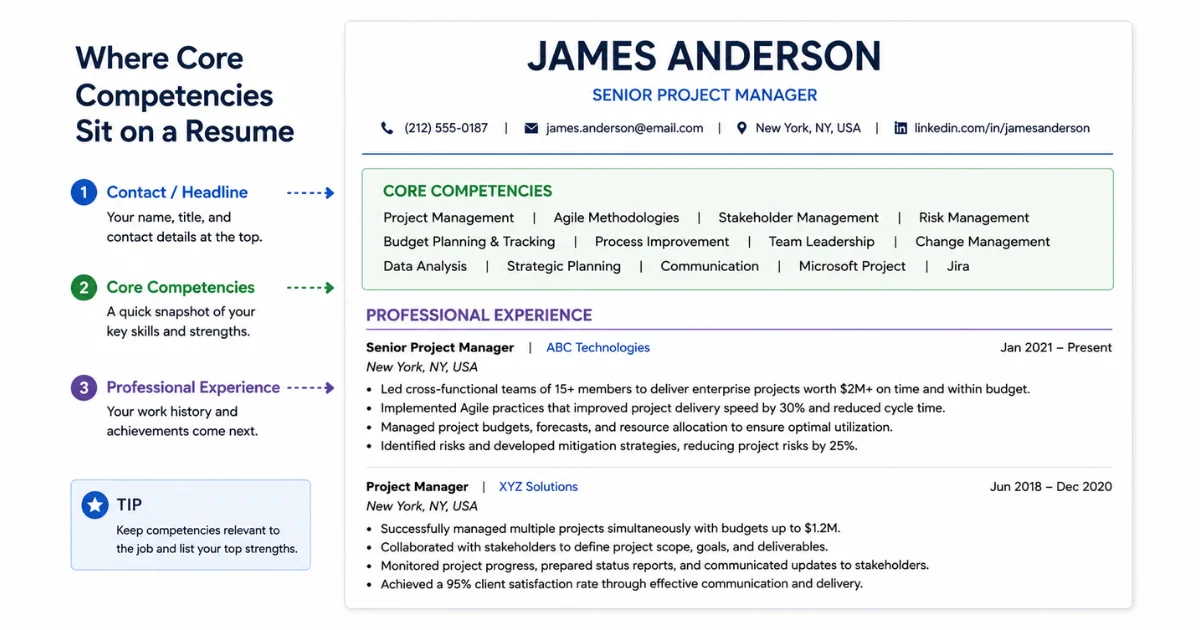
A core competencies section is a focused block of 5 to 10 key capabilities placed near the top of your resume, right below your summary statement. Its job is to give a hiring manager and an ATS an immediate snapshot of your capabilities before they read a single experience bullet.
Most job seekers skip this section entirely or mix it with their skills list, which flattens two distinct tools into one unhelpful block. Core competencies and technical skills serve different purposes, and combining them dilutes both.
This guide explains what core competencies are, how they differ from traditional skills, and lists 20 universally valued examples. You will also find 30 role-specific examples, a four-step framework to identify your own strengths, and layout guidelines for human readers and ATS systems.
What are core competencies?
Core competencies are the foundational professional strengths that define how you work. They represent the specific combination of behaviors, interpersonal capabilities and attributes that make you effective in a position beyond the technical tasks required.
Core competencies are broader than hard technical skills like Python or Salesforce, yet far more concrete than vague personality traits like motivated or positive. Presented as a dedicated block near the top of your resume, they typically appear as a scannable list of one- to three-word phrases, such as:
- Strategic planning
- Cross-functional leadership
- Conflict resolution
- Customer-centric design
- Data-driven decision-making
Core competencies vs. skills section: what goes where
Your skills section lists specific, verifiable hard skills and technical tools: software names, certifications, programming languages and specialized methodologies. It answers one fundamental question: What technical tasks can you execute?
Your core competencies section highlights broader professional strengths that combine soft skills and cross-functional behaviors. It answers a different question: How do you approach your work and drive results?
Both sections belong on a modern resume because they serve distinct purposes. The ideal placement puts core competencies near the top for immediate visibility, while placing your technical skills list lower on the page following your experience section.
If you must prioritize one section over the other, core competencies carry the most weight for senior-level, management and career-change candidates. A technical skills section carries more weight for specialized roles where specific tools must be validated instantly.
Why add a core competencies section?
- Delivers an instant snapshot: The hiring manager gets an immediate read on your professional identity before reaching your first experience bullet.
- Boosts ATS match rates: It creates a concentrated block of job-relevant keywords that mirrors the posting, lifting your match score without forcing language into your work history.
- Highlights high-level capabilities: It offers a natural space for strategic strengths that are critical to your performance but difficult to capture in a single achievement bullet, such as cross-functional leadership, relationship management and operational accountability.
20 core competencies that employers value across industries
30 core competency examples by role
If your role is not listed here, find the closest skill-adjacent position and use it as a starting framework. Adjust the specific competencies to match the job description language.
How to identify your core competencies
Finding your core competencies comes down to matching what you excel at with what employers actually need. Here is a clear, four-step process to pinpoint your strongest professional capabilities.
Step 1: Take an inventory of your professional strengths
Start by reflecting on the qualities that have made you successful throughout your career. To uncover them, ask yourself a few direct questions:
- What feedback do you hear often? Review your past performance reviews and praise from managers to see which strengths pop up repeatedly.
- Why do colleagues reach out to you? Identify the specific tasks, advice or problems teammates trust you to handle.
- What do you do automatically? Think about the high-value habits you put into practice every day without being prompted.
Step 2: Create a complete list without filtering
Write down every strength that comes to mind without judging or editing yourself yet. Use common career skills as an initial guide, then add items that are specific to your exact role or industry.
At this stage, your goal is simple: get every potential capability down on paper so you have a complete pool of options to choose from.
Step 3: Narrow your selection down to 5–10 key strengths
Filter your master list down to the best options using one rule: proof. If you cannot back up a capability with a real story or a measurable result, cross it off.
Only keep the strengths you feel completely confident explaining and defending during a job interview.
Step 4: Align your list with the job description
Compare your top competencies against the wording in the target job posting. Where possible, swap out generic terms for the exact phrasing the company uses.
For example, if you wrote down "collaboration," but the employer repeatedly asks for "cross-functional teamwork," update your term to match theirs. This small tweak ensures your resume speaks the employer's language and scans cleanly through ATS software.
How to format core competencies on your resume
Placement and formatting matter just as much as the words you choose. Your core competencies section must be instantly readable for human recruiters while remaining fully readable for automated tracking software.
Key placement rules
Position this section near the top of your page, right below your contact details, headline or summary statement, and directly above your work experience. This ensures a hiring manager sees your top capabilities within the first five seconds of opening your resume.
Choosing the right format
Pick a layout that fits your resume's style while keeping information clean and easy to read:
- Pipe-separated single line: Best for 4 to 6 concise competencies.
Example: Strategic Planning | Team Leadership | Data Analysis | Stakeholder Management
- Two- or three-column bulleted list: The most popular choice for 6 to 10 competencies. It breaks text into tidy, balanced columns that fill space effectively without cluttering the page.
- Simple vertical list: Ideal for minimalist layouts or candidates who prefer a single clean column.
How many competencies to include
Aim for 5 to 10 competencies maximum. A concise, tailored list of seven relevant strengths shows clarity and strong self-awareness. In contrast, a long list of 15 generic traits dilutes your message and makes the section harder to read.
ATS Formatting Tip: Avoid decorative elements like checkmarks, arrows, progress bars or custom symbols. Some ATS systems fail to parse them correctly, which can corrupt the section entirely.
Core competencies and ATS keyword optimization
The core competencies section acts as a primary target for Applicant Tracking Systems (ATS). These tools look for matches between the employer's job posting and your resume, making this top section ideal for high-density, high-relevance keywords.
- Mirror the job post: Open the target job description and note the specific behavioral terms or professional capabilities mentioned most often. Swap out generic terms on your resume for the employer's exact wording wherever accurate.
- Keep it truthful: Never add a keyword just to boost your match score. If you list a competency at the top, ensure your work history bullets below show clear evidence of that skill in action. Human reviewers quickly spot gaps between claimed strengths and actual experience.
How to show your core competencies through experience bullets
Listing a competency at the top of your resume names your strength. Proving it with a detailed bullet point in your work history gives it credibility. Every competency in your top section should link directly to at least one achievement bullet below.
To show, rather than just tell, use a simple three-part structure for your bullet points: Action verb + context + measurable result.
Real-world examples of competencies in action
1. Conflict resolution
- Competency: Conflict resolution
- Proving bullet point: Mediated a six-month product roadmap dispute between engineering and sales teams, establishing a phased release plan that both departments adopted without escalation to leadership.
2. Performance-driven focus
- Competency: Results-driven
- Proving bullet point: Exceeded quarterly sales targets by 28% for three consecutive quarters by shifting team strategy from cold outreach to targeted account penetration.
3. Strategic planning
- Competency: Strategic planning
- Proving bullet point: Led the annual planning process for a $4M marketing budget across five channels, reallocating 30% of underperforming spend toward high-converting digital campaigns to reduce acquisition costs by 22%.
.webp)

%20Which%20Should%20You%20Use.webp)