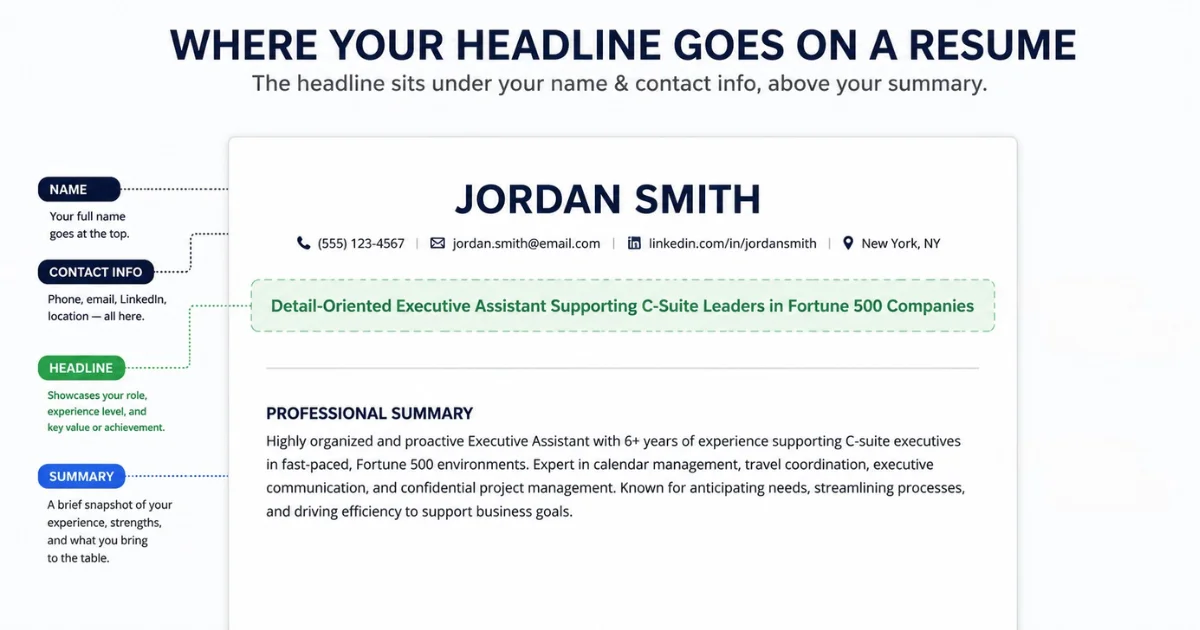
A resume headline is a one-line statement at the top of your resume, directly under your name and contact information. It tells a hiring manager who you are and what you offer before they read a single bullet point.
Think of it as the professional equivalent of a newspaper headline: its job is to capture attention and make the reader want to keep going. Without one, the top of your resume is just your name and phone number. A major waste of prime real estate.
This guide covers the formula for a strong resume headline, 80+ examples organized by industry and career stage, common mistakes to avoid, and how to write one that works for both ATS systems and the human who reads it.
At A Glance: Resume Headline
A resume headline is a one-line statement under your name that immediately tells a hiring manager who you are, how experienced you are, and why they should keep reading.
The formula: Job Title + Experience Level or Credential + Key Achievement or Skill. Keep it 8-12 words, written in title case.
Headline vs. summary: The headline is one line. The summary is 2-4 sentences. Both can appear on the same resume — headline first.
ATS tip: Use the job title from the posting and include 1-2 keywords. Customize per application.
What makes it work: Specific numbers, named credentials, a recognizable specialization, or an unexpected achievement. Generic descriptors do not land.
Common mistake: Using your current job title alone. That tells a hiring manager nothing they could not find in your experience section.
A resume headline is a short, title-case phrase of 5 to 12 words placed at the top of your resume, making it one of the first things someone will read. It’s also commonly called a resume title.
It is completely distinct from a resume summary. While a summary is a brief two to four sentence paragraph that expands on your professional story, a headline is a single line designed to make a hiring manager want to read further.
If your resume currently features a short paragraph starting with "Experienced professional with..." that is a summary rather than a headline. The two elements can easily coexist on the same resume, with the headline placed first and the summary immediately second.
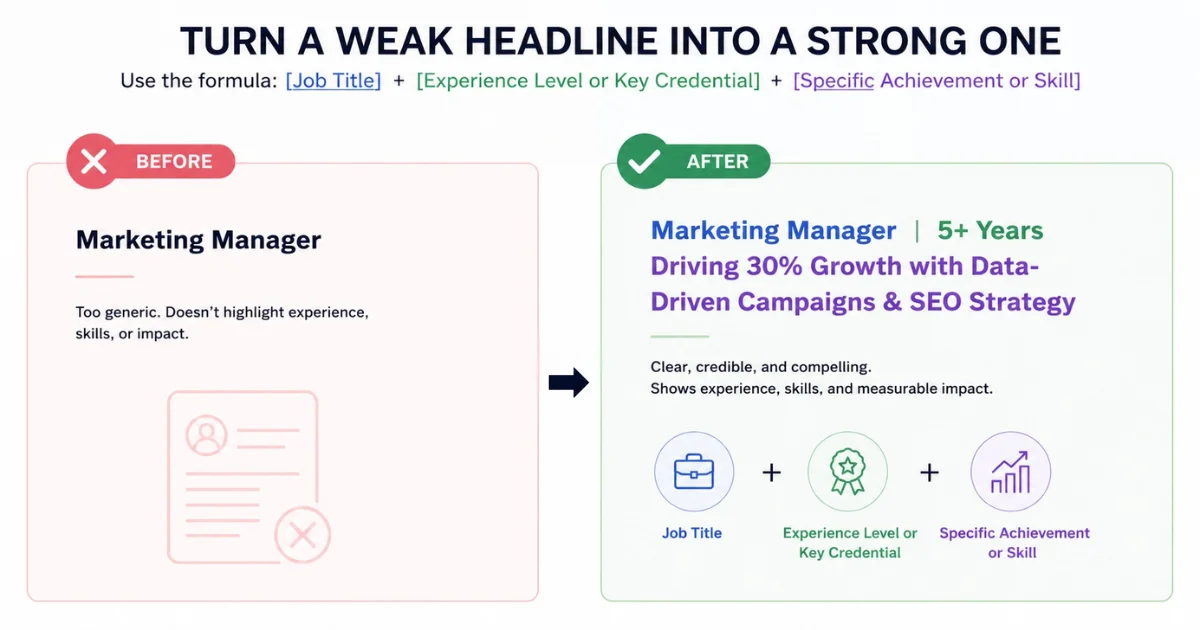
A strong headline combines your job title, your experience level or a credential, and one specific achievement or skill. This combination directly answers the three questions a hiring manager asks in the first three seconds: Who are you? How experienced are you? Why should I keep reading?
[Job Title] + [Experience Level or Key Credential] + [Specific Achievement or Skill]
This structure is highly effective because it answers the critical three-second question in the exact order a recruiter looks for: what you do, how established you are and why you stand out.
Examples of the formula in action
"Senior Data Analyst With 8 Years of Financial Modeling Expertise" (title + experience + skill)
"Certified PMP With Record of Delivering Complex Projects Under Budget" (credential + achievement)
"Award-Winning Graphic Designer Specializing in Brand Identity Systems" (achievement + title + specialization)
"Entry-Level Marketing Coordinator With Google Analytics Certification" (level + title + credential)
The elements can shift positions depending on your strongest selling point, but keeping these three core pillars intact ensures your value proposition lands instantly.
80+ resume headline examples by industry and role
Administrative and office support
Administrative Assistant With 2+ Years in Fast-Paced Legal Environments
Detail-Oriented Executive Assistant Supporting C-Suite Leaders in Fortune 500 Companies
Office Manager With Expertise in Payroll, HR, and Vendor Coordination
Diplomatic Receptionist With Consistent 98% Client Satisfaction Scores
Records Coordinator Specializing in HIPAA-Compliant Document Management
Virtual Assistant With 4 Years of Remote Operations Experience
Bilingual Administrative Assistant (English/Spanish) With 3 Years in Global Operations
Business, operations, and management
Resourceful Project Manager With 10+ Years Delivering On-Time, On-Budget Results
Lean Six Sigma Black Belt Driving Process Improvements Across Manufacturing Operations
Strategic Operations Manager Who Reduced Overhead by 18% Across 3 Facilities
Business Analyst With 7 Years of DevOps and Workflow Optimization Expertise
HR Manager Focused on Talent Retention and Culture Development
Supply Chain Manager Specializing in Just-in-Time Inventory Systems
Agile Scrum Master and Certified SAFe Practitioner
Change Management Consultant With 5 Large-Scale ERP Implementations
Procurement Manager Who Reduced Vendor Costs by 22% Through Contract Renegotiation
Technology and engineering
Full-Stack Developer With React and Node.js Expertise
Cloud Solutions Architect Specializing in AWS Infrastructure at Scale
Cybersecurity Analyst With CISSP Certification and Zero Major Incidents in 3 Years
Data Engineer With 6 Years of ETL Pipeline Development Experience
Machine Learning Engineer Focused on Production Model Deployment
DevOps Engineer Who Reduced Deployment Cycle From 2 Weeks to 4 Hours
Mobile Developer Specializing in React Native Cross-Platform Applications
Data and analytics
Data Scientist Proficient in Python, R, and Machine Learning Modeling
Business Intelligence Analyst Who Built Reporting Infrastructure From Scratch
Entry-Level Data Analyst Skilled in SQL and Excel With Internship Experience
Financial Data Analyst With CFA Level I and Tableau Certification
Senior Analytics Manager Leading a Team of 8 Across Product and Marketing
Analytics Engineer With dbt, Snowflake, and Looker Production Experience
Junior Data Analyst With E-commerce Reporting and Dashboard Delivery Experience
Marketing, communications, and sales
Digital Marketer Who Generated $30M in Sales Pipeline Through Content Strategy
B2B Marketing Manager Driving 40% Year-Over-Year Lead Generation Growth
Social Media Strategist With 500K+ Audience Reach Across Platforms
Growth Marketing Manager Specializing in SEM and Conversion Rate Optimization
Public Relations Specialist With Crisis Communication and Media Relations Expertise
Account Executive Specializing in Enterprise SaaS With 120% Quota Attainment
Senior Copywriter With Brand Voice Expertise Across 15+ Consumer Industries
Finance and accounting
Certified Public Accountant With 10 Years of Corporate Tax Experience
Financial Analyst With CFA Designation and Private Equity Background
Senior Controller Who Improved Month-End Close by 30% Through Process Redesign
Payroll Manager With Expertise in Multi-State Compliance and ADP Systems
Budget Analyst With Record of Zero Material Audit Findings in 6 Years
Risk Analyst With Basel III Compliance and Stress Testing Experience
Internal Auditor With 6 Years of SOX Compliance and Risk Assessment Experience
Healthcare and medical
Registered Nurse With 5+ Years in Pediatric ICU Care
Certified Medical Assistant With Emergency Care and EHR Experience
Licensed Physical Therapist Specializing in Sports Rehabilitation
Patient-Focused Dental Hygienist With 4+ Years of Clinical Practice
Healthcare Administrator With Epic EHR Implementation Expertise
Compassionate Home Health Aide With Geriatric and Memory Care Experience
Occupational Therapist With Pediatric Sensory Integration Specialization
Medical Billing Specialist With 99% Clean Claim Rate and Revenue Cycle Expertise
Education and training
High School Science Teacher With 8 Years of AP Curriculum Development
Instructional Designer With eLearning Development and LMS Administration Experience
Corporate Trainer Who Delivered 200+ Sessions to Global Teams
Online Learning Facilitator With Expertise in Blended Learning Environments
Special Education Teacher With IEP Development and Behavior Intervention Experience
Early Childhood Educator With 3 Years of Montessori Classroom Experience
ESL Teacher With 5 Years of International Curriculum Delivery Experience
Creative, design, and media
Graphic Designer With 6 Years in National Advertising Agencies
UX Designer Specializing in Mobile-First Product Experiences
Motion Graphics Artist With Emmy-Nominated Broadcast Work
Content Strategist With 3x Organic Traffic Growth Track Record
Brand Identity Designer With Portfolio of 40+ Established Consumer Brands
Podcast Producer With 2M+ Total Downloads Across 3 Series
Technical Writer With SaaS Documentation and API Reference Experience
Retail, hospitality, and customer service
Customer Service Specialist With Consistent 98% Satisfaction Ratings
Store Manager Leading High-Performing Team of 20 Across Two Locations
Friendly Cashier and Three-Time Employee of the Month
Hospitality Professional With 7 Years in Luxury Hotel Front Desk Operations
Sales Associate Who Drove a 42% Revenue Increase in Personal Book of Business
Restaurant Manager Who Improved Table Turn Rate by 25% in Six Months
Hotel Revenue Manager With 4 Years of Yield Optimization Experience
Entry-level and career starters
Motivated Marketing Graduate With Campaign Management Internship Experience
Recent Finance Graduate With CFA Level I and Equity Research Experience
Career Changer Bringing 5 Years of Operations Management to Project Management
Entry-Level Software Developer With Open-Source Contributions and CS Degree
Entry-Level HR Coordinator With SHRM Certificate and Talent Acquisition Internship
First-Year Registered Nurse With Pediatric ICU Clinical Rotation Experience
Recent Accounting Graduate With QuickBooks Certification and AP/AR Internship
Why these headlines work: five examples analyzed
"Cloud Solutions Architect Specializing in AWS Infrastructure at Scale"
The breakdown: The job title is highly specific (avoiding vague terms like "IT Professional"), the core platform credential (AWS) is instantly verifiable, and the phrase "at scale" signals senior-level capability without relying on a rigid year count.
"Digital Marketer Who Generated $30M in Sales Pipeline Through Content Strategy"
The breakdown: The metric is precise and high-impact. It explicitly names the method (content strategy) and focuses entirely on concrete business outcomes rather than day-to-day tasks.
"Career Changer Bringing 5 Years of Operations Management to Project Management"
The breakdown: This pre-emptively addresses the career transition. It frames prior experience as a direct asset and clearly identifies the target destination role.
"Friendly Cashier and Three-Time Employee of the Month"
The breakdown: Even for an entry-level position, a specific achievement—three times, not just once—provides social proof that generic titles cannot. The repetition makes the claim credible.
"Registered Nurse With 5+ Years in Pediatric ICU Care"
The breakdown: The essential credential (RN) is immediately visible, the tenure is clear, and the specialty (Pediatric ICU) positions the candidate as a highly skilled specialist rather than a generalist.
How to write your resume headline: step by step
1. Start with your target job title
Use the exact title from the job posting where possible. Applicant tracking systems look for direct language matches (see our guide to resume keywords), meaning a specific title like "Software Engineer" consistently outperforms a generic phrase like "Technology Professional.
2. Add your strongest professional signal
Incorporate a high-impact credential or experience marker. This can be your total years of experience, a prominent certification, an industry award, or a core specialization. One strong qualifier carries far more weight than multiple weak ones.
3. Add one specific differentiator
Add a specific detail to make your line memorable rather than generic. A precise metric, a specific methodology, a recognizable past employer, or a niche specialization all serve as excellent differentiators.
“The question that unlocks the differentiator most reliably: ‘Tell me about a time a senior leader specifically called out your work — not the team’s work, your work.’ The follow-up: ‘What specifically did they say you did that they could not have gotten from anyone else on the team?’ The answer to that question is almost always the differentiator the client has been discounting as obvious or common. Once they say it out loud and I ask why it was not obvious to the next person, they realize it is the headline.”
Capitalize the first letter of each major word just as you would for a major news article title. This formatting immediately establishes a polished, professional visual hierarchy at the very top of the page.
Tip: You can use tools like Capitalize My Title if you’re unsure how to do it.
5. Cap the length at 12 words
Keep the entire statement between five and 12 words max. Longer titles risk wrapping to a second line, which reduces visual impact and makes the section read like a redundant summary paragraph.
6. Draft multiple variations
Create a few alternative versions tailored to different applications. You can then quickly swap in the specific headline that mirrors the language and priorities of the exact role you are targeting.
“The question that unlocks the differentiator most reliably: ‘Tell me about a time a senior leader specifically called out your work — not the team’s work, your work.’ The follow-up: ‘What specifically did they say you did that they could not have gotten from anyone else on the team?’ The answer to that question is almost always the differentiator the client has been discounting as obvious or common. Once they say it out loud and I ask why it was not obvious to the next person, they realize it is the headline.”
Listing just your title tells a hiring manager nothing new. A single phrase like "Marketing Manager" acts as a basic label rather than a compelling headline, wasting prime real estate on information already visible in your experience section.
Relying on generic descriptors
Vague phrases like "experienced professional with strong skills" fail to communicate real value. They lack the specific metrics, tools, or domain expertise required to make your resume stand out from the stack.
Overloading the line with credentials
Jamming every acronym into one line creates an unreadable list. A string like "MBA, PMP, CPA, CISSP, Senior Manager" overwhelms the reader and belongs in your dedicated certifications or education sections instead.
Ignoring applicant tracking systems
Failing to align your text with the job description hurts your chances more. Matching the exact target job title and core keywords in your headline significantly boosts your performance during initial database screenings.
Writing in the first or third person
Headlines are punchy noun phrases rather than full narrative sentences. Avoid pronouns entirely, opting for direct statements like "Senior Developer" instead of "I am a Senior Developer" or "Results-driven professional who..."
Resume headline vs. resume title: what’s the difference?
The terms are often used interchangeably, and the minor distinction rarely matters to a recruiter.
A resume title typically refers to a brief professional label, such as "Senior Product Manager." A resume headline expands on that label by adding crucial context, resulting in a complete one-liner like "Senior Product Manager Who Launched 3 Products to $10M+ ARR."
For your resume, a headline version (title and context) is almost always better than a plain title. Use the full headline style.
How to write your resume headline with our AI resume builder
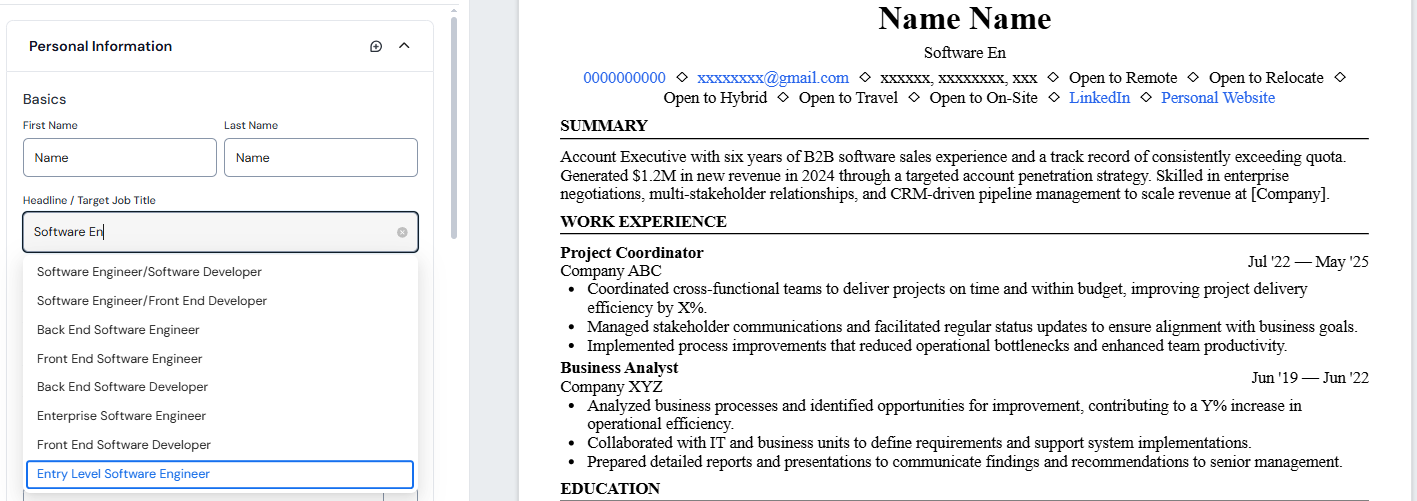
Step 1: Open our AI Resume Builder and navigate directly to the header section at the very top of your workspace.
Step 2: Enter your current or target job title.
Step 3: You’ll be presented with a list of related titles that you can choose from, or manually write your own
Step 4: You can see the headline being added to the resume in real time so you can see exactly how it looks
Create a Resume That Gets Noticed
Careerflow's AI Resume Builder helps you turn your experience into a polished, ATS-friendly resume that's tailored to the roles you want.
Puneet left a senior engineering role at Apple to co-found Careerflow, an AI-powered job search platform backed by Techstars and used by over 1 million job seekers worldwide. He brings more than a decade of hands-on experience in AI and machine learning, built across Apple, Amazon, and Leia Inc. As CEO, he leads the product and engineering behind the tools he wished existed during his own career transitions. You can connect with him on LinkedIn
FAQ: Resume Headline Examples
What is a resume headline?
A resume headline is a short, title-case phrase at the top of your resume that summarizes who you are professionally in one line. It sits under your name and above your resume summary or experience section. Its job is to immediately communicate your role, experience level, and strongest credential or achievement so a hiring manager wants to keep reading.
What should a resume headline include?
A strong resume headline includes your job title, one signal of your experience level or a key credential, and one specific achievement or differentiator. The formula: Job Title + Experience Level or Credential + Key Achievement or Skill. Aim for 8-12 words written in the title case.
Does a resume headline help with ATS?
Yes, if written correctly. Including your target job title and one or two keywords from the job description in your headline increases the likelihood of an ATS match. Use the exact language from the posting where possible, and avoid symbols or formatting that ATS systems may not parse correctly.
Is a resume headline the same as a resume summary?
No. A resume headline is a single line — typically 8-12 words in title case. A resume summary is a 2-4 sentence paragraph that expands on your professional story, key skills, and top achievements. Both can appear on the same resume: headline first, summary second. If you need help writing the summary that follows, our resume summary writer can draft it from your inputs.
Should I change my resume headline for each job?
Yes. The most effective headlines use the specific job title and keywords from each posting. A headline tailored to the role performs better with ATS and reads as more relevant to the hiring manager. Writing one per application is a small investment with a meaningful return.
Recommended Articles
Here are some of the recommended articles from our team


.avif)
.webp)

.webp)

%20Which%20Should%20You%20Use.webp)