Hard skills are the specific, teachable abilities that qualify you for a job and pass applicant tracking systems. Recruiters and ATS algorithms scan your resume for these measurable technical capabilities before reviewing anything else.
While soft skills describe how you work, hard skills provide verifiable proof of your technical expertise. Hiring managers can easily test your knowledge of SQL, confirm a project management certification or review a financial model. Including the right technical keywords determines whether your application moves forward or gets filtered out.
This guide covers 100+ hard skills examples organized by industry and category. You'll learn how to identify overlooked skills and format your section to clear ATS filters and impress human reviewers.
At A Glance: Hard Skills for a Resume
Hard skills are specific, measurable abilities — like SQL, PMP certification, or Adobe Illustrator — that qualify you for a role and pass ATS screening.
How many to list: Eight to twelve in your skills section. Prioritize skills from the job description.
Where they go: Dedicated skills section (for ATS), experience bullets (for impact), and resume summary (for immediate visibility).
ATS tip: Match the exact phrasing from the job posting. Avoid tables or graphics in your skills section — ATS systems often cannot read them.
Proficiency levels: Add basic/intermediate/advanced labels only when your levels vary enough to matter for the role.
Common oversight: Most job seekers undercount their hard skills. Every tool, platform, or system you use regularly at work is a hard skill worth listing.
🔧 Identify your hard skills and build an ATS-ready resume with our AI resume builder.
What are hard skills?
Hard skills are role-specific technical abilities you acquire through formal education, on-the-job training, targeted coursework or self-study. They include software proficiency, professional certifications, technical methodologies and foreign languages. Any capability that someone can teach, test and measure qualifies as a hard skill.
You can easily distinguish hard skills from soft skills by looking at job postings. Hard skills dominate the required qualifications section. Soft skills appear in phrases like "must be a team player" or "strong communicator." Both skill sets matter, but technical capabilities get your resume through the initial screening filters.
A programming language you learned years ago belongs on your resume only if you maintain a working proficiency. You must be honest about your current capability level. A hiring manager can easily test these skills during your interview.
100+ hard skills examples by category
✅ Technology and software
Technical roles require specific tools and platforms to build and manage modern digital infrastructure.
Design software: Adobe Photoshop, Illustrator, InDesign, Figma, Sketch, After Effects, Canva and Blender
✅ Marketing and content
Modern marketing relies heavily on digital platforms, data optimization and structured content creation tools.
SEO: Keyword research, on-page optimization, technical SEO, link building, Google Search Console, Ahrefs and SEMrush
Paid advertising: Google Ads, Meta Ads Manager, programmatic advertising, A/B testing and conversion rate optimization
Email marketing: Mailchimp, HubSpot, Klaviyo, Salesforce Marketing Cloud, list segmentation and marketing automation
Content production: Copywriting, content strategy, scriptwriting, podcast production and video editing with Premiere Pro or Final Cut Pro
Social media: LinkedIn, Instagram, TikTok, X/Twitter management, data analytics, Hootsuite and Sprout Social
✅ Finance and accounting
Financial professionals must master specific mathematical concepts, regulatory frameworks and specialized tracking software.
Modeling and planning: Financial modeling, forecasting, corporate budgeting, variance analysis and scenario planning
Accounting software: QuickBooks, NetSuite, SAP, Oracle Financials and Xero
Core concepts: GAAP accounting, IFRS, accounts payable and receivable, payroll processing and general ledger management
Data analysis: Financial statement analysis, DCF modeling, Excel pivot tables and VLOOKUP/XLOOKUP functions
✅ Project management and operations
Operations roles require knowledge of specific organizational frameworks and collaboration tools to keep projects on schedule.
Methodologies: Agile, Scrum, Kanban, Waterfall and Lean Six Sigma Green or Black Belt
Certifications: PMP, CAPM, PRINCE2, CSM, PSM and ITIL framework
Management tools: Jira, Asana, Monday.com, Trello, Notion, Smartsheet, MS Project and Confluence
Core competencies: Resource allocation, risk management, vendor management, SOP development and change management
✅ Healthcare and clinical
Medical professionals need verified certifications and software expertise to ensure patient safety and regulatory compliance.
Patient care: Clinical assessment, electronic health records (EHR/EMR), ICD-10 coding, CPT coding and HIPAA compliance
Clinical software: Epic, Cerner, Meditech and Allscripts
Certifications: CPR/BLS, ACLS, PALS, CNA, RN licensure, phlebotomy certification and CPC medical coding
✅ Trades and engineering
Engineering and trade roles demand mastery of physical building codes, safety regulations and design software.
CAD software: AutoCAD, SolidWorks, CATIA and Revit
Construction: Blueprint reading, project estimation, LEED certification and OSHA 10/30 safety training
Manufacturing: CNC operation, PLC programming, AWS welding certifications and ISO 9001 quality management
Electrical: Circuit design, electrical load calculations, NEC code compliance and specialized instrumentation
✅ Languages and communication
Verbal and written communication skills must be highly technical, structured and verifiably proficient.
Foreign languages: Only list languages at intermediate level or above. Format as Spanish (C2 proficient), Mandarin (B2 conversational) or French (B1 intermediate).
Professional writing: Technical writing, grant writing, proposal writing, legal writing, medical writing and UX writing
Skills section to avoid ✗
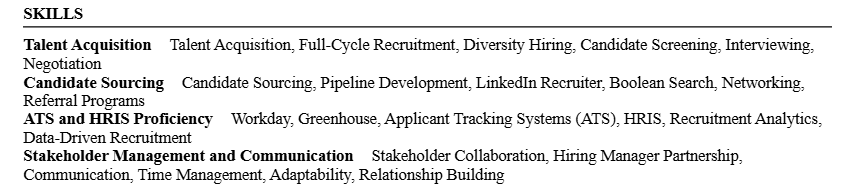
Skills section that works ✓
Basic Computer Skills. Familiar with Microsoft Office. Communication. Problem Solving. Hard Working. Teamwork. Management.
Business & Analytics: Financial Modeling (Excel Advanced), SQL (PostgreSQL/MySQL), Data Visualization (Tableau, Power BI), Agile/Scrum.
How to identify the hard skills you are overlooking
Start by listing every tool, platform, software system and methodology you used over the past five years. Job seekers routinely undercount their technical abilities because daily tasks feel ordinary. If you use Excel every single day, advanced Excel belongs on your resume.
Review the onboarding requirements for your previous roles. Consider whether you completed specialized software training, earned internal credentials or learned specific procedural frameworks. All of these technical requirements qualify as hard skills.
Read five recent job postings for your target role and highlight the qualifications. Cross-reference their required and preferred skills with your background. Any matching capability you omitted represents an easy win for your resume.
Look for accredited certifications you earned but forgot to list. Credentials from recognized professional bodies provide excellent proof of your technical expertise. You can even list expired certifications if they demonstrate valuable past proficiency.
How to list hard skills on your resume
How many to include
Aim for eight to twelve hard skills in your dedicated skills section. Listing fewer than five skills looks thin, while including more than fifteen dilutes focus. Too many technical keywords signal that you padded the list instead of prioritizing your core strengths.
Senior or technical professionals can use the upper end of this range if every skill is relevant. Entry-level applicants should focus on six to eight targeted skills to build a compelling narrative.
“The moment I open your resume, this is your time to shine. In the first 10 seconds, I should see a clear, concise, and targeted skills section that clearly aligns with the position I am hiring for. I don’t want to see endless lists or long phrases. From my military days, I go back to briefing senior officers. Be bright, be brief, be gone. The skills section on the resume should work the same way. If you look at the job requirements and you have those skills, say it, as simple as that. If I cannot clearly see you have the technical skills I am looking for, I move on to the next candidate.”
Dr. Brittany “Dr. C” Castonguay, CEO & Founder (Strategic Human Resources & Innovations) | Source
Where to put them
Your dedicated skills section provides a clear target for applicant tracking systems. Keep this section scannable by using a clear comma-separated list or a clean two-column layout. Group your talents by subcategory if you list more than ten skills.
The experience section is where your technical abilities carry real weight. Proving your skills through metrics is far more valuable than simply listing a tool.
Example:"Built automated reporting dashboard in Tableau, reducing weekly reporting time from six hours to 45 minutes."
Include critical keywords in your skills list, prove them in your experience section and repeat them in your resume summary.
ATS formatting rules
Spell out abbreviations: Write "Search Engine Optimization (SEO)" at least once because some applicant tracking systems miss short forms.
Avoid complex layouts: Never place your skills section inside a table, text box or graphic. Many parsing systems cannot read text inside table cells or image files.
Match the job description: Use the exact phrasing from the posting. If the company requests "Microsoft Excel" and you write "MS Excel," a strict filter might miss the match.
Adding proficiency levels like "Python (advanced)" or "R (intermediate)" helps when your expertise varies across tools. This sets accurate expectations and prevents awkward interview situations where your actual skills fall short of your resume claims.
Only add proficiency labels if they provide necessary context. A simple list without labels works perfectly if you use every listed skill confidently at a professional level.
How to build your hard skills section with our AI resume builder
To build a fully optimized technical profile, follow this step-by-step procedure using our integrated platform tools.
1. Generate initial skill suggestions
Open the Careerflow AI resume builder and enter your work experience. The platform automatically scans your background and generates tailored suggestions to surface technical skills implied by your professional history.
2. Map keywords to your target job
Paste your target job description directly into the builder. The platform immediately identifies matching technical keywords from the posting, flags critical gaps, and organizes your skills into an ATS-friendly layout.
3. Optimize for keyword alignment
Run your completed resume draft through the resume optimizer. This tool cross-references your document against the job posting to ensure your technical capabilities perfectly match the required screening terms.
4. Analyze against industry benchmarks
Use the resume keyword analyzer to evaluate your profile against broader market standards. The tool identifies high-priority hard skills frequently requested by top employers, letting you add vital keywords you might have missed.
Create an ATS-Friendly Resume That Highlights Your Skills
Careerflow’s Resume Builder helps you match your skills to job descriptions, optimize your resume for ATS, and present your technical expertise clearly to employers.
Puneet left a senior engineering role at Apple to co-found Careerflow, an AI-powered job search platform backed by Techstars and used by over 1 million job seekers worldwide. He brings more than a decade of hands-on experience in AI and machine learning, built across Apple, Amazon, and Leia Inc. As CEO, he leads the product and engineering behind the tools he wished existed during his own career transitions. You can connect with him on LinkedIn
FAQs: Hard Skills for a Resume
What is the difference between hard skills and soft skills?
Hard skills are specific, measurable technical abilities you learn and master through training, education or practical experience. Examples include Python programming, financial modeling and professional certifications. Soft skills describe how you work, collaborate and solve problems. Both skill sets belong on your resume, but technical capabilities are what screening systems scan for first.
How many hard skills should be on a resume?
Most resumes benefit from listing eight to twelve relevant technical capabilities in a dedicated section. Your goal is to highlight tools and methods directly relevant to your target role instead of listing everything. You must back up these core skills with metrics and context inside your professional experience bullet points.
Should I list skill proficiency levels on my resume?
Adding proficiency labels is helpful when your expertise levels vary significantly across your listed tools. This transparency sets accurate expectations and prevents awkward interview situations if a hiring manager tests your claims. Skip these labels entirely if you use every listed skill confidently at a professional level.
Can I list software I learned in a course but have not used on the job?
Yes, you can list training-only software if you can competently use the tool today. Classroom exposure is valuable to employers if you retain the technical knowledge. If you took a course years ago and never touched the tool again, leave it off until you refresh your skills.
What hard skills are most valuable to list right now?
Data analysis, artificial intelligence tools, cloud infrastructure, cybersecurity and project management certifications remain highly requested across most modern industries. However, the most valuable capabilities for your specific career document depend entirely on your target industry. Always prioritize the specific requirements highlighted in your target job description.
Recommended Articles
Here are some of the recommended articles from our team


.avif)
.webp)


.webp)