Resumes


Personal skills, also called "soft skills," are the character-based abilities that shape how you work, collaborate and handle everyday workplace challenges. They describe exactly how you do the job, not just whether you hold the technical credentials for it. Recruiters consistently cite these traits as decisive hiring factors, but only when candidates back them up with actual evidence rather than just listing empty labels.
According to the National Association of Colleges and Employers, teamwork, communication and problem-solving rank among the most-requested attributes employers look for in new hires. Despite this demand, most resumes simply list these critical attributes as bare labels with absolutely nothing to prove them.
This guide covers 28 personal skills organized into five distinct categories, each paired with a practical before-and-after bullet point example. You will also learn exactly where on your resume to place these skills, how to convert them into a professional summary in sentence form and which overused buzzwords you need to cut immediately.
What are personal skills?
Personal skills are transferable, character-based abilities developed through experience rather than formal technical training or professional certification. They describe how you work with others, manage your own time and navigate workplace challenges. For example, communication, leadership and adaptability are personal skills. Python, financial modeling and forklift certification are not.
The clearest distinction from technical skills is that a hard skill can be tested objectively with a specific task or an official credential. A personal skill is assessed over time through your daily behavior. Hiring managers look for evidence of these traits within your achievement bullet points rather than just a bare label in a skills section.
To Know More 👉: Hard Skills for a Resume: 100+ Examples by Industry
Both skill types matter equally to an organization. A candidate who can execute the technical work but cannot collaborate, communicate or manage their own schedule is a costly hire. Ultimately, personal skills are how employers predict whether someone will succeed in the actual environment of the role rather than just the tasks.
28 personal skills for your resume (with examples)
The 28 skills below are organized into five core categories: communication and interpersonal skills, leadership and teamwork skills, critical thinking and problem-solving skills, work ethic and reliability skills and adaptability and growth skills. Every skill includes a clear definition and a weak/strong bullet example showing the exact difference between claiming a skill and proving it.
Communication and interpersonal skills
Communication and interpersonal skills describe how a candidate expresses themselves, listens and navigates professional relationships. They appear in nearly every job description and are among the first attributes assessed during an interview screen.
1. Communication
Communication is the ability to convey ideas clearly and concisely in speech and writing while adjusting the message to the audience. Employers rank it as a top personal skill because it directly affects team efficiency and client relationships.
Weak: "Strong communication skills."
Strong: "Presented quarterly performance data to a 15-person cross-functional team, synthesizing 12 metrics into a single one-page visual that reduced meeting time by 20 minutes per session."
2. Active listening
Active listening is hearing what is actually being said, processing the information and responding in a way that confirms understanding. It allows you to catch the details that matter and build productively on others' ideas.
Weak: "Active listener."
Strong: "Reduced client escalations by 30% by introducing structured follow-up calls after each project brief to confirm scope alignment before work began."
3. Interpersonal skills
Interpersonal skills are behaviors that make someone effective and pleasant to work with, including building rapport and navigating different personalities. They are the foundation of productive working relationships across teams, functions and seniority levels.
Weak: "Good interpersonal skills."
Strong: "Collaborated with six stakeholders across engineering, design and legal to finalize product requirements on a 10-day timeline, with zero change requests after sign-off."
4. Empathy
Empathy is the ability to genuinely understand another person's perspective and respond to it in a way that builds trust. It is especially valued in customer-facing roles, healthcare, people management and collaborative environments.
Weak: "Empathetic team member."
Strong: "Identified that a top-performing rep was underperforming due to a scheduling conflict, not a skills gap. Adjusted territory coverage for four weeks and performance returned to target within the month."
5. Conflict resolution
Conflict resolution is the ability to surface disagreements constructively and guide parties to a workable outcome without damaging the working relationship. It is critical in cross-functional roles where competing priorities are the norm.
Weak: "Skilled at conflict resolution."
Strong: "Facilitated a two-hour session between product and engineering after a missed sprint deadline, identified a handoff gap in requirements and introduced a shared ticket format that prevented recurrence for the next six sprints."
6. Negotiation
Negotiation is the ability to identify the interests of all parties and reach agreements that work for everyone. Beyond sales, it appears in vendor contracts, project scoping, resource allocation and stakeholder alignment.
Weak: "Negotiation skills."
Strong: "Renegotiated a key vendor contract at renewal, securing a 12% cost reduction and a 30-day payment extension that saved $40K annually against a flat budget."
Leadership and teamwork skills
Leadership and teamwork skills describe how a candidate influences, guides and works alongside others. Leadership is highly relevant at every level of seniority, not just in formal management roles.
7. Teamwork and collaboration
Teamwork is the ability to contribute meaningfully to shared goals alongside people with different skills, backgrounds and working styles. Strong collaborators are recognizable by their outputs, knowing exactly when to lead, when to follow and how to disagree productively.
Weak: "Team player."
Strong: "Co-developed a client onboarding playbook with four colleagues across sales, customer success and product. Playbook reduced time-to-first-value from 14 days to 8 days."
8. Leadership
Leadership is the ability to set direction, motivate others toward a goal and create conditions where a team can do its best work. It is not defined by title; initiative, accountability and influence at any level are all forms of leadership.
Weak: "Leadership skills."
Strong: "Led three junior analysts through a six-week audit project with no direct manager oversight. Delivered on time and within budget; all three analysts rated the project a positive development experience."
9. Delegation
Delegation is the ability to assign work based on team members' strengths and development needs, provide clear direction and trust them to execute. Without delegation, managers become severe bottlenecks regardless of individual capability.
Weak: "Able to delegate effectively."
Strong: "Redistributed three recurring reporting tasks to junior team members during a capacity crunch, providing structured handover documentation. All three continued independently for the rest of the quarter with no errors or follow-up needed."
10. Motivation (inspiring others)
The motivating dimension of leadership is the ability to keep a team energized and committed, especially during difficult conditions. This trait is demonstrated through the concrete outcomes of the people around you rather than self-description.
Weak: "Motivating leader."
Strong: "Maintained full team retention and on-target output during a six-month product pivot that required a complete roadmap redesign, through weekly all-hands check-ins and individual goal realignment sessions."
Critical thinking and problem-solving skills
These skills describe how a candidate processes information, generates solutions and makes decisions under uncertainty. They are increasingly valued in every function as work becomes more ambiguous and data-driven.
11. Problem-solving
Problem-solving is the ability to identify the root cause of an issue rather than just its symptoms, allowing you to find a workable solution under time pressure or with incomplete information. Strong problem-solvers create forward momentum instead of waiting for someone else to act.
Weak: "Problem-solving skills."
Strong: "Traced a recurring data discrepancy in monthly reporting to a misaligned timestamp format introduced in a system migration. Built a reconciliation process that eliminated the error entirely and saved two hours of manual correction per month."
12. Analytical thinking
Analytical thinking is the ability to break down complex problems, identify hidden patterns across data sets and draw evidence-based conclusions. While it is table stakes in data-adjacent roles, it remains equally essential in operations, product, finance and marketing.
Weak: "Analytical thinker."
Strong: "Analyzed 18 months of churn data and identified that 62% of churned accounts had not used the core product feature in their first two weeks. Built a triggered onboarding sequence that reduced 30-day churn by 18%."
13. Decision-making
Decision-making is the ability to weigh diverse options, accurately assess risk and commit to a course of action within a reasonable timeframe. Good decision-makers move fast enough to capitalize on opportunities and deliberately enough to avoid preventable mistakes.
Weak: "Good decision-maker."
Strong: "Delayed a product launch by two weeks after QA surfaced a data privacy risk not scoped into the original timeline. The delay prevented a compliance issue that would have required retroactive remediation at significant cost."
14. Creativity
Creativity is the ability to generate original ideas and approach stubborn problems from unexpected angles. It is not limited to design or writing; critical process redesign, sales strategy and product thinking all depend heavily on creative thinking.
Weak: "Creative thinker."
Strong: "Proposed an internal talent-swap program during a budget freeze. The program placed three team members in cross-functional roles for 60 days, filled two open resource gaps and received positive feedback from every participant."
15. Resourcefulness
Resourcefulness is the ability to find workable solutions when time, tools or budgets are highly restricted. Resourceful employees create immense value in conditions where others stall, making them the people who always find a way to deliver.
Weak: "Resourceful."
Strong: "Built a client-facing reporting dashboard using existing tools after a $30K analytics platform was denied. Reduced client reporting time from six hours per week to 45 minutes."
Work ethic and reliability skills
These skills describe how a candidate shows up, follows through and conducts themselves in the workplace. They form the foundation of professional trust and are what experienced hiring managers often weigh most heavily when comparing candidates at the same technical level.
16. Time management
Time management is the ability to prioritize tasks by importance and deadline, allowing you to consistently deliver on commitments without requiring constant follow-up. It is visible in delivery records and in how you handle concurrent priorities.
Weak: "Strong time management."
Strong: "Managed four concurrent client accounts with overlapping deliverables across a six-month engagement. All 12 scheduled deliverables landed on or before the agreed date."
17. Organization
Organization is the ability to systematically manage information, workflows and resources so that nothing falls through the cracks. It represents the structural side of time management, relying on robust systems and processes rather than just good intentions.
Weak: "Highly organized."
Strong: "Built a shared project tracking system for a team of eight that had been using individual spreadsheets. Within one month, missed handoffs dropped to zero and project status was visible to all stakeholders in real time."
18. Attention to detail
Attention to detail is the ability to catch critical errors in documents, data, processes and outputs before they become costly problems. It is not about perfectionism; it is precision without paralysis, or knowing exactly what is important enough to check twice.
Weak: "Detail-oriented."
Strong: "Reviewed a 40-page vendor contract before signature and identified a liability clause that had been modified from the standard template. Legal confirmed the change would have exposed the company to an uncapped indemnity obligation."
19. Accountability
Accountability means owning your outcomes (including mistakes) and taking immediate corrective action without deflection or blame. It is a major signal of professional maturity and the attribute managers most frequently cite when describing top performers.
Weak: "Accountable team member."
Strong: "Shipped a feature with a bug that affected 2,400 users. Took ownership, communicated directly to the affected segment within four hours and led the fix deployment the same day. No escalations to senior leadership were required."
20. Work ethic
Work ethic is the combination of consistent effort, reliability and a commitment to quality regardless of visibility or recognition. Your work ethic is clearly reflected in your historical delivery records and the specific achievements you choose to highlight.
Weak: "Strong work ethic."
Strong: "Volunteered to lead documentation for a legacy system migration outside regular project scope. Delivered 120 pages of technical documentation over three weeks without impact to core project deliverables."
21. Integrity
Integrity is acting ethically and transparently, even when it is highly inconvenient. It is the single personal skill that, if absent, makes all other skills less trustworthy. It shows how you handle difficult decisions and moments of corporate pushback.
Weak: "Acts with integrity."
Strong: "Flagged an error in a client performance report that would have overstated results by 15% if left uncorrected. Disclosed proactively, recalculated and delivered a corrected version within 24 hours without prompting."
22. Reliability
Reliability means doing exactly what you said you would do when you said you would do it. It is the cornerstone of professional trust. Managers naturally give their most critical work to reliable people because they know it will get done without friction.
Weak: "Reliable team member."
Strong: "Covered a colleague's client accounts for three weeks during an unplanned absence with zero client complaints and no drop in satisfaction scores."
Adaptability and growth skills
These six skills describe how a candidate navigates sudden change, recovers from setbacks and continues developing. They have become increasingly decisive as roles evolve much faster than traditional job descriptions can capture.
23. Adaptability
Adaptability is the ability to adjust smoothly to new processes, priorities, technology or team structures without a meaningful loss of productivity. It is especially valued in fast-growth companies, restructuring environments and roles that require continuous learning.
Weak: "Adaptable."
Strong: "Transitioned from a specialist to a generalist role mid-year following a team restructure. Took on two new functional areas and met target KPIs in both within 60 days."
24. Initiative
Initiative is identifying exactly what needs to be done and starting the work without being asked. It is one of the clearest early predictors of high performance, separating people who create momentum from those who wait for direction.
Weak: "Takes initiative."
Strong: "Noticed the team was manually compiling a weekly stakeholder report from five sources. Built an automated version over a weekend, reducing preparation time from three hours to 15 minutes. The format was adopted company-wide."
25. Emotional intelligence
Emotional intelligence is the ability to understand your own emotional reactions and those of others, using that awareness to navigate relationships and difficult situations more effectively. It is among the strongest long-term predictors of management effectiveness.
Weak: "Emotionally intelligent."
Strong: "During a high-pressure launch, recognized early signs of burnout in two direct reports. Restructured sprint priorities to remove two non-critical deliverables, and both team members maintained performance through the deadline."
26. Curiosity and continuous learning
Curiosity is the genuine desire to understand new concepts, ask better questions and develop your capabilities beyond what the role requires. Curious employees adapt faster, solve problems others miss and become more valuable without needing strict management.
Weak: "Curious learner."
Strong: "Completed three industry certifications outside working hours over 12 months. Applied one framework directly to a process redesign that reduced cycle time by 25%."
27. Resilience (composure under pressure)
Resilience is the ability to recover quickly from professional setbacks, maintain composure under intense pressure and keep moving toward the goal when circumstances are difficult. Resilient individuals make better decisions during a crisis.
Weak: "Resilient under pressure."
Strong: "Led the response to a critical system outage on a live client deadline. Coordinated the technical fix, updated the client every 30 minutes and restored service within two hours with no contract penalty triggered."
28. Flexibility
Flexibility is the willingness to adjust instantly to changing priorities, new requests or unexpected obstacles. While it overlaps with adaptability, it more specifically describes your attitude toward change rather than just your ability to manage it.
Weak: "Flexible and easy to work with."
Strong: "Shifted project scope mid-engagement when the client changed strategic direction, reallocated resources across two workstreams within 48 hours and delivered a revised plan by the end of the week."
Personal skills by job type
Not every skill holds equal weight in every role. These specific combinations reflect what hiring managers and recruiters most commonly look for in your experience bullet points for each job type.
- Marketing professional: Communication, analytical thinking, creativity, initiative, attention to detail and adaptability.
- Project manager: Organization, time management, communication, accountability, conflict resolution and delegation.
- Software developer: Problem-solving, analytical thinking, attention to detail, adaptability, critical thinking and teamwork and collaboration.
- Healthcare professional: Empathy, active listening, reliability, attention to detail, emotional intelligence and resilience.
- Sales representative: Negotiation, communication, initiative, interpersonal skills, resilience and motivation to inspire others.
- Operations or business analyst: Analytical thinking, problem-solving, organization, attention to detail, accountability and resourcefulness.
To Know More 👉: 5 Essential Resume Elements for 2026 (That Make or Break Your Application)
Personal skills recruiters are tired of seeing
Some personal skill labels appear on so many applications they have lost all meaning. Listing them without evidence does not demonstrate the capability; instead, it signals you have not thought carefully about your application.
- "Team player": This phrase appears on nearly every resume and tells a recruiter absolutely nothing. Replace it with a specific cross-functional contribution or team outcome that explicitly proves collaboration.
- "Hard worker": This is a basic claim every candidate makes. Genuine work ethic is demonstrated through consistent delivery evidence rather than a generic label. Replace it with a bullet point showing high-volume output under pressure or tight timelines.
- "Go-getter" or "self-starter": These are personality claims that lack specificity. Replace them with clear examples of your initiative, such as a process improved without being asked, an operational gap identified and filled or a project started without top-down direction.
- "Passionate": This is the most common filler word used in professional summaries. True passion is only credible when attached directly to a tangible result. Cut the word entirely and show what your passion looks like, such as "Launched a community mentorship program that grew to 200 participants in eight months."
- "Detail-oriented": This attribute is only credible when an experienced bullet point demonstrates the actual outcome of that precision. If no line in your background shows you catching an error, improving data accuracy or preventing a costly problem, remove the label entirely or replace it with direct proof.
How to add personal skills to your resume
In your skills section (as a list)
A dedicated skills section works as a scannable reference point rather than a dumping ground for everything you believe about yourself. Choose 6 to 10 skills that are directly relevant to the specific job description, prioritizing the exact terms and the posting names. The job description is your filter. Our resume optimizer identifies which skills from the posting are missing from your current resume so you can close the gap before applying.
In your resume summary (in sentence form)
The professional summary is the ideal place to write personal skills in sentence form. Convert two or three of your strongest skills into natural sentences rather than listing them raw. Your goal is to demonstrate the skill within the statement itself rather than just naming it.
- Weak: "Experienced project manager. Skills: leadership, communication, time management."
- Strong: "Project manager with eight years delivering cross-functional software implementations on time and under budget. Known for clear stakeholder communication and the ability to realign teams quickly when scope shifts mid-project."
To Know More 👉: Tips to Write Impactful Resume Summaries (With Examples)
In your experience bullet points (the strongest approach)
Experience bullets are the most effective way to showcase your personal skills. The structure that works best follows a clear formula: Action verb + skill demonstrated in context + measurable result.
Use the before-and-after examples outlined in the skills sections above as your template. A well-written bullet point proves the skill to a hiring manager, while the label in your skills section confirms it for the ATS.
How to optimize your skills section with our resume optimizer
Identify and close skill gaps
- Open our resume optimizer and paste in the job description for your target role.
- Examine the skills match report to see which personal skills from the job description are missing from your current resume.
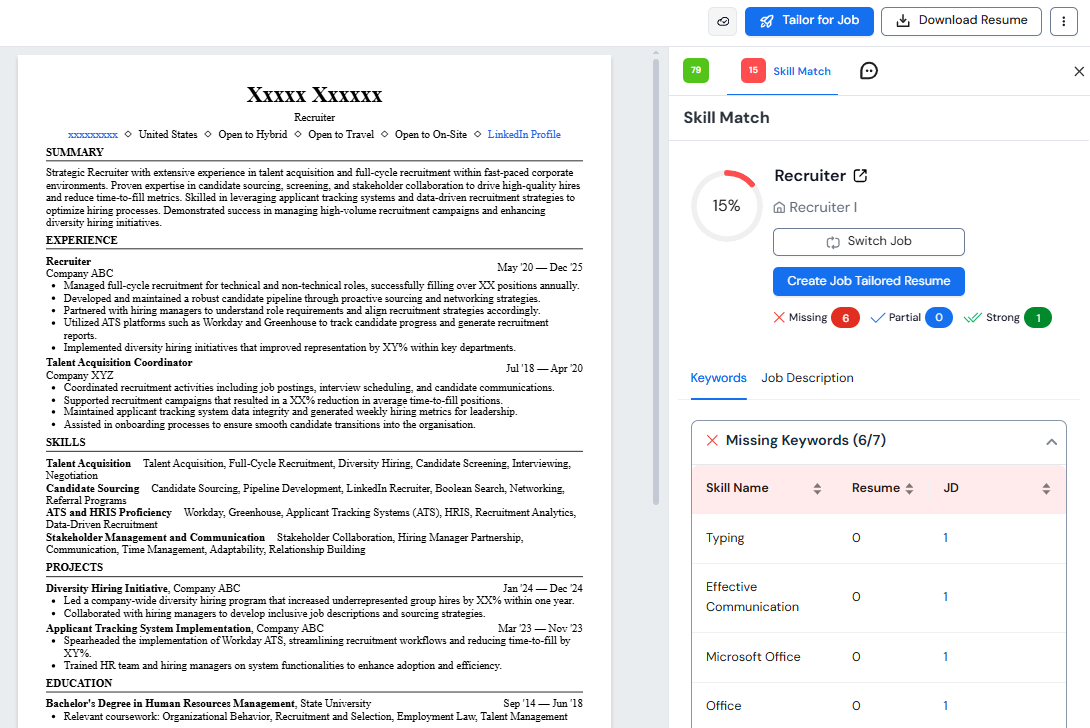
- For each flagged gap, use the before-and-after examples in this guide to draft a new experience bullet that actively demonstrates that capability.
- Paste the new bullet points back into our resume optimizer to confirm they close the gaps it flagged before you submit your application.