To answer "Tell me about yourself," deliver a focused one- to two-minute summary of your professional background. Build your answer around three clear steps: your Present (your current role and core strength), your Past (one or two key achievements) and your Future (why you're excited about this specific job). Keep personal hobbies out unless they directly support your qualifications.
Because this question kicks off almost every interview, nailing it sets a confident tone before you tackle other mock interview questions and answers. In this blog, you'll learn why hiring managers ask this opener, how to build your answer step by step and how to adapt five full sample scripts to your exact career situation.
At a Glance: How to Answer "Tell Me About Yourself" + Examples
The goal.
A short professional story, not your life story.
The formula.
Present, past, future.
The length.
One to two minutes, under 45 seconds on a phone screen.
The link.
Always end with why this role.
Why interviewers ask "Tell me about yourself"
Hiring managers ask this open-ended question to break the ice and see how clearly you communicate under mild pressure. They already have your resume sitting right in front of them. Instead of hearing a chronological list of job titles, they want to see what achievements you choose to prioritize and whether you can summarize your value concisely.
According to guidance from Harvard FAS Career Services, this opening question acts as a pitch that frames the rest of your conversation. A strong response immediately tells the interviewer why your background makes sense for their team.
A weak answer, on the other hand, sounds like someone reading their resume out loud from top to bottom. Starting with your college graduation ten years ago and listing every minor duty wastes valuable time and bores the listener. Worse yet, sharing unrelated personal trivia like your hometown or weekend hobbies signals that you haven't prepared a professional focus.
Expert Insight: "In the first 30 seconds of this answer, I'm listening for clarity and relevance. When a candidate immediately frames their core strength and connects it to the exact problem our team needs solved, I lean in right away." - Nikita Gupta, Former Senior Technical Recruiter at Uber.
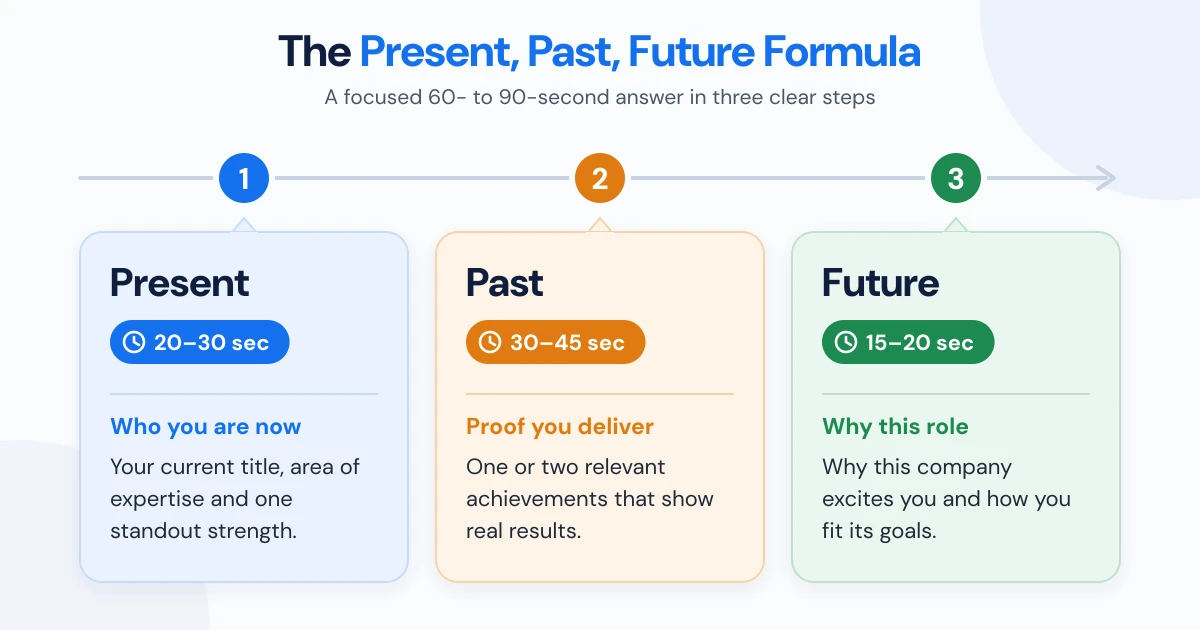
A simple formula: present, past, future
The easiest way to keep your introduction structured and persuasive is the Present, Past, Future formula. Breaking your story into these three distinct phases keeps you from rambling while ensuring you hit every detail a recruiter cares about.
Present (20 to 30 seconds): State your current job title, your primary area of expertise and one standout strength. Choosing strong words to describe yourself here helps anchor your professional identity right away.
Past (30 to 45 seconds): Highlight one or two relevant achievements from your previous roles or projects that prove you can deliver real results.
Future (15 to 20 seconds): Explain why you're excited about this specific company and how your background fits their immediate goals.
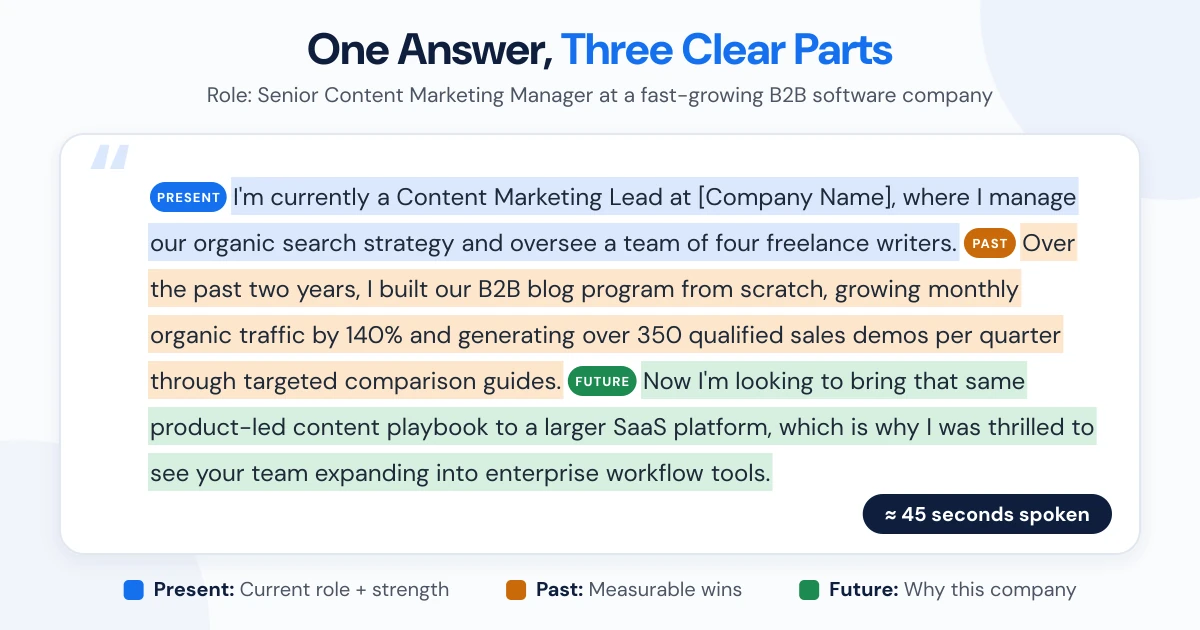
To see how this works in practice, imagine you're applying for a Senior Content Marketing Manager role at a fast-growing B2B software company. The job posting asks for someone who can scale organic traffic, manage freelance writers and drive qualified demo signups. Here is how you build the response step by step:
Step 1 (Present): "I'm currently a Content Marketing Lead at [Company Name], where I manage our organic search strategy and oversee a team of four freelance writers."
Step 2 (Past): "Over the past two years, I built our B2B blog program from scratch, growing monthly organic traffic by 140% and generating over 350 qualified sales demos per quarter through targeted comparison guides."
Step 3 (Future): "Now I'm looking to bring that same product-led content playbook to a larger SaaS platform, which is why I was thrilled to see your team expanding into enterprise workflow tools."
Put together, those three blocks create a smooth, 45-second spoken narrative that answers the job posting directly without a single wasted word.
Sample answers by situation
Every candidate brings a different background to the table. Use the five spoken-style templates below to tailor the Present, Past, Future formula to your exact stage of career.
Student or recent graduate
"I'm a recent Marketing graduate from [University Name] with a strong interest in digital brand strategy and consumer analytics. During my senior year, I completed a six-month marketing internship at a local e-commerce agency where I managed social media campaigns and analyzed weekly engagement metrics. One of my biggest wins was redesigning our email newsletter flow, which boosted subscriber click-through rates by 22% over three months. Alongside my coursework, I also served as vice president of our campus marketing club, organizing workshops for over 150 students. Now that I've graduated, I'm excited to bring my hands-on campaign experience and analytical skills to an entry-level marketing coordinator role where I can help grow your brand's online community."
If you're preparing for your very first job interviews, you can practice more entry-level questions using our guide to mock interview questions for freshers.
Experienced professional
"I'm currently a Senior Operations Manager with over seven years of experience streamlining supply chain workflows and leading cross-functional teams in the logistics sector. In my current role, I oversee daily fulfillment operations across three regional warehouses and manage a team of twenty-five staff members. Over the past two years, I spearheaded an inventory automation project that reduced order picking errors by 38% and saved the company $140,000 in annual shipping costs. Before that, I worked as an operations analyst, where I built vendor performance scorecards from scratch. I'm now looking to take on a director-level challenge at a fast-scaling company, and your recent expansion into direct-to-consumer fulfillment makes this role a fantastic fit for my background."
Career changer
"I'm currently transitioning into UX design after spending five years as a high school teacher and curriculum developer. While teaching gave me deep experience in breaking down complex information and observing how people interact with learning tools, I realized my favorite part of the job was designing intuitive digital resources for my students. Over the past year, I completed an intensive UX design certification and built three end-to-end mobile app prototypes focused on user accessibility. In my capstone project, I conducted usability testing with twenty participants and redesigned a checkout flow that cut task completion time in half. I'm thrilled about this junior UX designer role because it lets me combine my background in human empathy and user research with my passion for building clean digital products."
Returning to work
"I'm a financial analyst with six years of corporate budgeting experience who is returning to the workforce after a two-year planned career break to care for my family. Prior to my break, I worked as a Senior Financial Analyst at a mid-sized healthcare firm where I managed quarterly forecasting for a $15 million operating budget. One of my proudest achievements was automating our monthly variance reports, which cut close times by three full days each month. During my time away, I stayed sharp by completing an advanced financial modeling certification and volunteering as the treasurer for a local nonprofit organization. I'm energized to step back into a full-time analytical role and bring both my seasoned forecasting experience and fresh modeling skills to your finance team."
Internal candidate
"As many of you know, I've spent the past two and a half years as a Customer Success Specialist here on the enterprise accounts team, managing a portfolio of forty client accounts. During that time, I've maintained a 96% client retention rate and helped drive $220,000 in expansion revenue by identifying upsell opportunities during quarterly business reviews. Over the last six months, I've also taken the lead on mentoring three newly hired specialists and building our internal onboarding playbook. Stepping into this Team Lead position feels like a natural next step because I already know our product and customers inside out, and I'm excited to help scale our team's retention metrics at a leadership level."
How to adapt your answer for a phone screen or video interview
First-round phone screens and video calls move much faster than final panel interviews. Recruiters often speak with ten or fifteen candidates in a single afternoon, so they don't have time for a two-minute backstory.
For an initial phone screen, trim your response down to 30 to 45 seconds. Keep your Present and Future sentences intact, but cut your Past section down to a single headline achievement. Drop secondary projects, college clubs or older roles from five years ago so the recruiter hears your strongest qualification immediately.
Example:
"I'm currently a Product Marketing Manager with four years of experience launching B2B software features. In my current role, I led our last three major product releases, which drove a 30% lift in user adoption and generated $400,000 in pipeline revenue. I'm excited about this role because your company is expanding into mid-market SaaS, which matches my exact launch background."
When you're answering on a video call, delivery matters just as much as your script. Use these quick adjustments to sound natural rather than stiff:
Look at the camera lens: Staring at your own video preview makes your eyes drift downward. Look directly into your webcam while delivering your opening and closing sentences to build instant rapport.
Use bullet points, not full scripts: Reading word-for-word off your screen makes your eyes dart back and forth and flattens your vocal tone. Tape three short trigger words near your webcam instead.
Pause and smile before speaking: Take one calm breath after the interviewer finishes asking the question. Starting with a relaxed smile warms up your voice and keeps you from rushing through your first sentence.
Mistakes to avoid
Even strong candidates lose momentum in the first two minutes if they fall into common traps. Keeping your introduction focused and relevant to the position is essential for making a strong first impression.
Watch out for these five frequent mistakes when preparing your introduction:
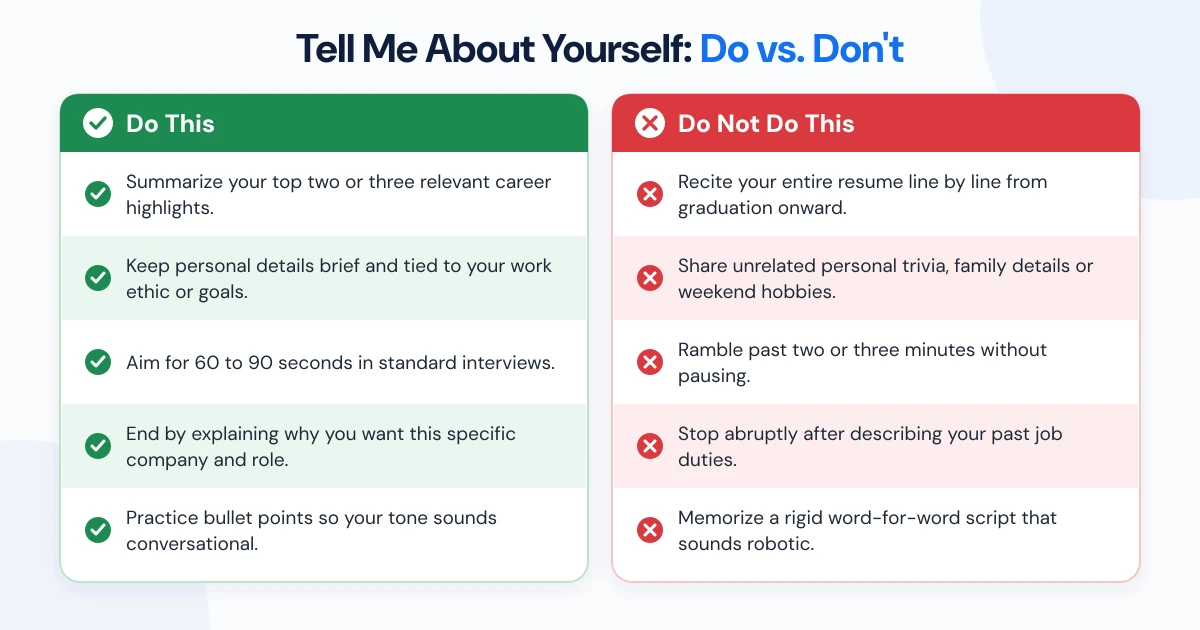
Reciting your resume: Your interviewer already read your work history. Use this time to connect the dots between your best achievements rather than repeating job descriptions.
Sharing your life story: You don't need to start with where you grew up or why you picked your college major ten years ago. Start with your current professional identity instead.
Talking too long: Going past two minutes tests the interviewer's patience right at the start of the conversation. Edit your draft ruthlessly until every sentence earns its place.
Forgetting the future link: Finishing your story in the past leaves the interviewer wondering why you applied. Always close by connecting your skills to their open role.
Sounding over-rehearsed: Memorizing every syllable makes you sound stiff and panicked if you forget a word. Practice the main ideas out loud until the flow feels natural.
How to do this with Careerflow
Because "Tell me about yourself" opens almost every interview, practicing it out loud is one of the highest-leverage things you can do before interview day. Rehearsing your delivery helps you catch filler words, tighten your pacing and build real confidence before you ever step into the room.
Practice out loud: Use our mock interview tool to rehearse your opening pitch and get instant feedback on clarity, pacing and relevance.
Create a networking version: Turn the exact same Present, Past, Future story into a punchy 20-second introduction for LinkedIn messages and career fairs with our elevator pitch writer.
Puneet left a senior engineering role at Apple to co-found Careerflow, an AI-powered job search platform backed by Techstars and used by over 1 million job seekers worldwide. He brings more than a decade of hands-on experience in AI and machine learning, built across Apple, Amazon, and Leia Inc. As CEO, he leads the product and engineering behind the tools he wished existed during his own career transitions. You can connect with him on LinkedIn
FAQ: How to Answer "Tell Me About Yourself" + Examples
How long should my answer to "Tell me about yourself" be?
Your answer should last between 60 and 90 seconds during a standard interview, and never exceed two minutes. For a brief initial phone screen with a recruiter, trim your response down to 30 to 45 seconds. Keeping your pitch concise shows strong communication skills and leaves plenty of time for deeper questions.
Should I talk about my personal life?
No, you should keep your answer focused on your professional background, skills and career goals. While some career advice suggests sharing a hobby to seem memorable, personal trivia often distracts from your qualifications. Only mention a personal detail if it directly connects to the company's mission or demonstrates relevant industry passion.
How do I answer "Tell me about yourself" as a fresher?
As a fresher or recent graduate, use the same Present, Past, Future formula by focusing on your education, internships and campus projects. Start with your degree and core skills, highlight a hands-on internship or academic achievement and finish by explaining why you're excited to launch your career with their team.
Is "Tell me about yourself" the same as an elevator pitch?
They share a similar structure, but an interview answer is slightly longer and tailored to one specific job opening. An elevator pitch lasts about 30 seconds and introduces your general value at networking events. You can review elevator pitch examples to see how to adapt your story for both settings.
What should I avoid saying?
Avoid reciting your entire resume chronologically, sharing unrelated personal history, complaining about former employers or rambling past two minutes. You should also avoid vague clichés like "I'm a hard worker" without backing them up. Instead, share specific, measurable achievements from your recent work that prove your value right away.
Recommended Articles
Here are some of the recommended articles from our team