


Resumes
.avif)
.webp)
Select precise, credible words to describe yourself in a resume summary, bio or interview answer. The descriptors you choose shape a recruiter's first impression before they read your achievements. Generic words without real evidence get filtered out in seconds.
Finding positive adjectives is easy, but choosing terms that sound authentic requires proof. Every word on your resume needs a real career example to back it up. Unsubstantiated buzzwords damage your credibility and weaken your application.
This guide provides 100+ professional words categorized by skills, leadership and business impact. You'll also learn a simple evaluation test alongside before-and-after examples that land interviews.
The specificity filter: how to tell if a word belongs on your resume
Apply the specificity filter by asking if you can name a real work example that proves the word. Keep the word on your resume if you answer with a clear yes. Replace it immediately if you don't have proof.
Common words like "hardworking," "passionate," "detail-oriented," and "results-driven" don't mean much to hiring managers. Applicants use them because they feel safe, not because they work. Precise words backed by real facts stand out and make your application far more memorable.
100+ words to describe yourself: organized by what they signal
Achievement-focused words
Use these words in your summary to highlight clear work results and business impact. They'll show hiring managers you care about real outcomes.
- Impact words: Accomplished, high-impact, proven, top-performing, award-winning
- Number-focused words: Data-driven, metric-focused, performance-driven, outcome-focused, measurable
- Growth words: Revenue-generating, efficiency-focused, scalable, systematic, growth-oriented
💡 Read our step-by-step guide on Tips to Write Impactful Resume Summaries (With Examples)
Leadership and influence words
Use these terms when applying for roles that manage teams or guide company goals.
- Strategy words: Strategic, visionary, decisive, direction-setting, change-driving
- Team words: Empowering, mentoring, team-building, people-focused, collaborative
- Ownership words: Accountable, influential, cross-functional, stakeholder-aligned, initiative-taking
Creative and innovative words
Use these words for design, marketing or product roles where fresh ideas matter most.
- Idea words: Inventive, imaginative, original, conceptual, forward-thinking
- Problem-solving words: Unconventional, solutions-oriented, experimental, iterative
- Design words: Prototype-minded, design-driven, brand-conscious
Analytical and technical words
Pick these simple words for engineering, data, finance or operations jobs. They show hiring managers your logical thinking.
- Logic words: Analytical, methodical, systematic, logic-first, hypothesis-driven
- Data words: Evidence-based, quantitative, precision-focused, detail-oriented
- Research words: Research-driven, investigative, pattern-recognition
Interpersonal and communication words
Use these words for roles with heavy client, customer or team interaction.
- Relationship words: Collaborative, empathetic, relationship-building, approachable, client-focused
- Communication words: Communicative, persuasive, diplomatic, transparent, clear
- Listener words: Listener, culturally aware
Adaptability and resilience words
Choose these words if your job involves fast changes, tight deadlines or high pressure.
- Flexibility words: Adaptable, agile, flexible, pivot-ready
- Calmness words: Resilient, composed, calm under pressure
- Action words: Resourceful, solution-oriented, self-sufficient
Work ethic and reliability words
Use these terms to highlight consistency, trust and strong follow-through in your work.
- Trust words: Reliable, consistent, accountable, disciplined
- Quality words: Thorough, precise, meticulous, diligent, committed
- Execution words: Follow-through, deadline-driven

Words for the "describe yourself in three words" question
Interviewers ask this question to check your self-awareness and see if you fit the job. They want words that match the role and short examples that prove your claims.
39 simple words to pick from
Pick three words from this list that best describe your daily work style:
Ambitious, analytical, attentive, calculated, creative, data-driven, dedicated, devoted, diligent, disciplined, driven, dynamic, empathetic, energetic, engaged, experienced, focused, honest, insightful, knowledgeable, methodical, meticulous, motivated, organized, passionate, patient, people-oriented, persistent, persuasive, proactive, professional, reliable, resourceful, results-oriented, self-starter, skillful, structured, thorough, versatile
How to answer "What are three words to describe yourself?": sample structure
Just listing three words isn't enough to convince a hiring manager. Follow this simple formula for each word you pick: [Word] + [one sentence of proof].
Weak vs. strong answer example
Weak answer: "I'm reliable, analytical and adaptable."
Strong answer: "First, I'm reliable. I managed three client accounts and turned in every quarterly report on time for two years straight. Second, I'm analytical. I found a billing mistake that was missed for six months, recovering $40,000 in unbilled income. Third, I'm adaptable. When our project roadmap changed mid-year, I rebuilt our entire content plan in three weeks without missing a single deadline."
Good adjectives to describe yourself on a resume summary
Resume summaries aren't personal essays. They act as your quick pitch to catch a recruiter's eye in ten seconds. Pair your words with real numbers, job titles or clear skills to make an impact.
Pick from these simple, effective words for your summary:
Accomplished, ambitious, analytical, attentive, caring, conscientious, cooperative, creative, data-driven, decisive, dedicated, detail-oriented, diligent, driven, empathetic, enthusiastic, experienced, flexible, focused, forward-thinking, hardworking, imaginative, innovative, knowledgeable, logical, methodical, meticulous, motivated, organized, passionate, patient, proactive, reliable, resourceful, results-oriented, self-motivated, skilled, strategic, systematic, thorough, versatile
Before and after: using descriptors with evidence
- Weak opening: "Passionate and results-driven marketing professional with strong communication skills."
- Strong opening: "Marketing manager with 6 years of experience building B2B content. Grew sales pipeline by $1.2M through search articles and product guides."
The strong version doesn't need to say "results-driven." The $1.2M outcome proves your success on its own. Empty words add no value when real facts are missing.
Golden rule: Use descriptive words to highlight real evidence, never as a replacement for facts.
.webp)
Words to avoid (and why)
These descriptive words appear on too many resumes. Recruiters skip right over them because they don't provide real value.
- Hardworking: Everyone claims this word. No job seeker writes that they're lazy on a resume.
- Team player: This phrase means nothing without context. Show what you accomplished with your team instead.
- Passionate: This word is overused everywhere. Show your true focus through your real work history instead.
- Detail-oriented: Saying this without proof feels like filler space. Let your clean formatting prove it.
- Motivated: Basic motivation is expected for every job. It doesn't set you apart from other applicants.
- Dynamic: This term sounds vague and self-praising. State your specific skills and tools instead.
- Results-driven: Almost every resume uses this exact phrase. Share your actual numbers and outcomes instead.
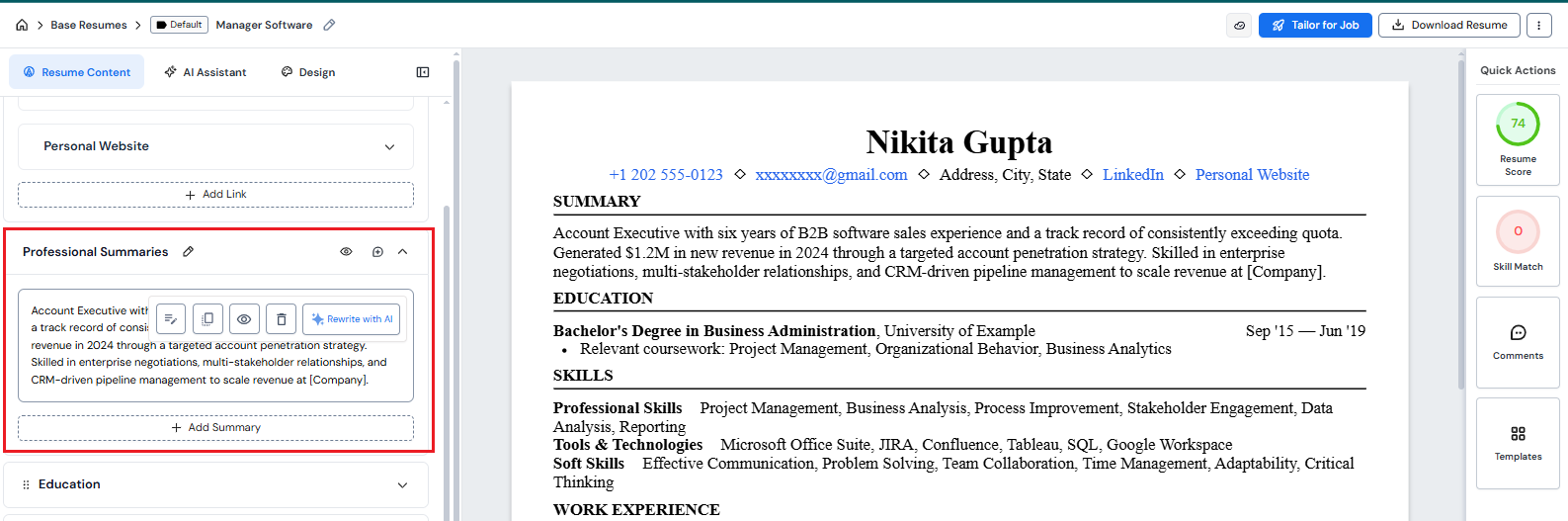
How to write your resume summary using these words with our AI resume builder
Use smart tools to build a strong summary with simple language and clear results.
- Open our AI resume builder and navigate to the summary section.
- Use the summary writer to mix simple descriptive words with real achievements.
- Check your draft using the specificity filter. Make sure you can back every word with real career proof. If not, revise the word choice or add a supporting bullet.


.webp)
