The STAR method interview technique is a structured way to answer behavioral interview questions with a short, compelling story. It breaks your response into four clear parts: the Situation, the Task you had, the Action you took and the Result. Using this framework keeps you from rambling while proving you can handle real workplace challenges.
In this blog, you'll learn how to build each part of a STAR method interview response and balance your speaking time. You'll also learn how to build a five-story bank that covers most behavioral questions, review six full example answers and spot common mistakes before your interview.
At a Glance: STAR Method Interview Guide
S and T.
Set the scene in two sentences.
A.
Spend most of the answer on what you did.
R.
End with a result, ideally a number.
The bank.
Five stories cover most behavioral questions.
What is the STAR method interview technique?
The STAR method interview framework is built specifically for behavioral questions. Recruiters use these questions to predict your future performance based on how you handled past situations. You can easily spot behavioral questions because they usually start with phrases like "Tell me about a time" or "Give me an example of when."
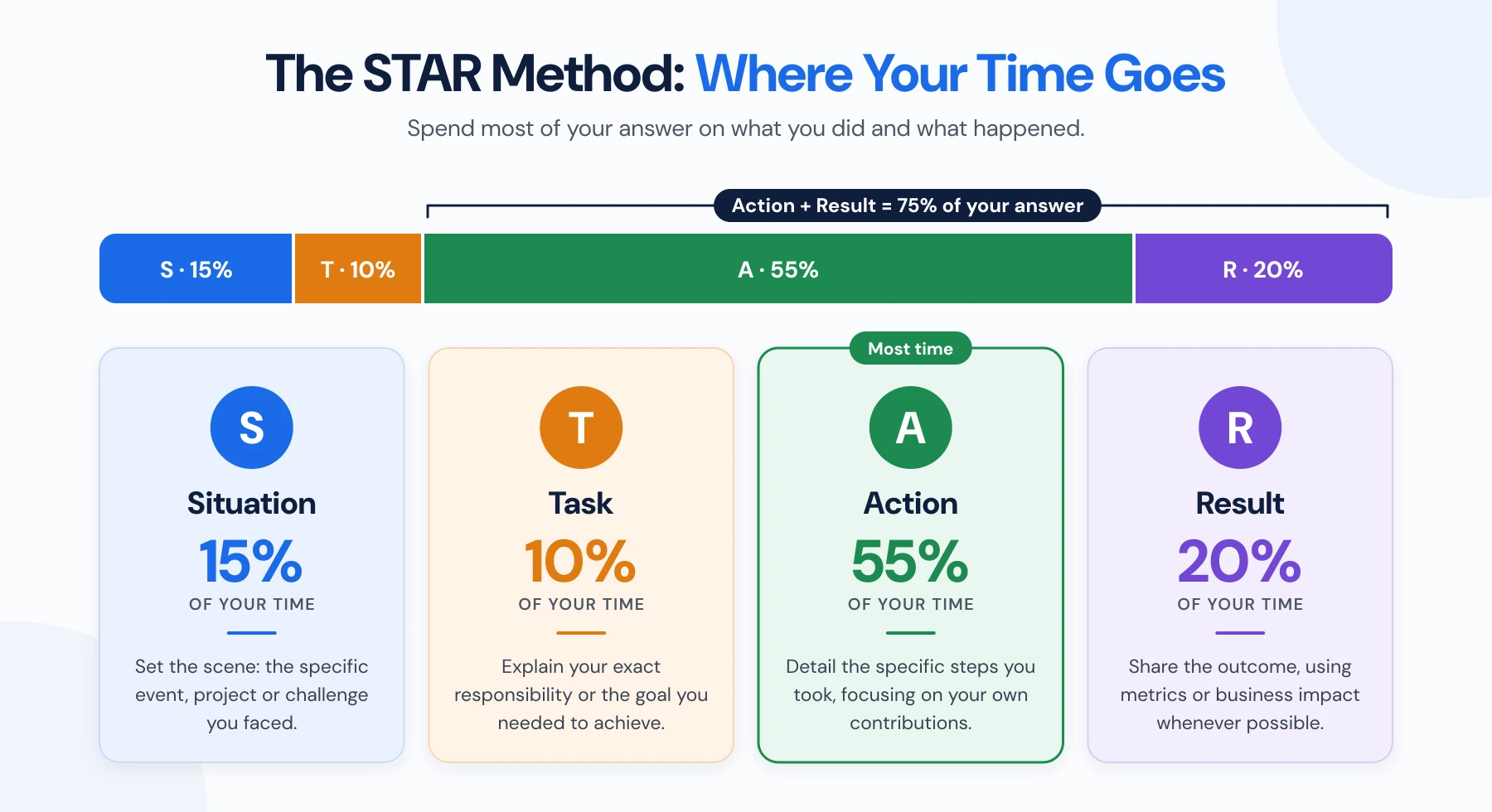
Situation (15% of your time): Set the scene by describing the specific event, project or workplace challenge you faced.
Task (10% of your time): Explain your exact responsibility or the specific goal you needed to achieve in that scenario.
Action (55% of your time): Detail the specific steps you took to address the problem, focusing strictly on your individual contributions.
Result (20% of your time): Share the positive outcome of your actions, using quantifiable metrics or concrete business impact whenever possible.
Notice how heavily this breakdown favors the Action and Result phases. Hiring managers don't need five minutes of background history about your former company's software stack. They want to spend seventy-five percent of the conversation hearing what you actually did and what happened because of your work.
Some career advisors also recommend adding a final "Learning" step at the end, often called the STARL method. While you don't need this for every answer, adding a quick takeaway works well when you're answering questions about a past mistake or project failure.
How to answer STAR method interview questions
Building a strong STAR method interview answer takes preparation before you ever step into the interview room. Rather than memorizing word-for-word scripts, follow these four steps to shape your experience into a tight, persuasive story.
Match your story to the job description: Scan the job posting for top required skills like cross-functional leadership, conflict resolution or analytical problem solving. Pick an example from your background that proves you own that exact skill.
Draft the four blocks: Write out two sentences for your "Situation" and "Task," four sentences for your "Action" and two sentences for your "Result." Focus heavily on using "I" statements instead of "we" so the interviewer knows what you personally accomplished.
Cut your time to two minutes: Read your draft out loud with a timer. Trim away unnecessary backstory, technical jargon and side tangents until your spoken answer lands comfortably between 90 and 120 seconds.
Add a measurable metric: Review your ending to ensure you included a hard number, percentage or clear business outcome. Numbers make your claims immediately believable.
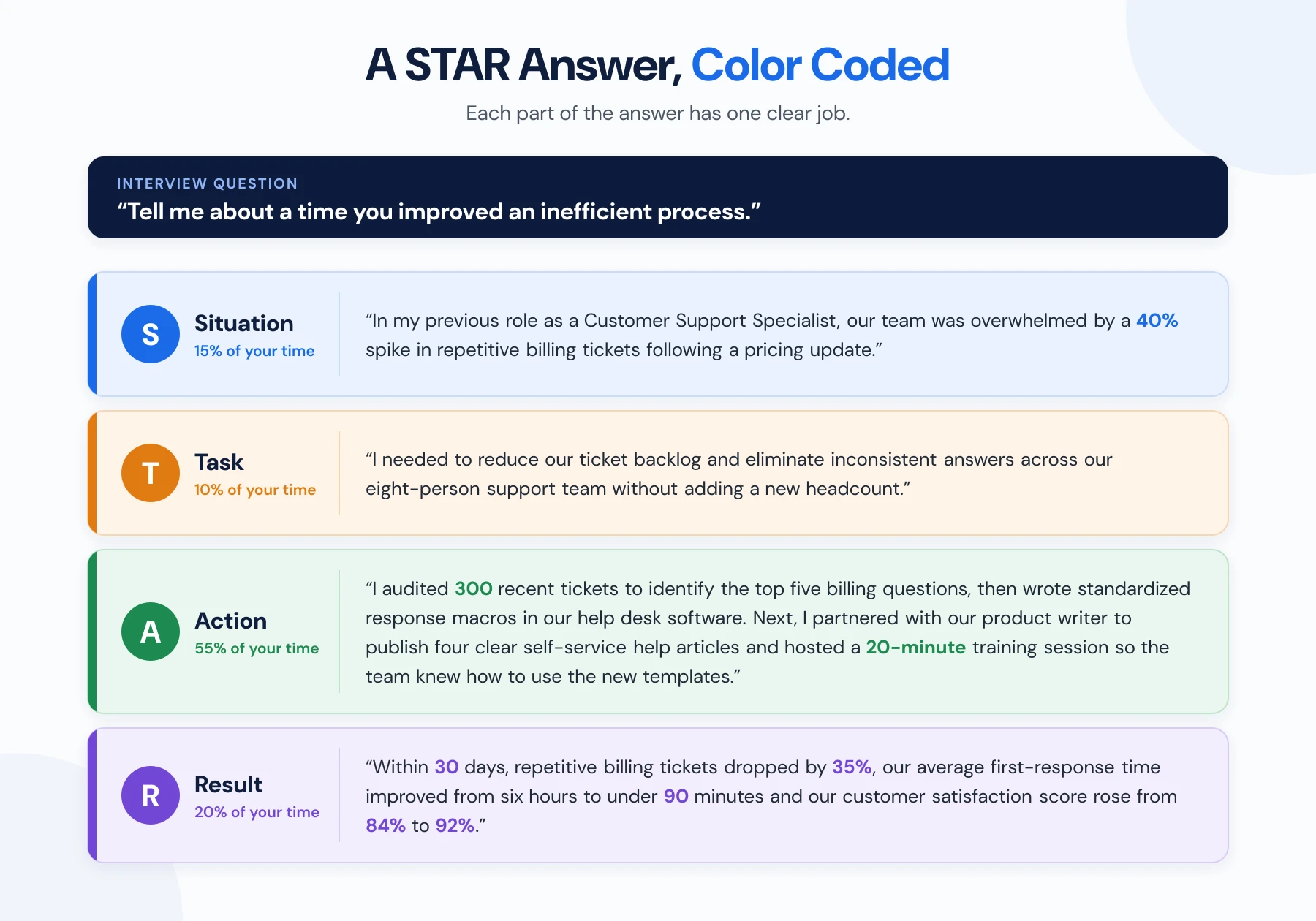
To see how much structure improves an answer, compare a rambling response against a refined STAR version for the question: "Tell me about a time you improved an inefficient process."
Before: The Rambling Answer
"At my last job in customer support, our ticket system was a total mess. Everyone was always stressed because customers kept emailing about the same billing issues over and over, and our team lead didn't really have time to fix the help center. So we all kind of started writing our own saved replies, which got confusing because people were sending different answers. Eventually, I decided to organize everything into a shared document and update some of our help articles. It took a few weeks of coordinating with the product team, and after that, things ran a lot smoother and customers seemed much happier."
After: The STAR Answer
[Situation]: "In my previous role as a Customer Support Specialist, our team was overwhelmed by a 40% spike in repetitive billing tickets following a pricing update."
[Task]: "I needed to reduce our ticket backlog and eliminate inconsistent answers across our eight-person support team without adding a new headcount."
[Action]: "I audited 300 recent tickets to identify the top five billing questions, then wrote standardized response macros in our help desk software. Next, I partnered with our product writer to publish four clear self-service help articles and hosted a 20-minute training session so the team knew how to use the new templates."
[Result]: "Within 30 days, repetitive billing tickets dropped by 35%, our average first-response time improved from six hours to under 90 minutes and our customer satisfaction score rose from 84% to 92%."
Build a story bank that covers most questions
You don't need to memorize thirty different stories to prepare for an interview. Instead, build a versatile story bank of just five core experiences from your career, internships or major academic projects. Because behavioral questions all test the same underlying competencies, these five pillars can easily adapt to cover almost any question an interviewer throws at you.
According to guidance from LinkedIn Talent Solutions, interviewers rely on behavioral questions to uncover soft skills like adaptability, collaboration and problem solving that don't always show up on a resume. Preparing one flexible story for each of the five categories below ensures you're never caught off guard:
A major win or proudest achievement: Highlight a project where you exceeded goals, solved a complex problem or delivered measurable business value.
A mistake or project failure: Pick a real setback where you took ownership, fixed the issue quickly and applied a clear lesson afterward.
A workplace conflict or disagreement: Choose a moment where you disagreed with a coworker, manager or client and reached a productive compromise.
Leading without formal authority: Identify a time you rallied teammates, guided a cross-functional initiative or mentored a peer without holding a manager title.
Handling extreme pressure or tight deadlines: Select an urgent crisis, shifting priority or last-minute deadline where you stayed calm and delivered quality work on time.
Story
Key Skills It Demonstrates
Behavioral Questions It Answers
1. A Major Success
Initiative, execution, analytical thinking
"Tell me about your proudest accomplishment."
"Describe a time you went above and beyond."
2. A Failure or Mistake
Accountability, resilience, fast learning
"Tell me about a time you failed."
"Describe a mistake you made and how you handled it."
3. A Workplace Conflict
Empathy, communication, negotiation
"Tell me about a conflict with a coworker."
"Describe a time you disagreed with your manager."
4. Leading Without Authority
Influence, collaboration, project ownership
"Tell me about a time you led a team."
"Describe how you convinced others to adopt an idea."
5. Handling Tight Deadlines
Prioritization, composure, time management
"Tell me about a time you worked under pressure."
"Describe how you handled competing priorities."
Once you map out your five stories, keep them handy for your entire job search. You can even condense these exact examples into high-impact achievements for your application documents by following our guide on how to use the STAR method on a resume.
STAR method interview examples for common questions
Reviewing complete answers helps you see how each part of the framework fits together in real conversations. Notice how every example below keeps the Situation and Task brief while spending the bulk of the response on specific Actions and measurable Results.
Tell me about a time you solved a difficult problem
Situation: At my previous SaaS company, our monthly churn rate jumped from 3% to 5.5% right after we launched a redesigned analytics dashboard. Customer support tickets showed users couldn't find their weekly export reports.
Task: As the Product Marketing Manager, I needed to identify where users were getting stuck and reduce churn back below 3.5% within one quarter.
Action: I partnered with our data analyst to review session recordings for 100 churned accounts. We discovered that 70% of users abandoned the new export menu after two failed clicks. I designed a three-step interactive walkthrough tooltip for the new dashboard, rewrote the onboarding email sequence with short GIF tutorials and hosted two live Q&A webinars for our top enterprise accounts.
Result: Within six weeks, feature adoption for the new export tool rose by 48%. Monthly churn dropped back down to 3.1%, saving an estimated $85,000 in annualized recurring revenue.
Tell me about a conflict with a coworker
Situation: During a major website redesign, our lead UX designer and I disagreed on the placement of our primary lead capture form. He wanted a minimalist layout with the form hidden behind a button, while I wanted it visible above the fold.
Task: As the Content Strategist, my goal was to protect our conversion rates without damaging my working relationship with the design team.
Action: Instead of arguing over personal preferences, I scheduled a 20-minute meeting to review our historical heatmap data together. I acknowledged his concern about visual clutter and proposed running a two-week A/B split test on our highest-traffic landing page so real user behavior would decide the winner. We agreed on clear success metrics before launching the test.
Result: The visible form generated 27% more qualified leads with zero negative impact on bounce rates. The designer appreciated the data-driven approach, and we adopted split testing as our standard workflow for future page launches.
Tell me about a mistake you made
Situation: Early in my role as an Operations Coordinator, I accidentally sent an outdated inventory spreadsheet to our primary shipping vendor ahead of a holiday weekend sale.
Task: I needed to correct the shipment order immediately so our warehouse wouldn't run out of our top-selling items during peak traffic.
Action: As soon as I spotted the error two hours later, I called our vendor representative directly instead of waiting for an email reply. I explained my mistake clearly, sent the verified inventory file and negotiated an expedited courier pickup for the missing pallets. Next, I informed my manager about the issue alongside the confirmed delivery fix. Finally, I created a mandatory pre-shipment checklist with automated version dates so nobody on the team could send an unverified file again.
Result: The corrected shipment arrived four hours before the sale launched, resulting in zero stockouts. Our team used my new verification checklist for the next 18 months without a single repeat error.
Tell me about a time you led a project
Situation: Our regional sales team relied on an outdated manual spreadsheet to track client renewals, which caused missed follow-ups and messy handoffs between account executives.
Task: Even though I wasn't a formal team manager, I volunteered to lead the migration of 400 active client accounts into our new CRM platform within four weeks.
Action: I broke the migration into four weekly milestones and assigned clear data-cleaning tasks to five fellow account coordinators. To keep everyone aligned, I built a shared progress tracker and ran 15-minute Monday check-ins to resolve formatting blockers. I also recorded three short screen-share tutorials showing reps how to set automated renewal reminders inside the new system.
Result: We migrated all 400 accounts three days ahead of schedule with 99% data accuracy. Over the next two quarters, on-time contract renewals increased by 18%, and leadership rolled out my onboarding videos to two other regional offices.
Tell me about a time you handled a tight deadline
Situation: Three days before our annual industry conference, our keynote speaker canceled due to a sudden medical emergency, leaving a 45-minute gap in our main stage schedule.
Task: As the Events Marketing Lead, I had 72 hours to secure a credible replacement topic, build a new slide deck and prepare an internal executive to present.
Action: I immediately pitched our VP of Product on hosting a live teardown of our upcoming product roadmap, which required zero outside travel. Once she agreed, I gathered customer survey data to shape the talking points, drafted a 20-slide presentation overnight and scheduled two 30-minute rehearsal sessions to refine her timing. I also updated our event app and signage the day before doors opened.
Result: The session drew over 350 attendees, making it the second highest-attended talk of the entire conference. Post-event surveys rated the presentation 4.8 out of 5 stars, and our sales team booked 22 product demos directly from the audience.
Tell me about a time you went above expectations
Situation: While working as a Junior Financial Analyst, I noticed our department spent nearly 12 hours every month manually copying expense data from PDF invoices into our accounting software.
Task: My regular job only required auditing the final numbers, but I wanted to eliminate the repetitive data entry slowing down our month-end close.
Action: On my own initiative, I spent two lunch breaks learning how to build an automated OCR parsing workflow using tools our company already owned. I tested the automation on three months of historical invoices to verify accuracy, documented the setup steps in a clear one-page guide and demonstrated the working prototype to my director during our Friday team meeting.
Result: The new workflow cut monthly invoice processing time from 12 hours down to 45 minutes and reduced manual typing errors by 95%. My director adopted the tool across the entire finance team and recognized my initiative during my annual performance review.
Common STAR mistakes
Even when you know the framework, small habits can weaken your story during a live interview. Watch out for these five common pitfalls when preparing your responses:
Spending too much time on the situation: Giving five minutes of background history leaves no time for what you actually did. Keep your setup to two crisp sentences and move straight into your actions.
Saying "we" instead of "I": Hiring managers want to hire you, not your former department. Always clarify your personal role in team projects so your individual contributions stand out.
Skipping a measurable result: Ending a story with "everything worked out well" feels flat. Always share a concrete metric, time saved, revenue gained or positive feedback received.
Telling a story that misses the question: Picking your favorite accomplishment won't help if it doesn't answer the specific skill the interviewer asked about. Listen carefully to the question before choosing a story from your bank.
Going over three minutes: Rambling signals poor communication skills. Practice with a timer so your complete story lands comfortably around two minutes.
If you want to test your answers before the real conversation, you can practice refining your story structure using our guide on ChatGPT for behavioral interview prep.
How to do this with Careerflow
STAR method interview answers get noticeably sharper when you practice saying them out loud rather than just reading notes off a screen. Building a consistent workflow between your interview prep and your application documents ensures your personal story stays cohesive at every stage.
Rehearse out loud: Use our mock interview tool to practice role-specific behavioral questions and get instant feedback on clarity and relevance.
Upgrade your resume: Turn those exact same STAR stories into high-impact resume achievements with our resume bullet point writer.
Puneet Kohli
Co-founder
Puneet left a senior engineering role at Apple to co-found Careerflow, an AI-powered job search platform backed by Techstars and used by over 1 million job seekers worldwide. He brings more than a decade of hands-on experience in AI and machine learning, built across Apple, Amazon, and Leia Inc. As CEO, he leads the product and engineering behind the tools he wished existed during his own career transitions. You can connect with him on LinkedIn
FAQ: STAR Method Interview Guide
What does STAR stand for in an interview?
STAR stands for Situation, Task, Action and Result. It is a structured framework used to answer behavioral interview questions with a clear, chronological story. You briefly describe the context and your specific goal, explain the exact steps you took to solve the challenge and finish with the measurable outcome of your work.
How long should a STAR answer be?
A strong STAR method interview answer should last between 90 seconds and two minutes. This timeframe gives you enough room to provide context, explain your individual actions thoroughly and share a concrete result without losing the interviewer's attention. Anything longer than three minutes usually means you're spending too much time on background details.
Can I use the STAR method for questions that are not behavioral?
Yes, you can adapt the STAR method for situational or hypothetical questions that start with "What would you do if." Instead of sharing a past event, briefly frame how you would assess the Situation and Task, then walk the interviewer through the exact Actions you would take and the Result you'd expect.
What if I do not have work experience for a STAR answer?
If you lack formal work experience, pull your STAR stories from college group projects, internships, volunteer work, campus clubs or part-time jobs. Hiring managers care more about how you approach problems, collaborate with teammates and take accountability than whether your examples happened in a traditional corporate office setting.
How many STAR stories should I prepare?
You should prepare a core story bank of five versatile examples before your interview. Choose one story each for a major success, a past mistake, a workplace conflict, leading without formal authority and handling a tight deadline. These five themes can easily adapt to answer almost any behavioral question you encounter.
Recommended Articles
Here are some of the recommended articles from our team