A career change cover letter has to do one critical job your resume can't: explain why you're switching fields and why your background makes you ready right now. To write one, lead with the clear reason for your move, bridge your past experience using transferable skills, prove your impact with one concrete result and close with proof of your commitment to the new industry.
In this blog, you'll learn why a standard cover letter falls short during a career change, how to write yours in four clear steps and how to translate your old job language into new industry terms. You'll also get three complete, ready-to-adapt cover letter examples for common career switches.
At a Glance: Career Change Cover Letter
Name the move.
Say what you are changing to and why in the opening.
Bridge.
Two or three transferable skills that match the posting.
Prove.
One result from your old career.
Commit.
What you have done to prepare.
What makes a career change cover letter different
When you apply for a job in a new field, the hiring manager immediately notices the gap between your past job titles and their open role. If you leave that gap unexplained, recruiters often assume you applied by mistake or don't understand what the job actually requires.
A standard cover letter fails for career changers because it relies on standard job progression. When you already have five years of direct industry experience, you can simply list past titles and metrics. When you're changing careers, your cover letter must act as a translator that connects dots the recruiter won't see on a general resume.
Some career advice suggests hiding your career switch and hoping your skills speak for themselves. In practice, naming the transition upfront almost always reads as more confident and intentional. According to guidance from the Georgia Southern Office of Career and Professional Development, addressing a career transition directly allows you to control the narrative and highlight the relevant competencies you bring from past work.
How to write a career change cover letter in 4 steps
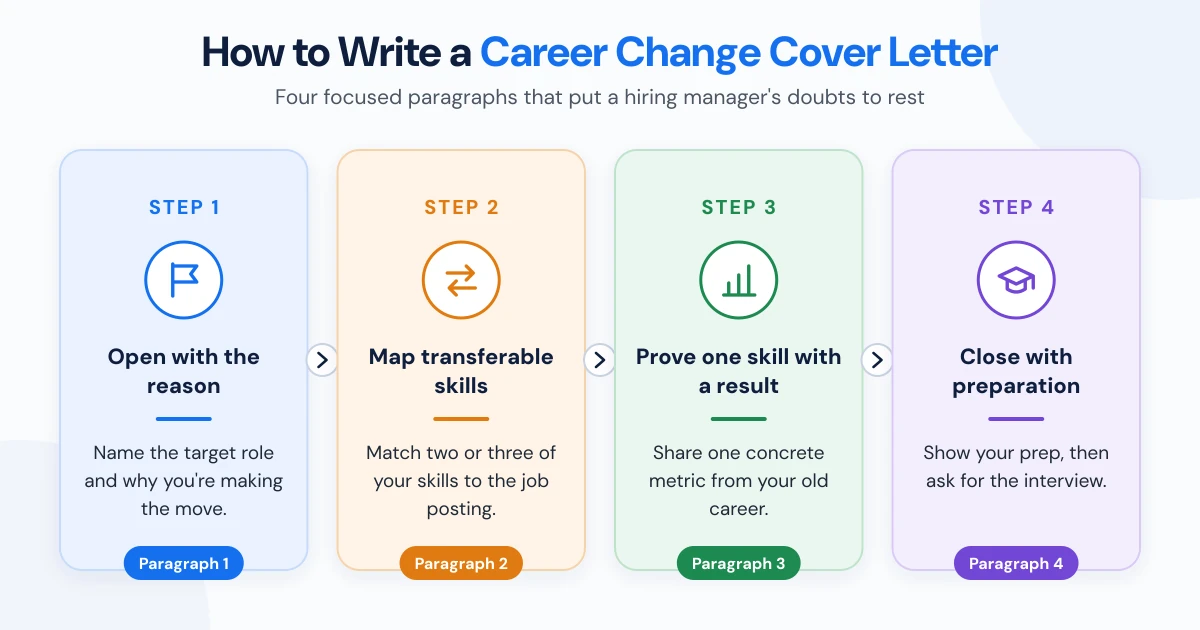
You don't need to write an essay defending your past choices. Follow these four focused steps to build a persuasive one-page letter that puts a hiring manager's doubts to rest.
Step 1: Open with the reason and the target role
Start your first paragraph by naming the exact role you're applying for and explaining why you're making the move. Keep your motivation positive and focused on what draws you to the new field rather than complaining about your old industry. Mention a specific company project, product or mission that sparked your interest.
Step 2: Map two or three transferable skills to the posting
Scan the job description for the top two or three core skills the employer values most, such as client onboarding, project management or stakeholder communication. Dedicate your second paragraph to showing how you already use those exact abilities every day in your current line of work.
Step 3: Prove one skill with a result from the old career
Hiring managers trust hard numbers more than enthusiastic promises. Pick one standout accomplishment from your previous career and share a specific metric that proves you deliver results under pressure. Even if the industry was different, saving money, streamlining workflows or boosting satisfaction scores translates everywhere.
Step 4: Close with preparation and a clear next step
Show the employer that your career change isn't a sudden whim. Mention any certifications, bootcamps, volunteer projects or freelance work you've completed to prepare for this switch. Wrap up with a confident call to action, following best practices on how to end a cover letter so the hiring manager knows you're ready to discuss your fit in an interview.
Career change cover letter examples
Seeing how the four steps work in a real letter makes writing your own much easier. Use the three complete examples below, each kept crisp and under 350 words as templates for common career transitions.
1. Teacher to Corporate Training or Instructional Design
Dear [Hiring Manager Name],
I'm excited to apply for the Instructional Designer role at [Company Name]. After six years as a high school curriculum lead and classroom educator, I'm transitioning into corporate learning and development to build scalable training programs for adult learners. Your recent launch of a global employee onboarding academy caught my attention, and I'd love to help your team design engaging digital modules.
While the setting differs, teaching and corporate instructional design rely on the same core skills: curriculum architecture, needs analysis and learner engagement. Every week, I break down complex technical concepts into accessible, step-by-step lessons tailored to diverse learning styles. I also regularly evaluate assessment data to pinpoint knowledge gaps and adjust training materials on the fly.
In my current role, I redesigned our department's digital learning portal and built 25 interactive video modules that boosted student assessment scores by 19% across 400 learners. Beyond the classroom, I led quarterly technology training workshops for 45 fellow teachers, cutting support requests for our new learning management system in half.
To prepare for this transition into corporate training, I completed the ATD Instructional Design Certificate and built two sample e-learning courses in Articulate Storyline. I'm confident my background in adult facilitation and digital curriculum design will help your team onboard new hires faster. Thank you for your time and consideration, and I look forward to discussing how I can contribute to [Company Name].
Sincerely,
[Your Name]
2. Retail or Hospitality to Customer Success
Dear [Hiring Manager Name],
I'm writing to express my interest in the Customer Success Manager position at [Company Name]. After spending five years leading front-of-house operations in high-volume hospitality, I'm pivoting into SaaS customer success because I love building long-term client relationships and solving real user problems. Your platform's focus on helping small businesses streamline their daily workflows aligns directly with my passion for service excellence.
Hospitality management is essentially fast-paced account management. Every shift requires active listening, proactive problem solving and de-escalating urgent issues before they impact satisfaction. Instead of waiting for complaints, I train teams to anticipate client needs and deliver personalized solutions that turn first-time visitors into loyal advocates.
During my time as Guest Services Manager at [Hotel or Restaurant Name], I redesigned our VIP guest follow-up process and introduced a digital feedback tracker. Those changes lifted our Net Promoter Score from 72 to 89 within eight months and drove a 24% increase in repeat corporate bookings. I also partnered closely with our booking software vendor to troubleshoot system bugs, which sparked my interest in working on the tech side of client support.
Over the past six months, I've completed a Customer Success Management certification and mastered CRM tools including HubSpot and Gainsight. I'm eager to bring my relationship-building skills and calm under pressure to your client onboarding team. I welcome the opportunity to discuss how I can help boost retention at [Company Name].
Best regards,
[Your Name]
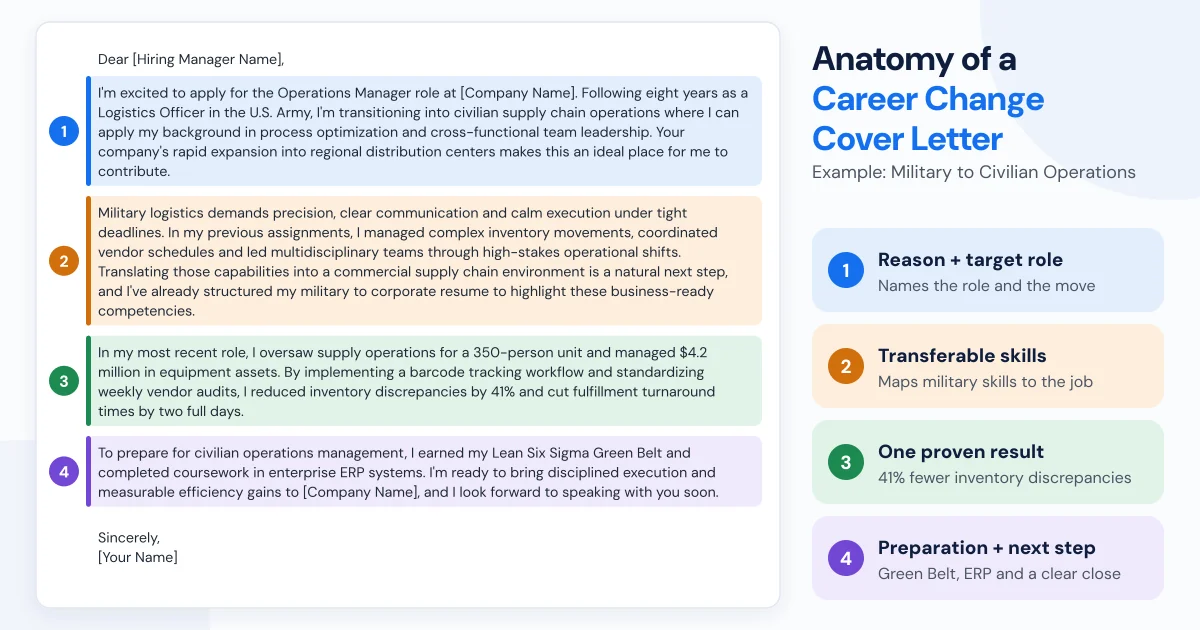
3. Military to Civilian Operations
Dear [Hiring Manager Name],
I'm excited to apply for the Operations Manager role at [Company Name]. Following eight years as a Logistics Officer in the U.S. Army, I'm transitioning into civilian supply chain operations where I can apply my background in process optimization and cross-functional team leadership. Your company's rapid expansion into regional distribution centers makes this an ideal place for me to contribute.
Military logistics demands precision, clear communication and calm execution under tight deadlines. In my previous assignments, I managed complex inventory movements, coordinated vendor schedules and led multidisciplinary teams through high-stakes operational shifts. Translating those capabilities into a commercial supply chain environment is a natural next step, and I've already structured my military to corporate resume to highlight these business-ready competencies.
In my most recent role, I oversaw supply operations for a 350-person unit and managed $4.2 million in equipment assets. By implementing a barcode tracking workflow and standardizing weekly vendor audits, I reduced inventory discrepancies by 41% and cut fulfillment turnaround times by two full days.
To prepare for civilian operations management, I earned my Lean Six Sigma Green Belt and completed coursework in enterprise ERP systems. I'm ready to bring disciplined execution and measurable efficiency gains to [Company Name], and I look forward to speaking with you soon.
Sincerely,
[Your Name]
How to talk about transferable skills
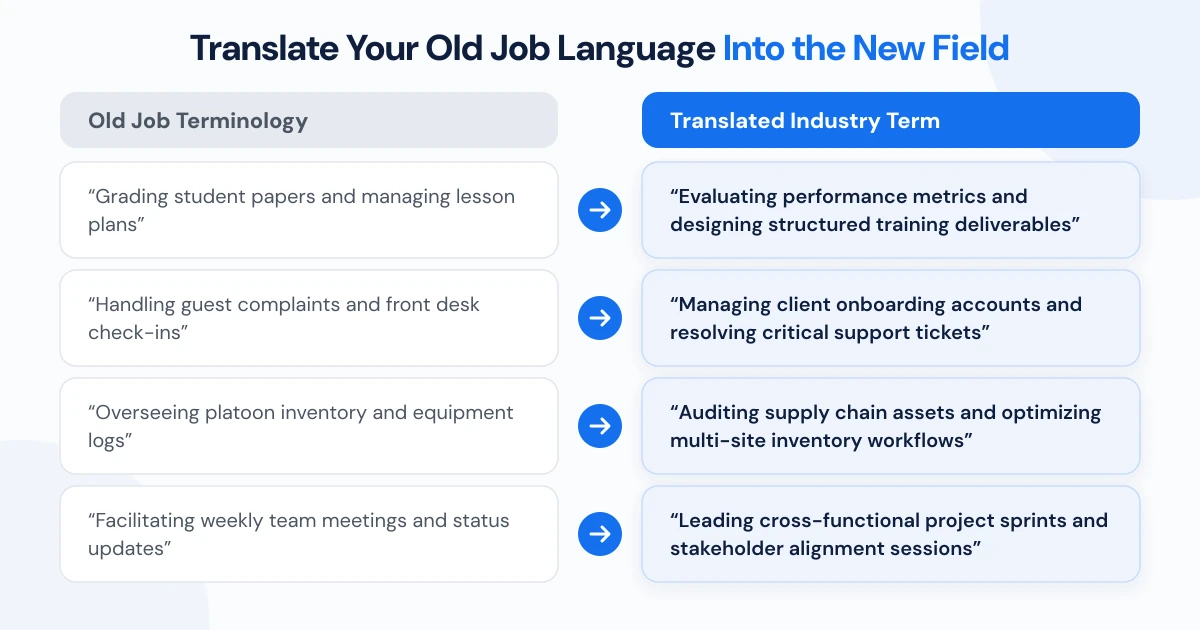
When you change careers, your biggest hurdle isn't a lack of experience. It's the vocabulary barrier. Every industry uses its own specialized jargon. If your cover letter reads like a direct copy of your old job description, a hiring manager won't see how your background applies to their problems.
To bridge this gap, you need to translate your past daily tasks into the language of your target role.
Instead of saying you "taught classes," explain that you "facilitated adult learning modules for groups of thirty." Translating your past experience into universal business outcomes proves you speak the language of your new field before you even land the interview.
Mistakes to avoid
Check these four frequent mistakes when drafting your career change cover letter:
Apologizing for your background: Don't start your letter by begging for a chance or making excuses for your lack of direct industry experience. Own your career change with confidence and lead with the unique perspective you bring.
Repeating your resume: Your resume already lists your past job titles and duties. Use your cover letter to tell the story behind those numbers and explain why you're choosing this exact moment to change paths.
Vague passion with no proof: Saying you've "always loved marketing" or "have a deep passion for tech" means nothing without evidence. Back up your enthusiasm with a concrete metric or a completed course.
Ignoring keywords from the posting: If the job description asks for project management, data analysis or client retention, use those exact words in your letter so hiring managers see an immediate match.
📣 If you're returning to the workforce after an extended career break rather than a direct industry switch, you can also review our dedicated guidance on how to write a resume when returning to workforce for tips on structuring your timeline.
How to do this with Careerflow
Changing your career to a new industry requires tailoring every application to a brand-new set of expectations. Doing that manually for every job posting burns hours of your valuable time.
Generate your cover letter instantly: Use our cover letter generator to analyze your past resume alongside the new job description, building a customized draft that highlights your transferable skills automatically.
Explore all career change resources: Visit our hub for career changers to access dedicated resume templates, networking guides and portfolio builders designed specifically for professional transitions.
Puneet Kohli
Co-founder
Puneet left a senior engineering role at Apple to co-found Careerflow, an AI-powered job search platform backed by Techstars and used by over 1 million job seekers worldwide. He brings more than a decade of hands-on experience in AI and machine learning, built across Apple, Amazon, and Leia Inc. As CEO, he leads the product and engineering behind the tools he wished existed during his own career transitions. You can connect with him on LinkedIn
FAQ: Career Change Cover Letter
How do I explain a career change in a cover letter?
Explain your career change by leading with a positive statement about what draws you to the new industry, followed by two or three transferable skills. Frame your past experience as an asset that brings a fresh perspective rather than viewing it as a disadvantage or a gap in your employment history.
Should I mention a career change in the first paragraph?
Yes, you should name your target role and address your career transition directly in the opening paragraph. Hiding your background until later in the letter feels evasive. Addressing it upfront allows you to control the narrative and immediately highlight why your past skills make you uniquely qualified.
How long should a career change cover letter be?
Your cover letter should fit comfortably on a single page, ideally staying between 250 and 400 words across three to four concise paragraphs. Keeping your letter brief forces you to focus only on your strongest transferable skills and most impressive metrics without overwhelming the hiring manager.
What if I have no experience in the new field?
Focus heavily on your transferable skills, such as project management, client communication, data analysis or problem solving. Back up those skills with a concrete result from your past career, and highlight any certifications, bootcamps or volunteer projects you've completed to prove your commitment to the new industry.
Do I need a cover letter when changing careers?
Yes, a cover letter is essential when you're changing careers because your resume alone won't explain the logic behind your pivot. While traditional applicants can sometimes skip it, career changers need this space to connect their past work to new requirements. You can read more about industry standards in our guide on is a cover letter necessary.
Recommended Articles
Here are some of the recommended articles from our team