


Resumes
.avif)
.webp)
Most resumes start with bullet points with the same dozen words like “managed,” “led,” “helped,” “responsible for,” “worked on.”
These words are weak, overused, and invisible to a recruiter scanning hundreds of applications in a single sitting. They describe a duty, not an accomplishment, and they say nothing about the person who actually got things done.
The right action words for your resume do two things: they signal competence in a specific area, and they force you to write in outcome-oriented language. This guide gives you 100+ strong action verbs for your resume organized by skill type, with real bullet point examples showing each one in use.
Apply these directly to your resume with our AI Resume Builder. ATS-compatible templates and an AI optimizer that identifies keyword gaps.
Why action verbs matter on a resume
Recruiters spend a matter of seconds on an initial resume scan. The start of each bullet point is one of the few things that registers in that scan window, and a passive opener signals a passive contributor. These action verbs describe what you actually did and signal the level at which you operated.
A note on ATS: These systems don't rank resumes higher because of strong verbs. But strong verbs push writers toward better bullet structure, which produces more keyword-dense, outcome-focused content that performs better in ATS review and with the humans reading after it. For a full breakdown of how keywords factor in, see our guide to resume keywords.
The most overused resume action words to replace
These are the words most likely to dilute your resume. Each one has a stronger alternative in the lists that follow.
Action verbs by skill area
.webp)
Leadership and management
Use these when you’ve directed people, projects, or teams. Pair with team size, scope, or outcome.
- Directed - Directed a cross-functional team of 8 to deliver a product redesign 3 weeks ahead of schedule.
- Supervised - Supervised onboarding for 12 new hires across 3 office locations.
- Mentored - Mentored 4 junior analysts, 2 of whom were promoted within 18 months.
- Delegated - Delegated project workstreams across a 6-person team, reducing delivery time by 20%.
- Coached - Coached a struggling sales rep from 60% to 105% of quota in one quarter.
- Spearheaded - Spearheaded the company's first remote work policy, adopted by 400+ employees.
- Championed - Championed a DEI initiative that resulted in a 30% increase in diverse candidates in the pipeline.
- Oversaw - Oversaw daily operations for 3 retail locations with combined revenue of $4M.
Analysis and research
Use these when you gathered, interpreted, or used data to make decisions. Pair with the data source, scale, or business outcome.
- Analyzed - Analyzed 18 months of customer behavior data to identify a retention opportunity worth $500K annually.
- Evaluated - Evaluated 5 vendor proposals and recommended a platform that reduced costs by 22%.
- Identified - Identified a process gap in accounts receivable that was causing a 12-day payment delay.
- Synthesized - Synthesized qualitative feedback from 200+ user interviews into 6 actionable product themes.
- Modeled - Modeled 3-year revenue projections for a $12M product line expansion.
- Forecasted - Forecasted quarterly demand with 94% accuracy, reducing overstock by $180K.
- Audited - Audited 3 years of vendor contracts and recovered $40K in billing errors.
- Mapped - Mapped the customer journey across 7 touchpoints to identify drop-off and improve conversion.
Communication and collaboration
Use these when you created content, presented ideas, or worked across teams. Pair with audience size, format, or outcome.
- Presented - Presented quarterly results to a board of 12 including external investors.
- Authored - Authored internal documentation adopted as the company-wide standard for onboarding.
- Negotiated - Negotiated a 3-year vendor contract that reduced annual spend by $85K.
- Facilitated - Facilitated weekly cross-functional standups across product, engineering, and design.
- Advised - Advised senior leadership on communications strategy during a company-wide restructuring.
- Collaborated - Collaborated with 4 regional teams to align on a unified go-to-market approach.
- Translated - Translated technical requirements from engineering into plain-language documentation for non-technical stakeholders.
- Pitched - Pitched a new content strategy to the CMO and secured a $30K budget increase.
Operations and process improvement
Use these when you made things more efficient, reduced costs, or built systems. Pair with before/after metrics or time saved.
- Streamlined - Streamlined the invoice approval process from 14 days to 3 days.
- Implemented - Implemented a new CRM system for a 40-person sales team, reducing data entry time by 6 hours per week.
- Reduced - Reduced customer churn by 18% by introducing a structured 90-day onboarding sequence.
- Standardized - Standardized project handoff documentation across 6 teams, eliminating a recurring source of errors.
- Automated - Automated weekly reporting using Python, saving 5 hours of manual work per analyst per week.
- Optimized - Optimized ad spend allocation across 4 channels, improving ROAS from 2.1x to 3.8x.
- Redesigned - Redesigned the returns process, reducing handling time by 35% and improving customer satisfaction scores.
- Centralized - Centralized 3 separate tracking systems into a single dashboard, used by 12 team members daily.
Building and creating
Use these when you built something new, like a product, campaign, system, or resource.
- Built - Built a reporting infrastructure from scratch that became the analytics foundation for the entire company.
- Launched - Launched a referral program that generated 1,200 new signups in its first 60 days.
- Developed - Developed a training curriculum now used to onboard all new customer success hires.
- Designed - Designed a responsive email template library that reduced production time by 40%.
- Created - Created a competitive analysis framework adopted by the entire sales team.
- Established - Established the company's first social media presence, reaching 10K followers in 6 months.
- Deployed - Deployed a machine learning model that reduced fraud detection false positives by 30%.
- Produced - Produced 40+ long-form articles that collectively drive 120K monthly organic visits.
Sales and growth
Use these when you drove revenue, expanded accounts, or grew metrics. Pair with dollar amounts, percentages, or time frames.
- Grew - Grew the enterprise account portfolio from 12 to 34 clients in 18 months.
- Exceeded - Exceeded sales quota by 127% for 3 consecutive quarters.
- Expanded - Expanded a key account from a single product line to a full platform contract worth $400K annually.
- Acquired - Acquired 500+ new B2B customers through outbound prospecting in Q3.
- Converted - Converted 38% of inbound trials to paid plans, up from 22% the prior year.
- Retained - Retained 92% of the top-tier customer base through a proactive renewal program.
- Upsold - Upsold enterprise features to 60% of mid-market accounts during annual reviews.
- Closed - Closed a $1.2M enterprise deal in a competitive 6-month sales cycle.
Technical and engineering
Use these when you built, fixed, or improved technical systems.
- Engineered - Engineered a microservices architecture that reduced system downtime by 80%.
- Refactored - Refactored a legacy codebase to reduce load time from 8 seconds to 1.4 seconds.
- Integrated - Integrated a third-party payment gateway into the checkout flow, supporting 3 new markets.
- Migrated - Migrated 5TB of data from on-premise servers to AWS with zero downtime.
- Debugged - Debugged a critical authentication issue affecting 2,000+ active users within 4 hours.
- Configured - Configured CI/CD pipelines for 3 product teams, reducing deployment time from 2 hours to 12 minutes.
- Tested - Tested 200+ edge cases to validate payment processing logic before a major product launch.
- Architected - Architected a scalable event-driven system handling 50M daily transactions.
How to use action verbs in a complete bullet point
Strong action words are a start, but they're not enough on their own. The full bullet needs to show what you did and what it led to.
The formula: [Action verb] + [what you did] + [result or scale]
For a deeper dive on bullet structure and the STAR method applied to resume writing, see our guides on resume bullet points and how to use the STAR method on a resume.
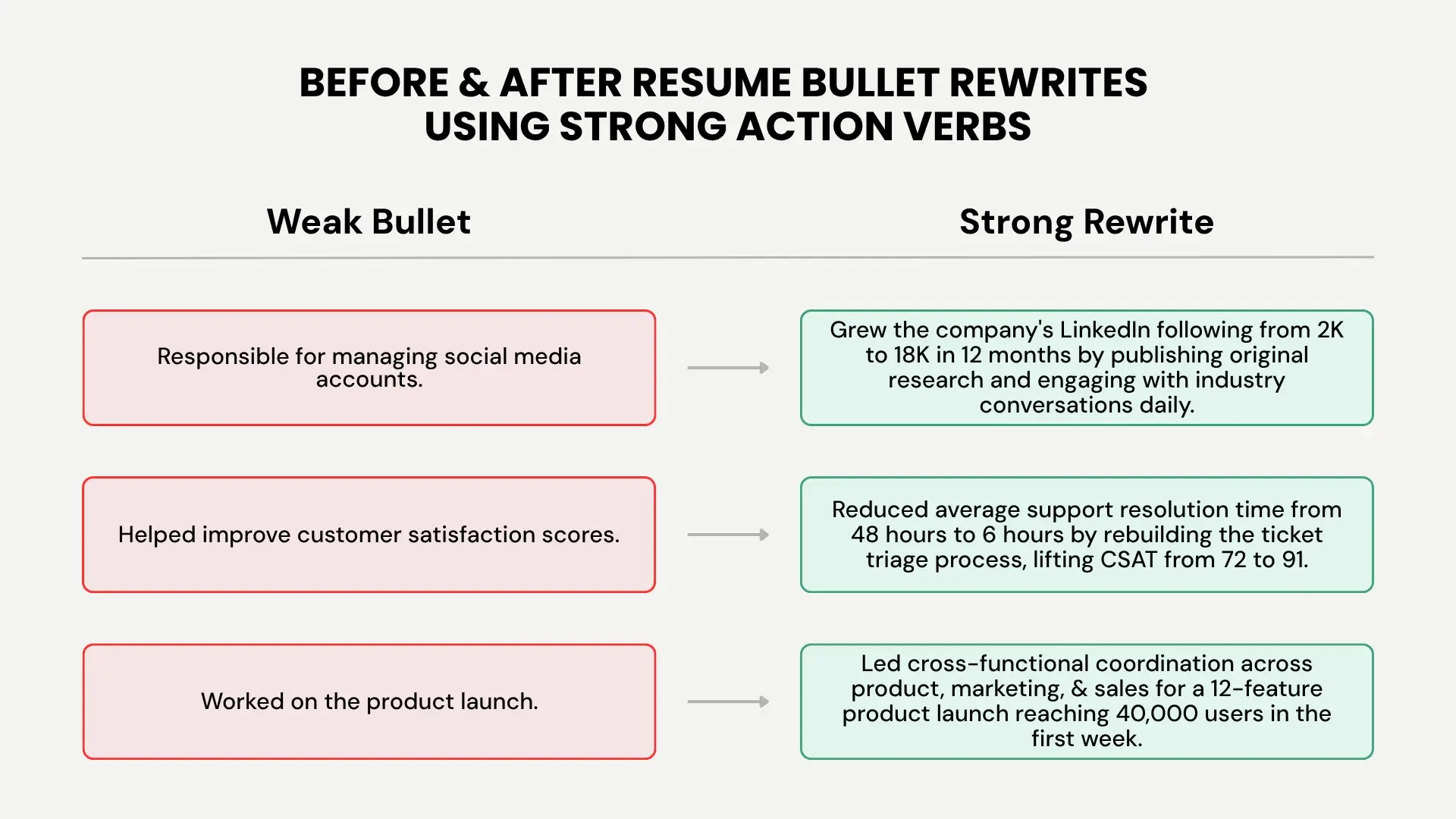
Before: Responsible for managing social media accounts.
After: Grew the company's LinkedIn following from 2K to 18K in 12 months by publishing original research and engaging with industry conversations daily.
Before: Helped improve customer satisfaction scores.
After: Reduced average support resolution time from 48 hours to 6 hours by rebuilding the ticket triage process, lifting CSAT from 72 to 91.
Before: Worked on the product launch.
After: Led cross-functional coordination across product, marketing, and sales for a 12-feature product launch reaching 40,000 users in the first week.
The pattern is the same every time: a weak verb gets replaced by one that describes ownership, paired with a specific action and a measurable result. If your bullet point can't complete that formula, the accomplishment hasn't been defined yet.
How to build stronger resume bullets with Careerflow
Resume Builder: Write and optimize in one place
The worst resume update happens six weeks into a job search, when the specifics of what you did and what it produced have started to blur. Do it now, while the details are sharp.
Open our resume builder and select an ATS-compatible template. For each role, write your bullet points using the verb categories above as a starting point. Then run the AI optimizer against the job description of your target role to identify high-priority keywords that will align with specific verb categories. Revise any bullets flagged as vague or passive, export, and your resume is ready to send.
For a full walkthrough of resume writing from structure to content, see how to write a resume.
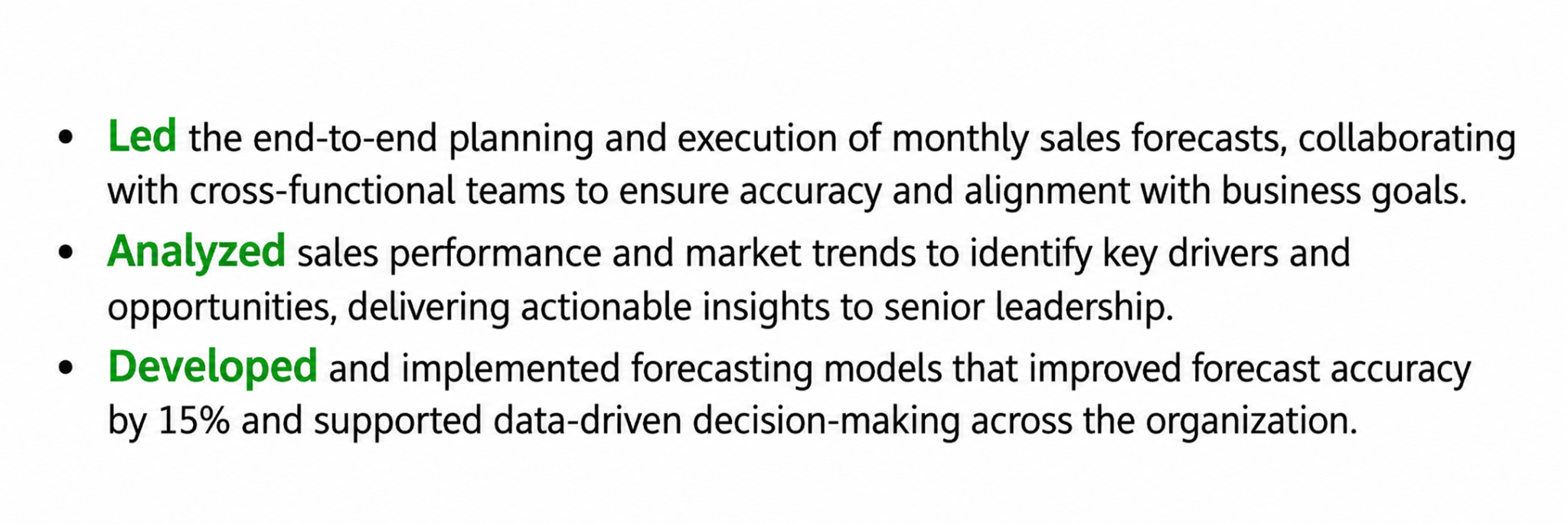
AI Resume Optimizer: Close the gap between your resume and the job description
Paste a target job description into the AI resume optimizer. Review the keyword gap report. Missing leadership keywords point you to the leadership verb list; missing technical terms point you to the engineering list. Rewrite flagged bullets with stronger verbs and relevant outcomes. For everything you need to know about making your resume readable by ATS systems, see our guide to ATS-friendly resumes.

.webp)

%20Which%20Should%20You%20Use.webp)
