Job search
.avif)
.webp)
If you receive no response to your applications, your resume may not be the issue. You may simply be applying to positions that never had a live opening to begin with.
Ghost jobs—postings for roles that are already filled, on indefinite hold, or never intended to hire—now account for an estimated 20% to 40% of all listings on major job boards, according to a 2025 Columbia Law Review analysis of Greenhouse hiring data. That means the already exhausting modern job search has become a frustrating guessing game.
The instinctive response is often to apply to more roles faster, but cutting corners only wastes valuable energy on dead ends. The smarter strategy requires focusing on quality over quantity. By using targeted tools to create tailored, ATS-ready applications in minutes rather than hours, you can stop wasting time on dead ends and focus on opportunities that are actually open.
What are ghost jobs?
A ghost job is a job posting that appears entirely legitimate but leads nowhere. When you encounter these listings, the role may already be filled or placed indefinitely on hold. Others are posted speculatively to build a pipeline or were never approved by a hiring manager.
To understand how ghost jobs became so common, we need to look back at recent labor market shifts. The term emerged from The Wall Street Journal's coverage of the post-pandemic hiring freeze, when companies began leaving positions open on job boards long after real hiring had stopped.
Ghost jobs are distinct from fraudulent scam postings designed to steal your personal data or money. Instead, these are fake job postings from real, reputable companies acting in bad faith. While they're not trying to defraud applicants criminally, they’re absolutely wasting candidate time and energy.
Why ghost jobs became so common: a brief history
Ghost jobs are not new, but their prevalence has increased dramatically. Understanding the history behind this shift helps active job seekers calibrate their expectations and adjust their strategies.
Pandemic-era over-hiring (2020–2022): Many corporations expanded headcount rapidly during the initial post-lockdown economic recovery. When market conditions cooled, companies scaled back their active hiring but left the existing job listings live rather than formally closing them. Removing a live listing publicly signals a hiring freeze, whereas leaving it up signals stability.
The tech layoff cycle (2023–present): Mass layoffs across the technology and corporate sectors created immense operational uncertainty. Companies continued to post roles as an intentional safety net or placeholder while internal budgets and headcount approvals remained completely unresolved.
Automated job distribution: Modern recruiting relies heavily on automated applicant tracking systems (ATS) and job board software. Many of these platforms are programmed to automatically repost roles at regular intervals to maintain visibility in search algorithms. Consequently, a posting often stays live simply because no one turned off the automation.
Economic caution (2024–2025): Facing ongoing concerns about inflation and market volatility, companies became increasingly reluctant to commit to immediate hires. However, employers still want to maintain an active talent pipeline just in case conditions shift. Because the cost of leaving a digital posting live is near zero, but the cost of resourcing candidates from scratch is high, companies default to keeping listings active.
How widespread is the problem?
The scale of this issue is significant, turning the digital application process into a frustrating numbers game. Recent labor market data highlights a massive disconnect between listed vacancies and actual hiring activity.
Understanding the data
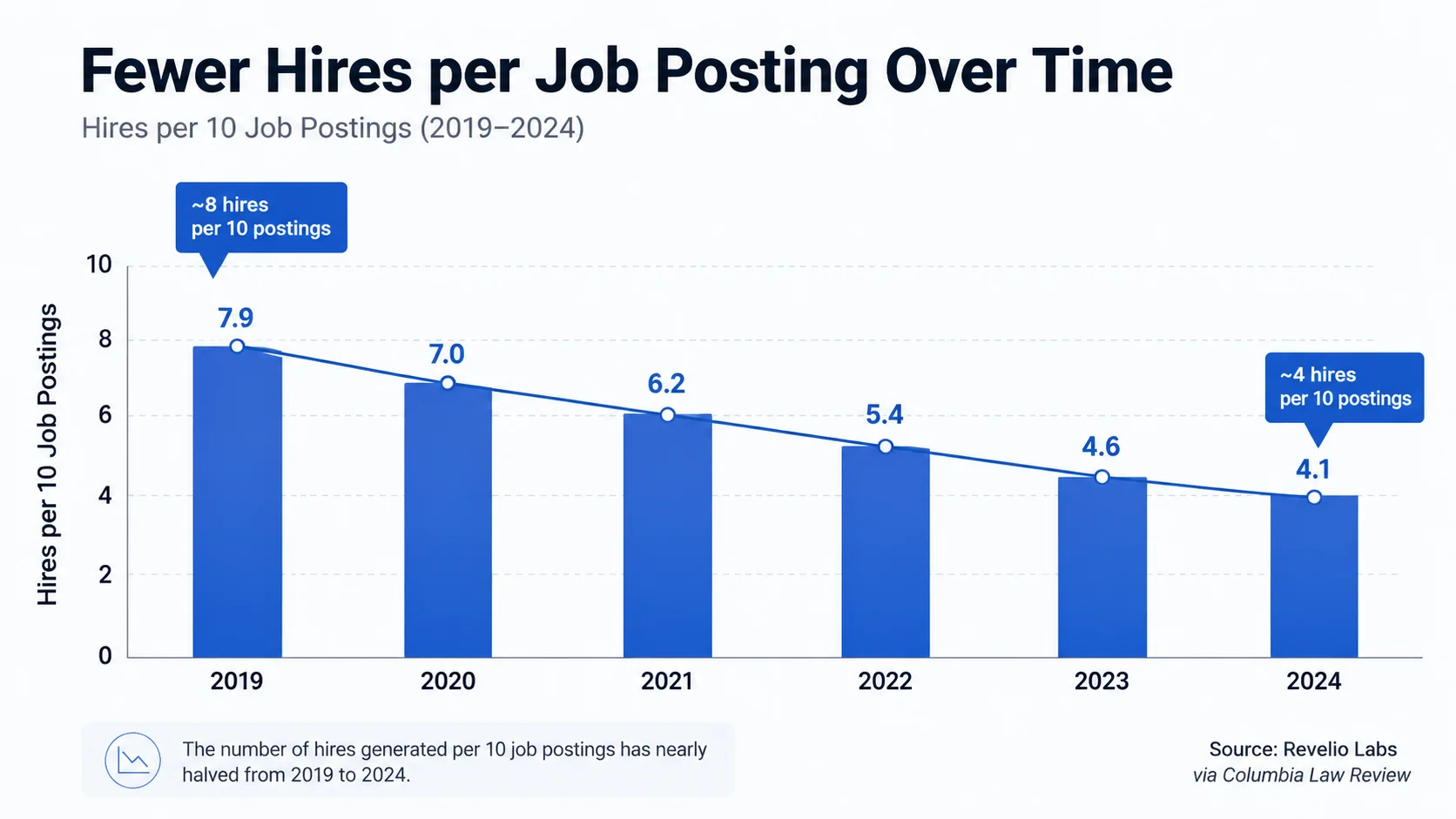
Hiring rates have halved: The rate of hires per job posting dropped from eight hires for every ten listings down to just four between 2019 and 2024, according to Revelio Labs employment data cited in the Columbia Law Review. While digital postings continue to multiply, actual corporate hiring fails to keep pace.
The multi-million openings gap: Job openings have consistently outnumbered actual monthly hires by more than 2.2 million since the start of 2024, according to Bureau of Labor Statistics (BLS) data reported by CNBC. This persistent macroeconomic gap points directly to the sheer volume of digital listings that never convert into real positions.
One in five listings are ghosts: A comprehensive analysis of internal data from the Greenhouse hiring platform, published by the Columbia Law Review, reveals that approximately 20% of active listings are ghost jobs. This means that at least one in five opportunities you see online may never result in an interview.
Millions of active dead ends: Separate evaluations using language model classification to analyze active Glassdoor listings identified up to 21% of postings as ghost jobs, as detailed in the Columbia Law Review. Experts scale this data to estimate that roughly 1.7 million potential ghost listings haunt platforms like LinkedIn at any given moment.
Hiring managers admit the practice: Employers are openly participating in this practice, according to a hiring manager survey cited in the Columbia Law Review. In that survey, 40% of hiring managers admitted their companies had advertised ghost jobs in the past year. Thirty percent acknowledged maintaining active fake listings at the time of the survey.
Applications ghosted by default: Only 20% to 25% of applications submitted on major job boards like Indeed receive any response, according to Juvo Jobs research published in Fast Company. The vast majority of modern job seekers are not experiencing formal rejection; they are simply being ignored by roles that were never truly open from the start.
Why do companies post ghost jobs?
Understanding the motivation behind these listings helps you decode corporate behavior and adjust your search strategy. Most companies keep ghost roles active for specific internal, financial or operational reasons.
The strategic motivations behind fake listings
Building a talent pipeline: Some companies post continuously to collect resumes for future hiring needs. If a position opens up in six months, they want qualified candidates already in their database. While not explicitly malicious, there's no active opening when you apply.
Managing frozen headcount: A role is frequently posted the moment it receives budget approval, but the position gets frozen before the listing is taken down. Teams often leave these up because removing them publicizes internal scaling or budget problems.
Signaling organizational growth: Active hiring signals company health and upward momentum to current employees, investors and competitors. Some organizations maintain listings purely to project external stability, even when no actual hire is budgeted.
Defending against legal risks: Certain human resources departments run perpetual postings to demonstrate they're continuously and fairly evaluating talent. This serves as a defensive legal posture rather than an active search for a new team member.
Gathering competitive intelligence: Collecting resumes allows companies to track the exact skills, salary expectations and seniority levels of people leaving their direct competitors. This extracts valuable market data at the job seeker's expense.
Testing salary benchmarks: A company might post a hypothetical role at a specific compensation level simply to measure candidate response. They use application volume to judge whether their salary ranges are competitive without any intention of hiring.
Gaming job board algorithms: Major recruitment platforms favor employers that post frequently and maintain high listing volumes. Keeping a filled or frozen role live maintains the company's visibility in search results, turning the job board into a corporate marketing tool.
How to spot a ghost job
No single signal guarantees a listing is fake, but a combination of these patterns strongly indicates a ghost role. Spotting these indicators allows you to protect your schedule and direct your energy toward legitimate opportunities.
Key indicators of a ghost listing
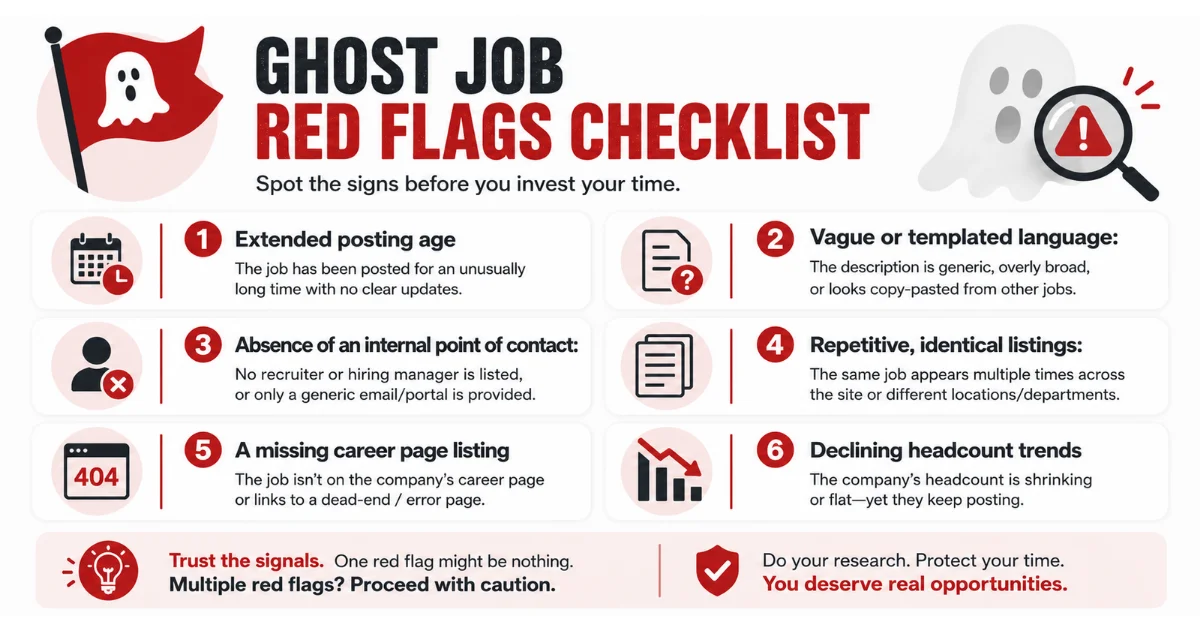
Extended posting age: Legitimate corporate hiring cycles typically conclude within four to six weeks. A job posting that remains live for over 60 days without any structural updates is a major warning sign. Be especially cautious if the exact same role gets systematically reposted every 30 to 45 days with completely identical text.
Vague or templated language: Ghost jobs frequently rely on generic, boilerplate text that requires zero effort to maintain. Look closely for job descriptions that could apply to almost any company in your industry without changing a word or listings that mash three entirely different roles into a single document.
Absence of an internal point of contact: Urgent, real openings almost always have a specific internal recruiter or hiring manager attached to the listing. A posting with no human name attached, or one that directs applications to a generic corporate email address, requires extra scrutiny. Check if any current team members have shared the role on their personal feeds; for real openings, internal employees are usually eager to amplify the listing.
Repetitive, identical listings: Seeing the exact same role posted continuously across multiple months indicates one of two things. Either the company suffers from severe operational turnover or they are executing a speculative data collection strategy. Both scenarios represent significant risks to your time.
A missing career page listing: Always cross-reference external job boards with the employer's official website. If a position is actively promoted on LinkedIn or Indeed but is absent from the company’s dedicated careers page, consider it a significant warning sign. Legitimate openings almost always appear on the internal system first.
Declining headcount trends: Check the company's LinkedIn profile to see whether its headcount has been growing or shrinking. A business that has systematically shrunk its total employee footprint over the last six months is highly unlikely to be aggressively recruiting for premium roles, meaning their active listings are likely legacy clutter.
A total lack of recent hires: Search professional networks using targeted phrases like "excited to join" or "thrilled to announce" alongside the company name. If a specific title has been advertised for months but no professionals have publicly celebrated landing that role, the position is likely at a standstill.
Zero recorded interview activity: Review employee insight platforms like Glassdoor, focusing specifically on the interview feedback section for that exact role. If a posting has been live for 90 days but there are absolutely no recent candidate interview submissions, it proves that applicants are not moving through an active pipeline.
Unedited automated distribution: High-volume automated distribution systems push identical, unformatted copy across every third-party job board simultaneously. If a text string appears word-for-word across four different platforms without a single localized detail or recruiter comment, an automated script is running the listing, not a human being.
"Talent Pool" and "Open Application" labels: Treat titles like "Software Engineer: Open Application" or "Join Our Global Talent Pool" exactly for what they are: digital resume collectors. These listings are expressly designed to gather candidate data for hypothetical future openings rather than filling a current budget vacancy.
How to confirm a job is real before applying
Before investing time tailoring your resume for a role, run a quick two-minute validation check. If a listing meets the majority of these criteria, you can safely treat it as an active, genuine opportunity:
- The job was officially posted within the last 30 days.
- A specific hiring manager or internal team member has actively shared or commented on the listing.
- The description details precise day-to-day deliverables, specific tech stacks, or niche tools rather than generic responsibilities.
- The company's public feed shows evidence of successful hires for similar roles within the last three to six months.
- The listing is actively published on the company’s internal corporate careers page.
- The post contains highly specific operational details, including defined salary ranges, precise office location models, or explicit start timelines.
Note: If a listing satisfies fewer than four of these validation points, do not spend hours tailoring your resume. Either leverage a rapid "Easy Apply" feature that requires zero customization, or walk away entirely to focus on verified openings.
What is being done about ghost jobs?
Awareness of this issue is growing fast. While a complete solution doesn't exist yet, job platforms, tech companies and governments are beginning to push back against fake listings.
Job boards are cracking down: Platforms like LinkedIn, Indeed and Glassdoor now feature employer responsiveness ratings, auto-expiry prompts and user reporting tools. Companies that repeatedly leave inactive listings online face penalties that lower their visibility in search results.
Pay transparency laws offer protection: States like California and Colorado require employers to list clear salary ranges. This extra requirement makes phantom listings easier to spot while raising the effort and cost for companies posting roles that aren't real.
Ontario passed a major disclosure law: Ontario, Canada passed a law requiring employers to state clearly if a posting is for a real, immediate opening or just for pipeline-building. This marks a major regulatory shift toward transparency.
AI-powered detection is emerging: New recruitment software is learning to flag ghost job patterns automatically. The systems identify listings that pull in massive numbers of applications but never actually move any candidates forward in the hiring process.
The wrong response to ghost jobs
When you receive no response to your applications, it's natural to apply for more roles. If you assume that only 10% of applications get a response, submitting 50 resumes feels like a logical path to securing five interviews.
Wasted effort multiplies: This volume logic completely breaks down when a massive chunk of the market consists of ghost listings. Sending your resume to 50 postings, 15 of which are completely fake, isn't an effective numbers game; it only compounds wasted effort.
Application quality plummets: You can't properly customize your resume for every single position when trying to hit a massive weekly application goal. This lack of personalization directly hurts your chances of landing a real role.
ATS filters block generic resumes: Standard, un-tailored applications are highly unlikely to pass modern automated applicant tracking systems. Even if your resume somehow reaches a real person, generic content rarely appeals to busy hiring managers looking for specific skills.
Burnout increases without clear feedback: The "spray-and-pray" approach ultimately leads to extreme keyboard fatigue and terrible results. Because you can't tell the difference between a silent ghost job and a real rejection based on your qualifications, you gain zero useful feedback on how to improve your search.
The right response: quality over quantity
A better strategy treats ghost listings as a clear signal to focus your efforts rather than scale them up. Applying to fewer, highly targeted roles allows you to invest your saved time in application quality.
How to shift your approach
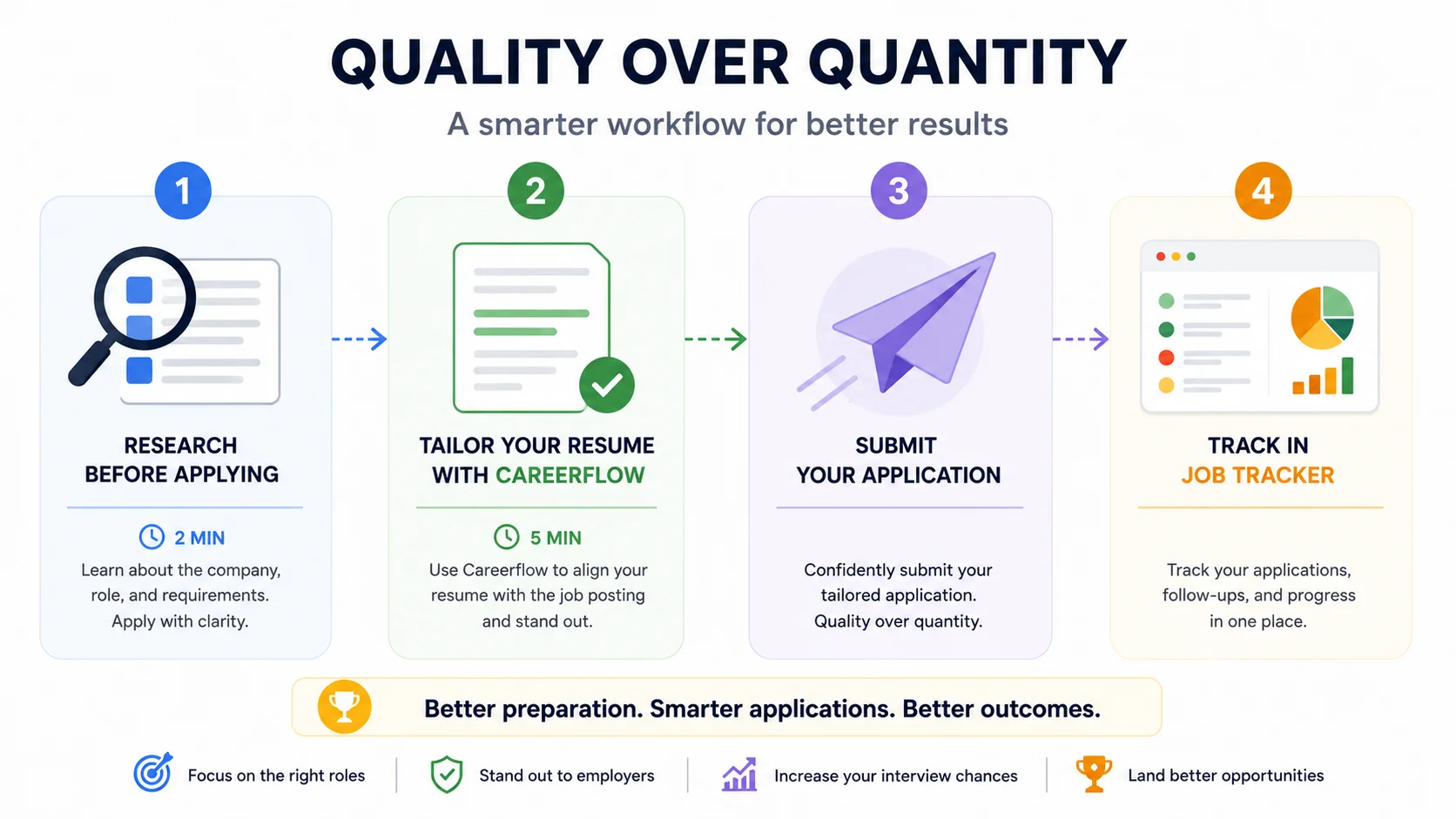
- Research before you apply: Taking two minutes to check the corporate careers page, look up headcount trends and verify the posting date eliminates dead ends before you waste time tailoring your materials.
- Customize every single resume: Applicant tracking systems automatically score your resume against the exact keywords used in the job description. A generic application fails this test silently, while a tailored one consistently outperforms it.
- Track your applications with Careerflow's Job Tracker: Keeping a clear record of when you applied and whether you received a response helps you spot helpful patterns. This data reveals exactly which platforms and companies tend to produce real hiring outcomes.
- Streamline the customization step: High-quality applications require dedicated time, and rewriting your resume from scratch for every new role is genuinely slow. The key is using targeted tools to speed up this process without sacrificing quality.
How to create high-quality, job-specific resumes in minutes with Careerflow
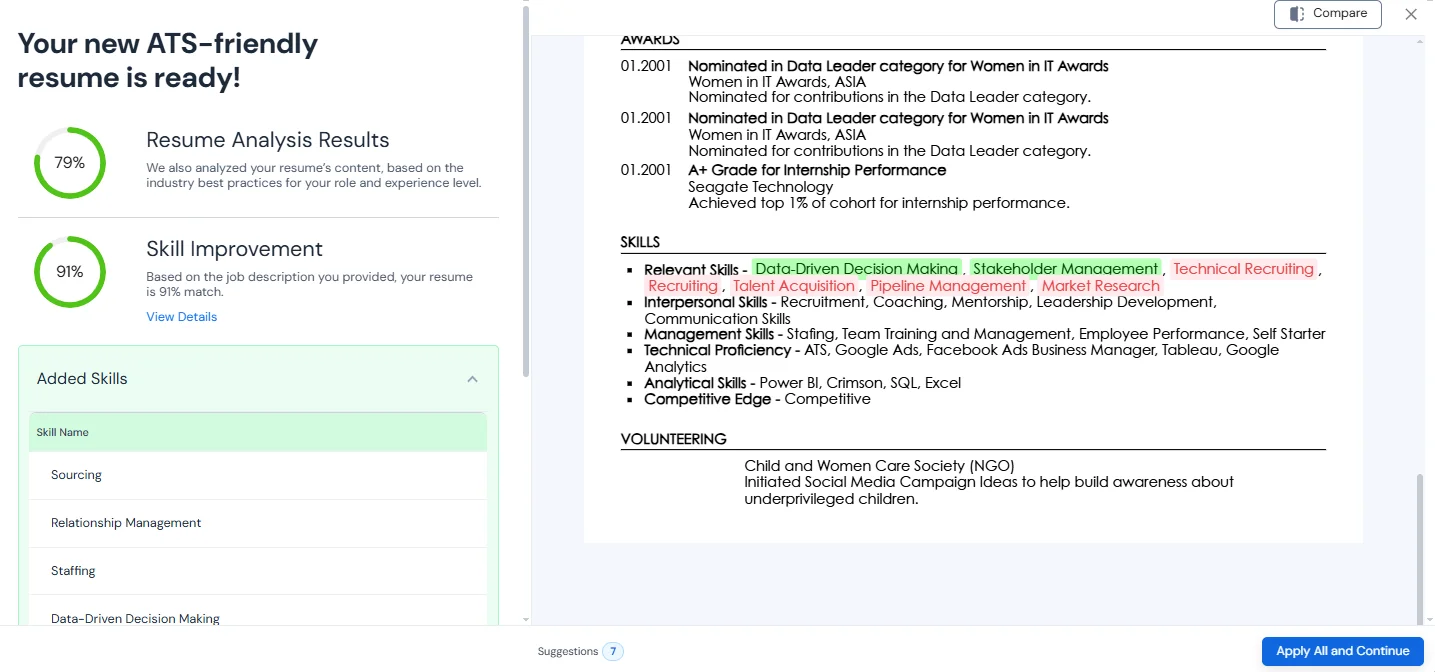
Careerflow's Resume Builder and Resume Optimizer solve your biggest time constraints. These tools allow you to produce a tailored, ATS-ready resume for a specific job description in minutes rather than hours.
Resume Builder
- Go to the Careerflow website to import your existing resume or choose from a selection of optimized templates.
- Input the text of the job description directly into the AI assistant.
- The AI surfaces relevant keywords from the listing, suggests edits to your experience bullet points and flags missing qualifications.
- Accept the relevant suggestions and quickly export a clean PDF that is ready to upload immediately.
- Maintain a single master version while generating tailored variations for every unique role, replacing an hour of manual rewriting with five minutes of targeted editing.
Resume Optimizer
- Upload your current resume alongside your target job description into the tool.
- The system scores your application against the specific listing to show you missing keywords, weak phrasing and formatting issues that ATS platforms flag.
- Review the concrete feedback and apply the recommended edits directly to your document before submitting it.
- Most ATS systems filter out generic resumes before a human ever sees them. Optimizing your resume to a specific job description removes that risk and produces measurably better results.
.webp)
%20Which%20Should%20You%20Use.webp)