If you’re applying for your first job and staring at a blank template, you likely feel like you have nothing to include on your resume. You actually have plenty to leverage, including school projects, volunteer work, extracurricular leadership, part-time roles and the transferable skills employers value.
This guide walks you through building a compelling first-job resume when you have limited or no formal experience. You will find specific strategies for highlighting academic achievements, translating coursework into relevant skills and formatting volunteer work like professional roles.
You will also learn which resume sections matter most, such as education, skills, projects and volunteer work. We’ll cover what to include, what to skip and how to write achievement-focused bullet points even without formal job titles. Finally, we will show you how to use our Resume Builder to create an ATS-friendly, professional document in under 30 minutes.
At A Glance: Building a First-Job Resume
You have more experience than you think. The right format turns coursework, volunteering, and part-time work into a professional, ATS-friendly resume.
Best format: Reverse chronological, with Education listed first, then Skills, then Experience (including volunteer work, clubs, and part-time jobs).
What counts as experience: School projects, volunteer work, extracurriculars, part-time jobs, internships, personal projects, and certifications.
Must-include sections: Contact info, Education (with GPA if 3.0+), Skills (technical and soft), and Experience, broadly defined.
Skip these: Objective statements, "references available upon request," irrelevant hobbies, a photo, and high school info once you're in college.
Ideal length: One page for entry-level resumes. Only go to 1.5 pages with extensive internships and projects.
Bullet formula:Action Verb + Task + Result, with a metric wherever you can add one.
📝 Turn your coursework, volunteering, and part-time jobs into a resume employers take seriously with our AI resume builder.
Why "no experience" is a mindset problem, not a resume problem
The biggest barrier for first-time job seekers is not a lack of experience. The real issue is failing to recognize academic work, volunteer roles, school clubs, personal projects and part-time gigs as valid experience.
Employers hiring for entry-level positions don’t expect years of corporate experience. They’re simply looking for evidence of key skills like communication, problem-solving, teamwork, reliability and a strong potential to learn quickly.
The biggest mistake first-time job seekers make is leaving their resume nearly blank because they think only corporate jobs count. In reality, leading a club, organizing an event or completing a capstone project all demonstrate the exact transferable skills managers want to see.
“A client came to me with no paid work experience, a 2.9 GPA, and four months until graduation. We built his resume entirely around two things: a 14-month commitment to a campus food bank where he had grown from volunteer to operations coordinator, and a self-directed data analysis project he had completed using publicly available city data because he was interested in the topic. Those two entries, written with specific outcomes and metrics, were more compelling than the internship-heavy resumes he was competing against. He received three offers in his target field within 10 weeks of graduating. The lesson: depth of engagement beats breadth of participation every time.”
What counts as experience for your first job resume:
Academic projects: Include intensive research papers, complex group projects, presentations, case studies, lab work or coding projects.
Extracurricular activities: Highlight your involvement in student government, clubs, sports teams, honor societies, the school newspaper or the debate team.
Volunteer work: List community service, nonprofit work, tutoring, mentoring and event volunteering roles.
Part-time or seasonal work: Show your reliability through retail, food service, babysitting, lawn care or independent freelance gigs.
Internships or apprenticeships: Count every short-term, micro-internship or unpaid role as professional experience.
Personal projects: Feature initiatives like building a website, starting a blog, creating digital content or learning technical skills independently.
Certifications: Showcase relevant coursework completed on platforms like Coursera, LinkedIn Learning or Google Career Certificates.
The best resume format for first-time job seekers
For first-job resumes, use a reverse-chronological format where you list your most recent experiences first. However, you should lead with your education section instead of work experience since your studies are currently your strongest credential.
This format is highly ATS-friendly and familiar to hiring managers. It makes your document easy to scan, unlike functional or skills-based formats that can raise red flags about trying to hide a lack of experience.
Structure your resume in this exact order:
Contact Information
Education
Relevant Skills
Experience, and
Optional sections like Certifications, Projects, or Awards
Why education comes first for first-time job seekers
Your degree or expected graduation date signals to employers that you have foundational knowledge in your field. For recent graduates and current students, education is your most recent major achievement and belongs right at the top.
Once you gain one to two years of professional experience, you’ll flip this order. At that point, your work experience will always go before your education section.
Template structure example:
Template
[Your Name]
[Phone] | [Email] | [LinkedIn] | [City, State]

EDUCATION
Bachelor of Science in Marketing (Expected May 2026)
University of California, Los Angeles | GPA: 3.6/4.0
Relevant Coursework: Digital Marketing, Consumer Behavior, Data Analytics

SKILLS
Technical: Google Analytics, Canva, Microsoft Excel, Social Media Management
Soft Skills: Communication, Project Management, Teamwork, Problem-Solving

EXPERIENCE
Marketing Intern | ABC Nonprofit | June - August 2025
• Managed social media accounts, increasing Instagram engagement by 35%
• Created 10+ email campaigns that drove 200+ event registrations

Volunteer Coordinator | Campus Food Bank | September 2024 - Present
• Recruit and train 15+ volunteers per semester for weekly food distribution
• Organize monthly donation drives that collect 500+ pounds of food

PROJECTS
Personal Finance Blog | January 2025 - Present
• Write weekly articles on budgeting and investing, reaching 1,000+ monthly readers
• Built website using WordPress and grew audience through SEO and social media
✨ Want more options? Browse free, ATS-friendly resume templates to find the format that fits your first-job resume.
Resume sections every first-time job seeker needs (and what to skip)
Must-include sections
1. Contact Information
What to include: List your full name, phone number, professional email address, city and state. Don’t include your full street address.
Professionalism check: Ensure your email address sounds professional, such as firstname.lastname@gmail.com, rather than an outdated or casual handle.
Digital Links: Add clean hyperlinked URLs to your LinkedIn profile, GitHub repository, portfolio or personal website if they relate directly to the role.
2. Education
What to include: List your degree or current major, the school name and your graduation date or expected graduation timeline.
Academic metrics: Include your GPA only if it’s 3.0 or higher, and round it to a single decimal place.
Targeted coursework: Add up to four relevant courses that directly mirror the keywords used in the job posting.
Honors: Showcase academic achievements like scholarships, specific department awards or recurring placements on the Dean's List.
Education Example:
Bachelor of Arts, Computer Science | Georgia Institute of Technology
Graduation Date: Expected May 2026 | Cumulative GPA: 3.7/4.0
Relevant Coursework: Completed advanced modules in Machine Learning, Data Structures, Web Development and Database Systems
Honors & Awards: Recipient of Dean's List recognition for academic excellence (Fall 2024 and Spring 2025)
3. Skills
What to include: Divide your skills into distinct sections for technical skills, such as software, tools, and languages, and soft skills, like communication and leadership.
Specific Terms: Avoid vague entries like "Microsoft Office." Instead, list specific capabilities such as "Microsoft Excel (pivot tables, VLOOKUP, data visualization)."
Actuals: Only include proficiencies you can confidently demonstrate on the spot if an interviewer asks you to do so.
Alignment: Match your skills directly to the vacancy. If the description asks for social media management, explicitly list platforms like Instagram and tools like Canva.
4. Experience (broadly defined)
What to include: Include any activity that demonstrates professional capability, such as internships, part-time jobs, volunteer work, club leadership or freelance projects.
Standard formatting: Treat every entry like a traditional corporate role by clearly listing your title, the organization name and the dates active.
Bullet points: Use up to four bullet points per entry, starting each line with a strong action verb and incorporating measurable metrics where possible.
Experience Example:
Event Coordinator | Habitat for Humanity | September 2024 – Present
Coordinated end-to-end logistics for five recurring community build events, directing over 30 volunteer team members
Managed vendor relationships and supply procurement while delivering comprehensive safety training to on-site teams
Increased volunteer retention by 40% through better onboarding and regular follow-ups
What to include: Feature capstone initiatives, theses, major research papers or intensive lab simulations.
Personal projects: Highlight standalone initiatives like building a responsive website, launching a YouTube channel or coding an application.
Freelance or side projects: Include freelance graphic design for local brands, private tutoring networks or independent social media consulting.
Standard formatting: List the Project Name and Date, followed by up to three bullet points detailing what you built, the tools utilized and the final impact.
6. Certifications
What to include: Add relevant certifications or comprehensive online courses, such as a Google Analytics Certification or HubSpot Inbound Marketing.
Relevance filter: Only include credentials that match the requirements specified in the target job description.
Standard formatting: Clearly state the certification name, issuing organization, and the date completed.
7. Awards and Honors
What to include: Showcase consistent Dean's List placements, honor roll status or merit-based scholarships.
Competition wins: Highlight placements in technical hackathons, business case competitions or essay contests.
Leadership awards: Feature official recognitions like Student Leader of the Year or specific club president awards.
Sections to skip for first-job resumes
Objective statements
These are highly outdated and waste valuable space. Hiring managers already know you want the job because you submitted an application.
References
Do not write "References available upon request" because employers already assume this. Save your valuable page space for skills and achievements.
Irrelevant hobbies
Generic activities like watching movies or traveling add zero professional value. Only include a hobby if it directly relates to the role, such as a travel blogger applying for a content marketing position.
High school information
If you’re currently enrolled in college, remove your high school achievements. The only exceptions are massive milestones like a national award.
Photos and personal details
Never include your photo, age, marital status or personal identification numbers. These details introduce unconscious bias and violate standard hiring practices.
How to write bullet points that prove your skills (even without job titles)
The key to writing strong resume bullet points is following a simple, impact-driven formula:
Action Verb + Task + Result
Start each line with a strong verb, clearly describe the exact task you handled and quantify the final impact whenever possible.
First-time job seekers often write vague, passive lines like "Helped with marketing" or "Responsible for social media." These phrases fail to prove your actual skills or show your true value to a potential employer.
A much better approach is to be completely specific about what you accomplished, the exact tools or methods you used to do it and what changed as a direct result of your work.
Weak bullets vs strong bullets
Review how these common, passive resume lines can be rewritten into high-impact, results-focused achievements:
Weak: Responsible for managing the club's Instagram account
Strong: Managed the club Instagram account for over 500 followers, posting three times weekly to increase engagement by 45% in one semester
Weak: Helped organize events for the student government
Strong: Organized four campus-wide events with over 200 attendees each while managing a 3,000 dollar budget and coordinating a 10-person planning committee.
Weak: Worked on a team project about climate change
Strong: Led a four-person research team analyzing global climate policy, presenting key findings to more than 50 students and faculty at the annual symposium
Action verbs for first-time job seekers
Start every bullet point with a strong action verb to immediately capture a recruiter's attention. Categorize your achievements using these strong, professional verbs:
Leadership and initiative: Led, organized, coordinated, managed, founded, launched or directed.
Communication: Presented, wrote, designed, created, published, facilitated or authored.
Problem-solving: Analyzed, researched, solved, improved, streamlined, optimized or developed.
Results and achievement: Increased, achieved, reduced, generated, delivered, completed or exceeded.
Adding metrics and numbers without corporate data
Numbers make your achievements credible and memorable. Many first-time job seekers assume they have no metrics to share because they lack corporate sales data, but you can quantify almost any activity. Think about the number of people you assisted, events you organized, social followers you grew, hours you dedicated or projects you successfully completed.
Examples of metrics you can use:
Number of people: Tutored 15 students in calculus to improve average exam scores by 20%.
Time or frequency: Volunteered 10 hours weekly at a local animal shelter for 18 months.
Growth percentages: Grew active student club membership from 20 to 45 members in one academic year.
Volume of work: Wrote over 25 comprehensive blog articles on personal finance with a focus on SEO.
Audience size: Presented original research findings to over 100 attendees at a regional academic conference.
Budget managed: Managed a 2,000 dollar fundraising budget for the annual community charity run.
What to do if you truly have zero experience
If you genuinely have no work, volunteer or extracurricular experience, you can still build a powerful resume by focusing entirely on your coursework, academic projects, specific skills and professional certifications. While this scenario is rare, you can easily fill a standard one-page resume by using the following strategic steps.
1. Expand your education section with relevant coursework and projects
List four to six relevant courses and briefly describe a major project or assignment from each module. Treat these academic achievements just like traditional work experience by focusing on the tools you used and the final outcome.
Coursework Example:
Data Structures (Python): Built a custom binary search tree algorithm to optimize database queries, successfully reducing search time by 60%.
2. Create a robust skills section with context
List technical skills and platforms you have mastered through coursework or self-study. Add a brief line explaining exactly how you developed or applied each capability to build immediate trust with hiring managers.
Skills Context Example:
Proficient in Excel: Mastered advanced functions through a business analytics course and applied data modeling to personal budget tracking.
3. Add professional certifications and online courses
Complete free or low-cost certifications through recognized training platforms and list them prominently on your page. Earning these credentials shows initiative and a genuine drive to learn on your own.
4. Start building experience immediately
You do not have to wait for a formal job offer to build your resume. Take proactive steps today to quickly add one or two relevant experiences to your background:
Volunteer for a local nonprofit or look for flexible, virtual volunteering opportunities.
Join a campus club or professional organization and quickly step up to handle a small leadership role or event.
Launch a personal project, such as building a responsive website, writing a niche blog or creating a digital portfolio.
Offer freelance support or look for short-term, micro-internships to gain practical exposure.
5. Write a strong resume summary statement
If you completely lack a formal experience section, consider adding a brief, two to three sentence summary right at the top of your page. Use this space to connect your academic achievements directly to your immediate career goals.
Summary Example:
Recent graduate with a Bachelor of Science in Marketing and hands-on experience utilizing core digital tools like Google Analytics, Canva and Hootsuite. Passionate about data-driven campaigns and eager to contribute creative ideas to a fast-paced marketing team.
Common first-job resume mistakes (and how to avoid them)
1. Listing duties instead of accomplishments
The mistake: Writing lines like "Responsible for answering customer questions." This merely describes the basic requirements of the role rather than what you actually achieved.
The fix: Rewrite the line to focus on results: "Resolved more than 30 customer inquiries daily to maintain a 95% satisfaction rating." This clearly demonstrates your skill and competence.
2. Using overly complex templates that ATS software cannot read
The mistake: Choosing a resume design filled with complex graphics, text boxes, dual columns or images because it looks creative.
The fix: Stick to a clean, single-column layout using standard professional fonts like Arial or Calibri. Ensure your section headings are clearly defined so the software can parse them easily.
3. Making your resume too long
The mistake: Stretching your document to two pages by inflating your font size, adding fluff or listing every single course you have ever taken.
The fix: Keep your document strictly to a single page. Entry-level resumes should be concise, clear and focused entirely on your highest-value credentials.
4. Including an outdated objective statement
The mistake: Adding a generic phrase like "Objective: To obtain a challenging position in marketing where I can utilize my skills."
The fix: Remove the objective completely. Use that valuable space to highlight your skills section or jump straight into your education.
5. Sending a generic resume to every job description
The mistake: Blasting the exact same resume to dozens of different openings without modifying the content.
The fix: Spend five to 10 minutes tailoring your skills and experience bullet points to match the exact keywords listed in each individual job posting.
6. Overlooking spelling and grammar errors
The mistake: Submitting a document with careless typos, such as "posting content three times a weak." A single error can signal a lack of attention to detail.
The fix: Review your text multiple times, run it through digital proofing tools and ask a trusted peer to look it over before you submit your application.
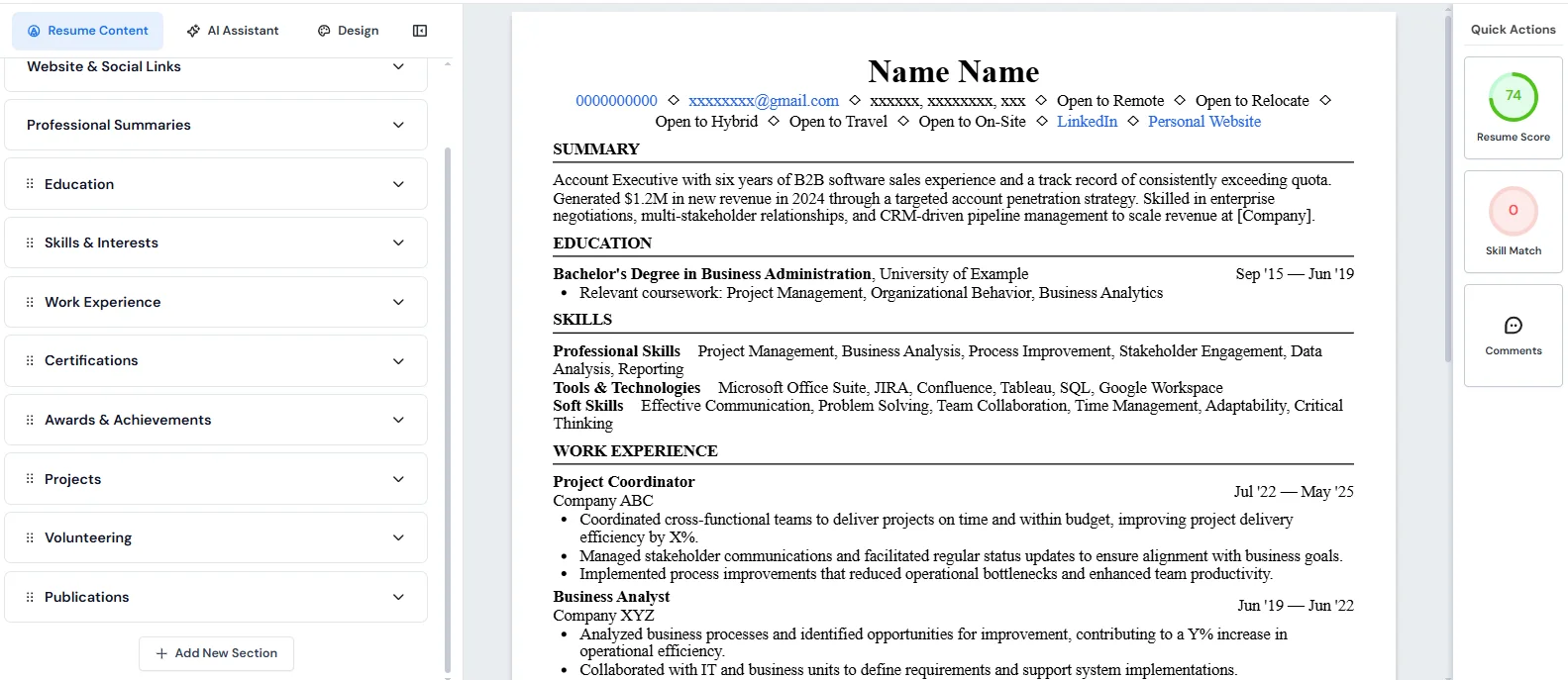
How to create your first-job resume with Careerflow's Resume Builder
First, sign up for Careerflow.ai and select an entry-level or student resume template. These layouts are designed specifically for first-time job seekers and place your education section in a prominent position.
Education first: Fill in your academic details first, including your degree, school name, cumulative GPA if it is 3.0 or higher, relevant coursework and honors.
Add skills: Use the built-in AI suggestions to identify core technical and soft skills based on your coursework and unique background.
Enter your experience: Enter your internships, volunteer initiatives, part-time positions and extracurricular leadership roles.
AI bullet point generator: Paste a basic description of what you did, and the tool will instantly rewrite it into the high-impact action verb, task, and result formula.
Skills match score: Upload the target job description to analyze which critical keywords you need to add or emphasize.
Final download: Export your completed document as a clean PDF and review it one final time for formatting consistency before submitting your application.
Why this works:
Templates are pre-formatted for applicant tracking systems and optimized for candidates with limited work history.
AI guidance helps translate academic and non-professional experiences into professional achievements.
The skills match feature ensures your resume mirrors the exact language used in each job posting.
Built-in guardrails stop common entry-level mistakes like excessive length, poor formatting or weak bullet points.
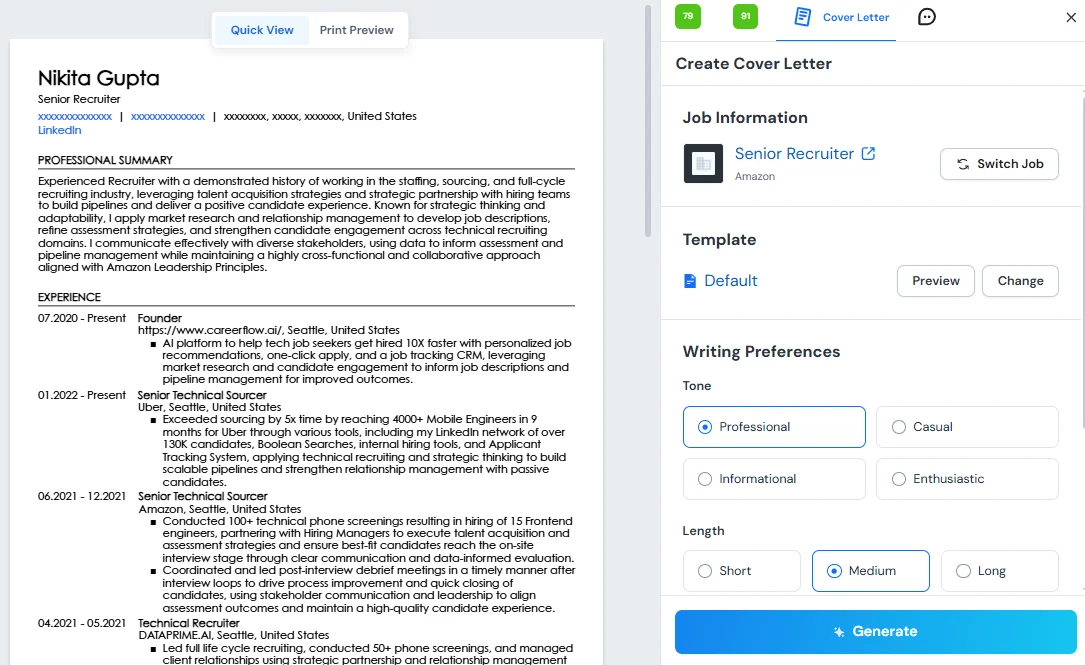
AI Cover Letter Generator (pair your resume with a tailored letter)
Use Careerflow's AI Cover Letter Generator to create a tailored letter that explicitly addresses your passion for the role despite limited formal experience.
Bridge the gap: Highlight the transferable skills earned through your coursework, personal projects and volunteer achievements.
Targeted proof: Mention one or two specific examples from your resume that prove you possess the capability to succeed in the role.
Job Tracker (organize your applications and follow-ups)
Use Careerflow's Job Tracker to save every opportunity, track your application status and set automated reminders for professional follow-ups.
Data-driven insights: Tag jobs by industry or role type to easily see which resume versions and application strategies convert into interviews.
Version control: Store customized versions of your resume for different job categories, such as separate folders for marketing roles versus sales positions.
Build a Resume for Your First Job
Careerflow’s Resume Builder helps you turn your education, skills, projects, and experience into a polished, ATS-friendly resume tailored to the jobs you want.
Puneet left a senior engineering role at Apple to co-found Careerflow, an AI-powered job search platform backed by Techstars and used by over 1 million job seekers worldwide. He brings more than a decade of hands-on experience in AI and machine learning, built across Apple, Amazon, and Leia Inc. As CEO, he leads the product and engineering behind the tools he wished existed during his own career transitions. You can connect with him on LinkedIn
FAQ: First Job Resume
How do I write a resume for my first job if I have no work experience?
A first-job resume with no work experience should focus on academic achievements, relevant coursework, school projects, volunteer work, extracurricular activities, part-time jobs and transferable skills developed through education. Format these experiences like professional roles: start with action verbs, include metrics and show impact. Employers hiring entry-level candidates don't expect corporate experience -- they look for transferable skills, potential and reliability.
Should I include my GPA on my first-job resume?
Include your GPA only if it is 3.0 or higher. If your GPA falls below 3.0, leave it off entirely and focus on highlighting your coursework, projects and skills instead. You can also feature your major GPA if it happens to be higher than your cumulative score. Once you gain one to two years of professional work experience, you can remove your GPA from your resume completely.
What resume format is best for first-time job seekers?
Use a reverse-chronological format with your education section listed right at the top, followed by skills and your experience section. This experience section should broadly include your volunteer work, internships, part-time jobs and extracurriculars. This specific layout is highly ATS-friendly, easy for hiring managers to scan and highlights your degree as your strongest current credential. Avoid functional or skills-based formats because they often raise red flags about trying to hide a lack of experience.
How long should my first-job resume be?
Keep your first-job resume strictly to a single page. With limited experience, you can easily fit your highest-value credentials onto one page using a standard professional font size and reasonable margins. Only extend to one and a half pages if you have completed multiple internships, extensive volunteer work, significant independent projects and relevant certifications. Never submit a two-page resume for an entry-level position.
Can I use a resume builder if I am applying for my first job?
Yes, using a dedicated tool like our Resume Builder is incredibly helpful for first-time job seekers. It provides specialized entry-level templates, AI-powered bullet point suggestions and tailored guidance on how to format non-professional experiences. The built-in ATS optimization ensures your document successfully passes applicant tracking systems, while the skills match feature helps you tailor your content to each job description. While free tools exist, paid builders often offer advanced customization and time-saving AI capabilities.
Recommended Articles
Here are some of the recommended articles from our team


.avif)
.webp)