Resumes
.avif)
.webp)
Communication skills are the most consistently requested soft skill across every industry and the most universally wasted on resumes. Nearly every candidate claims to have them, but almost none actually prove them.
According to the National Association of Colleges and Employers, oral and written communication skills appear on 67% of employers' most-wanted attributes for new hires. Because this attribute is too important to ignore, simply listing it as a generic label does not work. You need to show it through concrete context.
This guide covers the three distinct types of communication skills and highlights 12 specific skills worth putting on your resume. You will get over 25 tailored examples, organized by their significance to hiring managers, along with strategies to clearly demonstrate each skill with evidence. We’ll also cover which communication skills matter most by industry and exactly where each type belongs on your document.
What Are Communication Skills?
Communication skills are the specific abilities that allow you to share information, ideas, and feedback clearly while accurately receiving and understanding them in return. These skills span everything from crafting a clear email to navigating a difficult stakeholder conversation or managing the body language you bring into a meeting.
There are three primary types of communication:
- Verbal communication: Your spoken words, vocal tone, clarity, pacing, and your ability to adjust a message for different audiences.
- Written communication: Emails, reports, documentation, messages, and any text-based output. Employers test your written communication skills the exact moment you submit your resume and cover letter.
- Nonverbal communication: Eye contact, body language, facial expressions, and physical presence. These silent signals heavily shape how your verbal messages land with others.
In the workplace, these three categories overlap constantly. True communication experts don’t just master one or two areas, they manage all three intentionally to make sure their message is received exactly as intended.
12 Communication Skills Worth Putting on Your Resume
Incorporating targeted communication skills into your resume helps demonstrate your ability to collaborate, solve problems, and lead effectively.
- Active listening: Really listening to what’s being said and responding to it rather than just waiting for your turn to speak. Active listeners rapidly develop professional trust and recognize potential project pitfalls well ahead of their colleagues.
- Verbal clarity: Delivering spoken information concisely so your specific audience can take immediate action. True clarity differs from mere confidence because a confident speaker can still deliver an ambiguous message.
- Written communication: The ability to produce emails, reports, and documentation that readers understand and act on immediately. Your resume itself serves as the first test of this skill.
- Nonverbal communication: Managing body language, eye contact, and physical presence so they reinforce your spoken words. This capability is critical for any role involving client contact, leadership, or in-person presentations.
- Confidence: Delivering a message in a way that signals conviction. True professional confidence avoids unnecessary hedging and over-qualification rather than relying on volume or assertiveness.
- Open-mindedness: Entering conversations without pre-dismissing alternative perspectives. Open-minded professionals adapt quickly based on new data, making them highly effective in cross-functional team environments.
- Empathy: Understanding what your audience cares about and framing your message around those specific priorities. Empathy directly drives client satisfaction, team trust, and successful people management.
- Giving and receiving feedback: This paired ability allows you to deliver constructive criticism gracefully and accept notes without defensiveness. This skill is vital in high-stakes delivery environments and creative operations.
- Transparency: Sharing information, bad news, or uncertainty proactively without waiting for someone to ask. Transparent communicators build stronger professional relationships and require less micromanagement.
- Cross-cultural communication: The ability to adjust your style across different cultural norms and language levels. This skill is increasingly relevant for distributed teams and global corporate operations.
- Choosing the right medium: Knowing when to send an email, schedule a meeting, or write formal documentation. Selecting the wrong channel causes communication breakdowns even if the message itself is correct.
- Asking questions: Using targeted inquiries to clarify requirements, surface underlying assumptions, and show engagement. The quality of your questions signals analytical thinking and active listening to hiring managers.
25+ communication skills for your resume
Use any of these terms in your skills section only when you have a matching experience bullet that proves it. Recruiters skip unsupported labels, the value is in the evidence, not the list.
Communication skills by industry
How to show communication skills on your resume
Listing "excellent communicator" in your skills section signals nothing to a hiring manager. Because nearly every resume uses this exact phrase, experienced recruiters skip over it automatically.
The formula that actually works is straightforward: Action verb + communication context + outcome. You can prove any communication skill on your resume by using this structured approach.
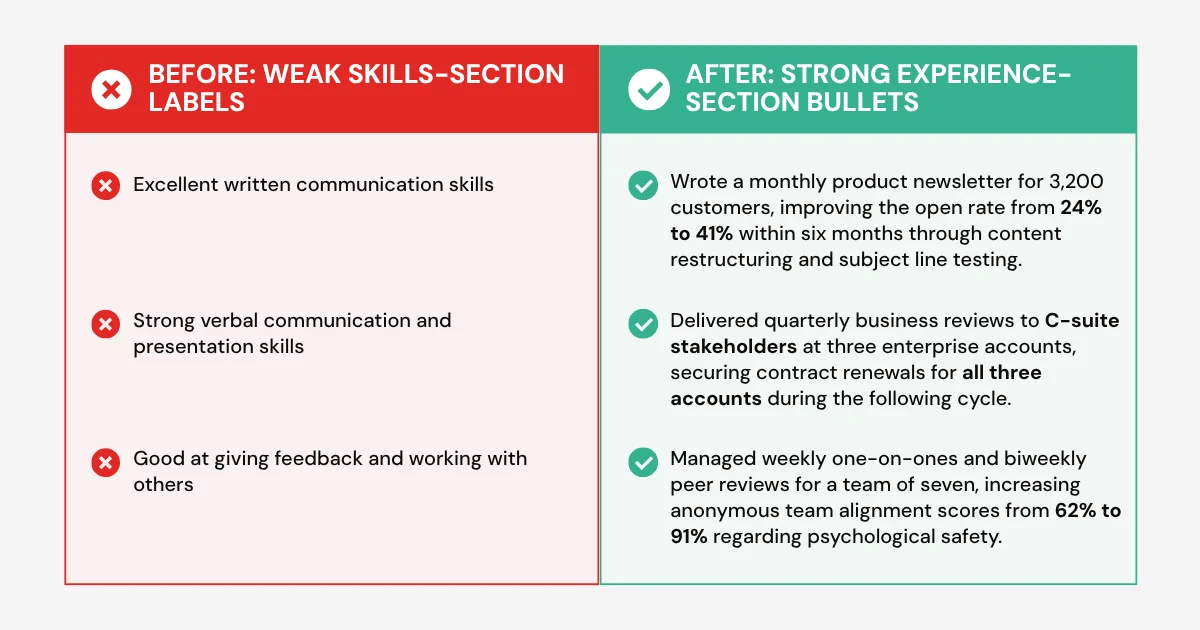
Before and After Examples
❌ Weak: Excellent written communication skills.
✅ Strong: Wrote a monthly product newsletter for 3,200 customers, improving the open rate from 24% to 41% within six months through content restructuring and subject line testing.
❌ Weak: Strong verbal communication and presentation skills.
✅ Strong: Delivered quarterly business reviews to C-suite stakeholders at three enterprise accounts, securing contract renewals for all three accounts during the following cycle.
❌ Weak: Good at giving feedback and working with others.
✅ Strong: Managed weekly one-on-ones and biweekly peer reviews for a team of seven, increasing anonymous team alignment scores from 62% to 91% regarding psychological safety.
Where to put communication skills on your resume
Strategically distributing your communication skills throughout your document will enhance their effect and generate instant credibility.
- Experience Bullets: This is the most credible placement on your resume. Demonstrate the skill through a specific, quantified outcome, allowing the evidence to imply your communication capability rather than explicitly naming the trait.
- Resume Summary: Name one or two communication strengths that describe your professional identity, and provide evidence immediately after. Saying “communicator” doesn’t do anything for you. Saying “technical writer who reduced customer support tickets by 30% through revised onboarding documentation” is incredibly impactful.
- Skills Section: List specific, role-relevant communication types like business writing, bilingual English/Spanish, or stakeholder communication rather than generic labels. Limit this selection to 3–5 specific entries if you include any here.
How to build your resume with our AI resume builder
Stop listing generic soft skills that recruiters skip over automatically. Use our smart tools like Careerflow's AI Resume Builder to transform your communication strengths into high-impact, quantified achievements that win interviews.
Our interactive AI tools streamline your writing process, making it simple to highlight your communication skills with concrete data.
- Open our AI resume builder and navigate to the experience section to select a role where your communication skills directly drove a business result.
- Write each bullet point using our structured Action + Context + Outcome framework, ensuring you name the communication medium or audience explicitly rather than using a generic skill label.
- Review each entry to confirm it clearly details the communication setting, your specific action, and the resulting metric. Ensure to include this substantial evidence in your work history instead of a skills list.
.webp)

%20Which%20Should%20You%20Use.webp)