Job search
.avif)
.webp)
Sending a thank-you email within 24 hours of your interview reinforces your interest and keeps you top of mind. It gives you one final opportunity to leave a lasting impression before the team makes a decision.
A great follow-up note shouldn't sound stiff, generic or overly eager. You simply need to reference a specific moment from your conversation and connect your skills to the role.
This guide offers practical timing rules, proven subject lines, fill-in templates and scenario-specific examples you can personalize quickly. You'll also learn how to track your follow-ups so you never miss an update.
Should you send a thank-you email after an interview?
Yes, you should send a thank-you email after almost every job interview.
A quick follow-up shows appreciation and confirms your interest in the role. It also gives you a chance to highlight one relevant point from your conversation. Sending a note demonstrates strong communication skills, professionalism and solid organization.
A thank-you note won't guarantee a job offer or fix a poor interview performance. Treat it as a standard professional courtesy rather than a secret tactic to win over hiring managers.
Rare situations to skip sending a thank-you email
You can skip sending a thank-you note in a few unusual situations:
- Explicit instructions: The hiring manager specifically asked you not to send follow-up messages.
- Automated systems: The entire process relies on automated forms with zero direct human contact.
- Non-interviews: The conversation was an informal networking chat rather than an actual interview.
When to send a thank-you email after an interview
Send your thank-you email within 24 hours of your interview. If your interview occurs late in the day, sending your message the next morning works well. Early morning delivery lands your note at the top of the recipient's inbox.
Send a quick message even if you missed the 24-hour window. Don't over-apologize or give long explanations for the delay. A slightly late thank-you note is always better than sending nothing at all. Keep your text focused on your appreciation and key discussion points.
Send a tailored follow-up after every major interview stage. Prioritize notes after speaking with hiring managers, panel interviewers, final decision-makers and recruiters who covered detailed role requirements. Personalize each email to reflect the specific conversation you had with that interviewer.
What to include in a post-interview thank-you email
A strong post-interview thank-you email consists of four core elements: thanks, a specific conversation detail, a short reminder of fit and a professional close.
Thank the interviewer
Start your email by thanking the interviewer for their time and insights. One clear sentence is enough to set a professional tone. Express appreciation for the conversation without sounding overly formal.
Mention a specific conversation point
Include a specific detail from your discussion to make your message unique. Mention a project, a team challenge or a goal discussed during the interview. This personal touch proves you actively listened and stayed engaged.
Reaffirm your fit
Connect one key skill or experience back to the needs of the role. Don't repeat your entire resume in this section.
For example: "Our discussion on onboarding made me excited, given my customer enablement background."
Keep the next step open
Close your email by stating that you look forward to next steps. If the interviewer requested extra materials, confirm they're attached. End with a polite sign-off that makes responding effortless.
Thank-you email subject lines
Keep your subject line simple, clear and professional so the interviewer recognizes your email immediately. Avoid clever, emotional or vague phrases. Stating your purpose directly ensures your message gets opened quickly on any device.
Use these clear subject line options for your follow-up:
- Thank you for the [Job Title] interview
- Thank you for your time today
- Great speaking with you – [Job Title] role
- Thank you for the conversation
- Appreciated our conversation about [Topic]
- Follow-up after our [Job Title] interview
Thank-you email after an interview template
Use this fill-in-the-blank template to quickly draft a thoughtful post-interview thank-you email.
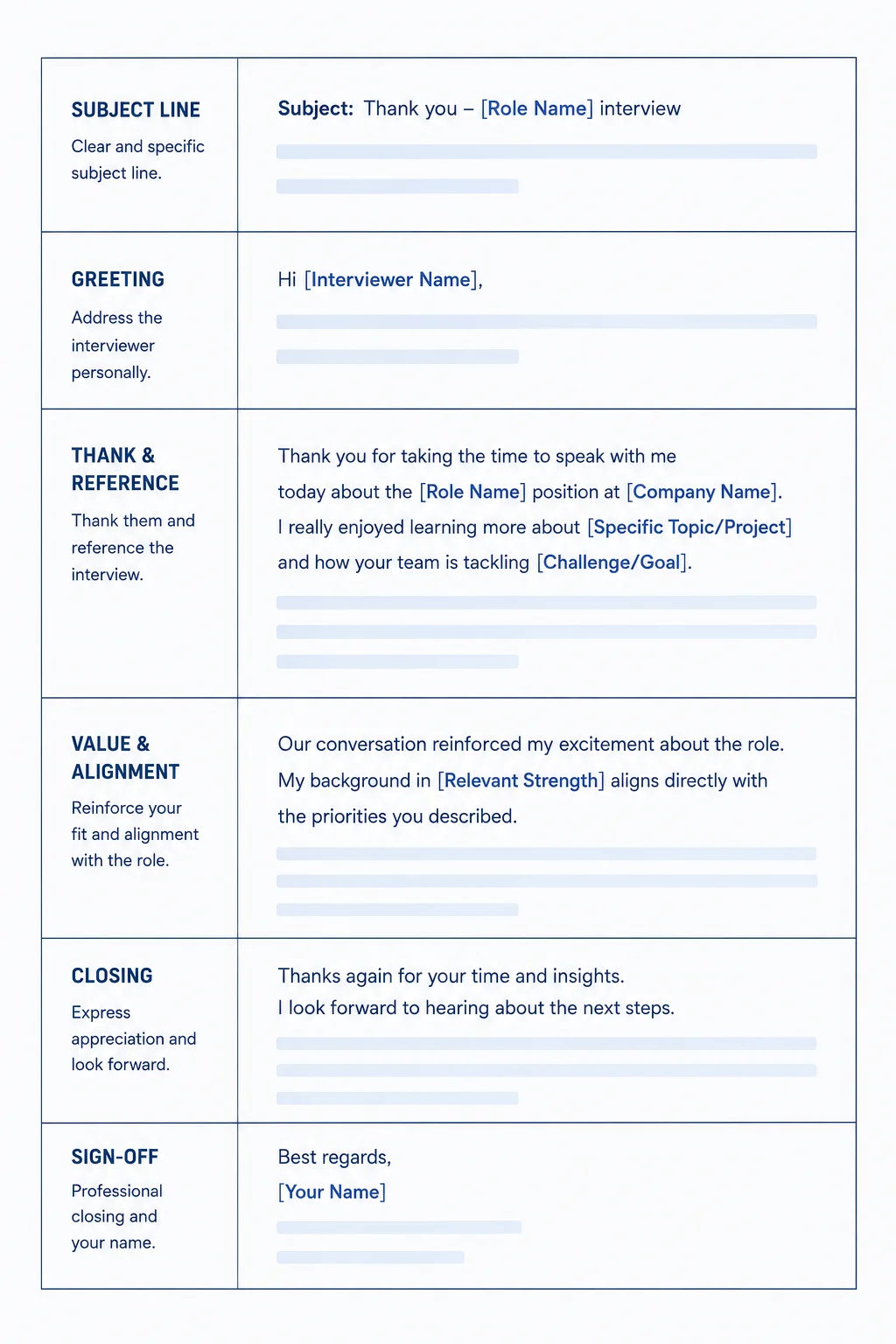
Subject: Thank you – [Role Name] interview
Hi [Interviewer Name],
Thank you for taking the time to speak with me today about the [Role Name] position at [Company Name]. I really enjoyed learning more about [Specific Topic/Project] and how your team is tackling [Challenge/Goal].
Our conversation reinforced my excitement about the role. My background in [Relevant Strength] aligns directly with the priorities you described.
Thanks again for your time and insights. I look forward to hearing about the next steps.
Best regards,
[Your Name]
Personalization checklist
Customize your message before hitting send to make sure it sounds natural and authentic:
- Replace placeholders with real details: Mention a specific project, goal or topic from your actual conversation.
- Highlight one key strength: Keep a single relevant proof point so your message stays focused.
- Cut irrelevant sentences: Remove any line that doesn't fit your specific interview discussion.
- Maintain a warm tone: Keep your language friendly, concise and professional throughout.
- Vary messages for panel interviews: Send unique notes to each interviewer by referencing individual discussion points with them.
How to personalize a thank-you email without overthinking it
Personalizing your email takes just two elements: one conversation detail and one reason the role fits. You don't need to recap the whole meeting. Referencing a single specific detail makes your message feel intentional without adding friction.
If your interview went well, focus on momentum. Connect the conversation to a skill, project or result the interviewer cared about. Showing how your experience solves their core priorities reinforces your value.
If you stumbled on a question, use this note to briefly clarify your answer. State your point in one clear sentence, then pivot back to your appreciation and excitement.
Thank-you email examples by situation
Choosing the right thank-you email depends on your interview stage and format. Use these practical examples to send a polished message in less than ten minutes.
After a phone interview
Phone screens are brief early-stage conversations. Keep your note short to confirm your excitement and move to the next round.
Subject: Thank you for your time – [Role Name] interview
Hi [Interviewer Name],
Thank you for speaking with me today about the [Role Name] position at [Company Name]. I enjoyed learning more about your upcoming plans for [Project/Goal].
Our conversation confirmed my enthusiasm for the role and your team's direction. I look forward to the next steps in the process.
Best,
[Your Name]
What to personalize: Replace [Project/Goal] with a brief topic touched on during the call.
After a video interview
Video interviews dive deeper into experience. Include a concrete detail to show active listening and engagement.
Subject: Great speaking with you today – [Role Name] position
Hi [Interviewer Name],
Thank you for the detailed conversation today about the [Role Name] role. I loved hearing about how your team approaches [Specific Challenge or Project].
My background in [Relevant Skill] directly matches the goals we discussed. I am confident I can step in and help [Company Name] drive similar results.
Thanks again for your time, and I look forward to staying in touch.
Best regards,
[Your Name]
What to personalize: Reference the specific team project or challenge discussed during the video call.
After a panel interview
If you have individual email addresses and distinct topics were discussed, send personalized notes to each person. If not, send one thoughtful group note.
Subject: Thank you from [Your Name] – [Role Name] panel interview
Hi [Panel Lead Name] and team,
Thank you all for taking the time to meet with me today about the [Role Name] opportunity. I appreciated learning how your team collaborates across [Specific Focus Area].
The insights shared by [Panel Member Name] regarding [Topic A] and [Panel Member Name] on [Topic B] increased my excitement about joining.
I look forward to hearing about the next steps.
Best regards,
[Your Name]
What to personalize: Reference each panelist's specific contribution or send distinct individual notes referencing private conversations.
After a final interview
Final-round emails demonstrate deep alignment and readiness to join. The tone can be slightly warmer while remaining professional.
Subject: Thank you for the conversation – [Role Name] role
Hi [Interviewer Name],
Thank you for taking the time for our final conversation today. I thoroughly enjoyed discussing [Company Name]'s vision for [Department/Strategy].
Everything I learned throughout this process confirms my experience in [Key Expertise] is a strong fit for your team's goals.
I remain very interested in joining [Company Name] and look forward to hearing your decision.
Best regards,
[Your Name]
What to personalize: Reference high-level strategic goals or executive priorities brought up during the meeting.
After an interview that didn't go perfectly
Clarify a weak answer without sounding defensive. Add brief context in one sentence, then return to your enthusiasm for the position.
Subject: Thank you – [Role Name] interview follow-up
Hi [Interviewer Name],
Thank you for speaking with me today about the [Role Name] role. I really enjoyed our discussion about [Topic/Project].
I wanted to briefly clarify my answer regarding [Question/Topic]. In my previous role, I handled this by [Concise Action Taken], which yielded [Positive Result].
Thanks again for your time and consideration. I look forward to staying connected.
Best regards,
[Your Name]
What to personalize: Keep your clarification to a single sentence so you don't dwell on the mistake.
After speaking with a recruiter
Recruiters manage the candidate pipeline. Thank them, reinforce your fit and avoid asking for an immediate hiring decision.
Subject: Thank you for the connection – [Role Name] opportunity
Hi [Recruiter Name],
Thank you for connecting with me today regarding the [Role Name] position at [Company Name]. I enjoyed learning more about the role requirements and company culture.
The position aligns closely with my background in [Core Skill], and I am excited to move forward.
Please let me know if you need any additional information from my end.
Best,
[Your Name]
What to personalize: Mention the exact job title and one detail the recruiter highlighted about company culture or team expectations.
What not to say in a thank-you email
Avoid key mistakes that ruin your great impression. Keep your message clean, concise and focused on the conversation.
- Don't press the hiring manager for quick updates or immediate hiring decisions.
- Don't dwell on a weak interview answer. Briefly clarify it or move on.
- Never send a template that lacks a specific detail from your conversation.
- Avoid re-listing your entire work history. Mention only one relevant proof point.
- Don't bring up salary, benefits or negotiation unless the interviewer brought it up first.
- Keep the email short. Long messages overwhelm busy hiring managers.
How to track follow-ups after interviews
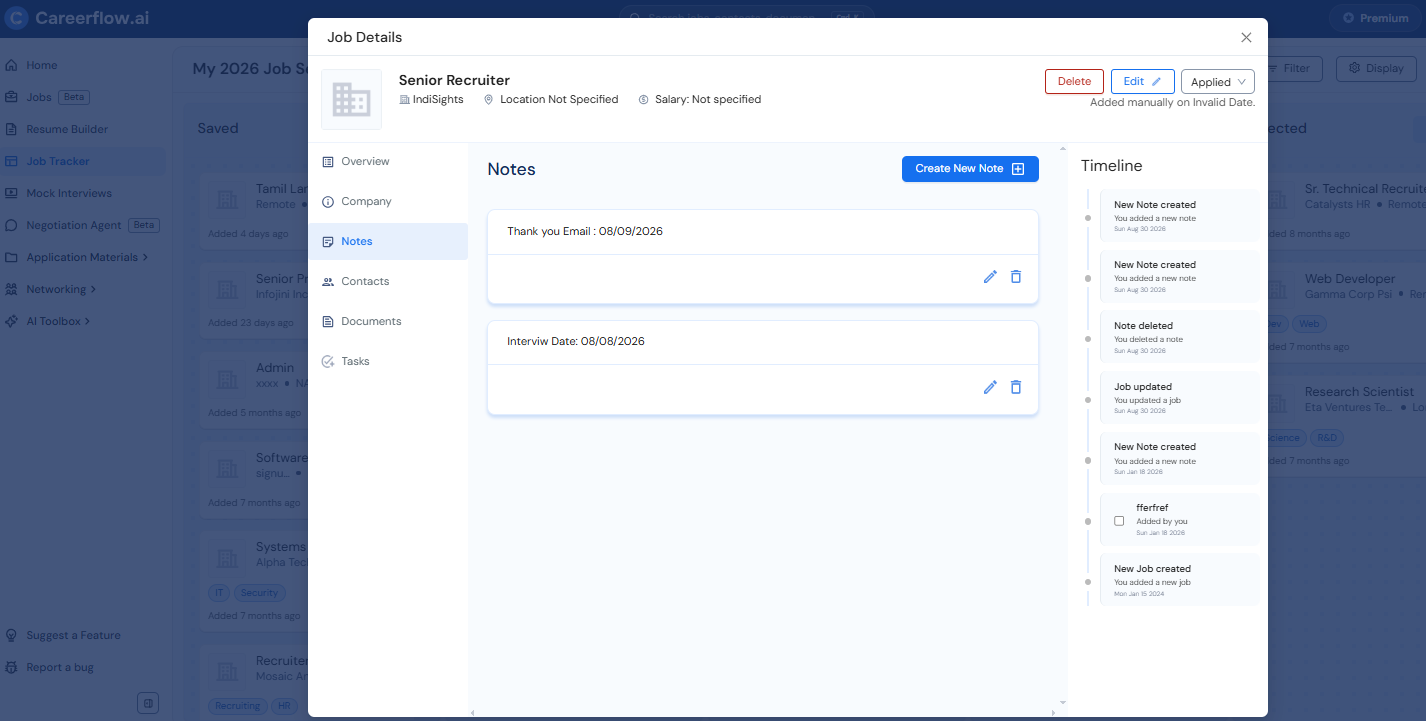
Staying organized after an interview prevents missed opportunities. Tracking your outreach ensures you follow up at the right time without guessing.
Our job tracker simplifies this entire process in one dashboard. You can log interview dates, note when you sent thank-you emails and set automated follow-up reminders. Staying on top of your timeline keeps your job search organized and stress-free.
Thank-you email vs. interview follow-up email
A post-interview thank-you email and a status check follow-up email serve different purposes at distinct stages of your job search.
📢 To Know More: How to Follow Up on a Job Application (Phone & Email Sample Templates)
How Careerflow can help
Managing your job search requires staying organized and preparing quickly for every round. Careerflow offers practical tools to support you through every stage of your job search.
- Prepare for upcoming rounds: Practice answering role-specific questions with our ai mock interview tool to build confidence.
- Draft polished follow-ups: Generate tailored thank-you messages and follow-up emails in seconds using our ai email writer.
- Track your progress: Log interview dates, save recruiter contacts and set follow-up reminders with the our job tracker.
.webp)