


Behavioral Interview
.avif)
.webp)
Behavioral interview questions (typically starting with "tell me about a time when...") are the most underprepared aspect of the job search. Candidates often focus on technical skills, only to freeze when asked for specific examples of leadership, conflict resolution or adaptability under pressure.
ChatGPT is a great tool for this type of preparation. It generates realistic questions for your target role, provides immediate feedback on your answers and pushes you with follow-up prompts. This guide teaches you exactly how to leverage AI to master your next behavioral interview.
To Know More 👉: How To Use ChatGPT For Your Job Search In 2026
What is a behavioral interview and why does it matter?
Behavioral interviews are built on a simple premise: past behavior predicts future performance. Employers use this format to assess how you've handled real situations, not how you'd handle hypothetical ones. This format is used by employers to see how well you can quickly and clearly remember and talk about relevant experiences. They don't want you to just memorize answers from a textbook; they want to see how well you can solve problems and talk to people.
Common behavioral questions often begin with "Tell me about a time when..." and focus on key competencies like leadership, conflict resolution, and adaptability. Employers can see how you handle stress, work with others, and deal with setbacks at work through these interviews.
STAR Method
Use the STAR method to do better in interviews. This framework ensures your answers are complete, verifiable, and easy to follow.
- Situation: Briefly describe the context or the challenge you faced.
- Task: Clearly explain what you were responsible for in that situation.
- Action: Detail exactly what you did to address the problem. Focus on your personal contributions rather than team efforts.
- Result: Share the outcome of your actions. Whenever possible, quantify your success with metrics or clear positive changes.
Answers that follow this structure help the interviewer understand your thought process and your direct impact on project outcomes.
Setting up ChatGPT for behavioral interview prep
Go to chatgpt.com and start chatting. No account is required.
Signing in is worth it if you plan to use ChatGPT more than once. A free account saves your conversation so you can return between sessions, build on previous responses, and track your progress over time.
You don't need a paid subscription. The free version of ChatGPT handles everything in this guide, including question generation, feedback and mock simulations. A Plus account is only needed if you want to upload your resume as a file instead of pasting it as text.
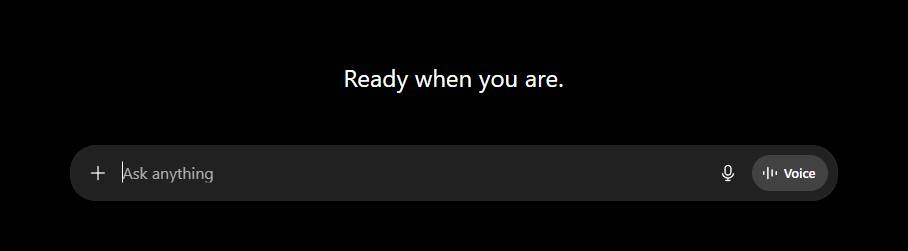
Effective setup
Maximize the quality of your practice by providing context before starting the session. Paste your resume and the job description into your first message. This gives the AI the specific background and role requirements needed to generate highly relevant, tailored questions.
When you use generic prompts like "ask me behavioral questions for a front end dev", you get generic answers. Using your actual resume and job description produces questions tailored to the exact role, the ones you'll actually face in the interview.
How to generate behavioral interview questions with ChatGPT
Puneet Kohli, co-founder at Careerflow and ex-Senior ML Engineer at Apple, says,
“While asking questions to ChatGPT, think of it as a very smart but very stupid machine. Despite being smart enough to know everything, it won't give you an accurate answer unless you tell it exactly what you need.”
ChatGPT is trained on data, it can only give you useful output if you give it useful input. It can’t read your expressions or your mind. The only way it can provide you with correct answers is if you can tell it what exactly you want. The following hacks will help you ask ChatGPT questions more effectively:
1. Be specific and clear in your question: ChatGPT is a large language model, so it's critical to be as specific and clear as possible to help it understand what you're asking.
For example,
❌Instead of asking: What are some common behavioral interview questions?
✅Ask: What are some examples of behavioral interview questions that employers might ask to assess a job seeker's leadership skills?
❌Instead of asking What should I expect during a behavioral interview?
✅Ask: What is the typical structure of a behavioral interview, and how many questions can I expect to be asked?
2. Use proper grammar and punctuation: You must ask your question using proper grammar and punctuation to make ChatGPT understand it properly.
3. Ask follow-up questions: ChatGPT may not always provide the most comprehensive response to your first question. If you feel like the initial response didn't fully answer your question, you can ask follow-up questions to expand on the initial response.
For example, if you ask ChatGPT, "What are some common behavioral interview questions that employers might ask to assess a job candidate's leadership skills?" and its response doesn't include a specific example, you could follow up with a question like: "Can you provide an example of a behavioral interview question that employers might ask to assess a job candidate's leadership skills?" This can help you get the most detailed and accurate response from ChatGPT.
4. Summarize ChatGPT's previous answers and follow-up questions: After asking ChatGPT a series of questions and receiving its responses, it can be helpful to summarize its previous answers and follow-up questions to get a clear and concise final answer.
if you asked ChatGPT a series of questions about behavioral interviews and received detailed responses, you could ask it to summarize all previous responses by saying, "Can you summarize previous answers and follow-up questions into a single paragraph or bullet point list?" This will help you organize and synthesize the information you received from ChatGPT and make it easier to understand and remember.
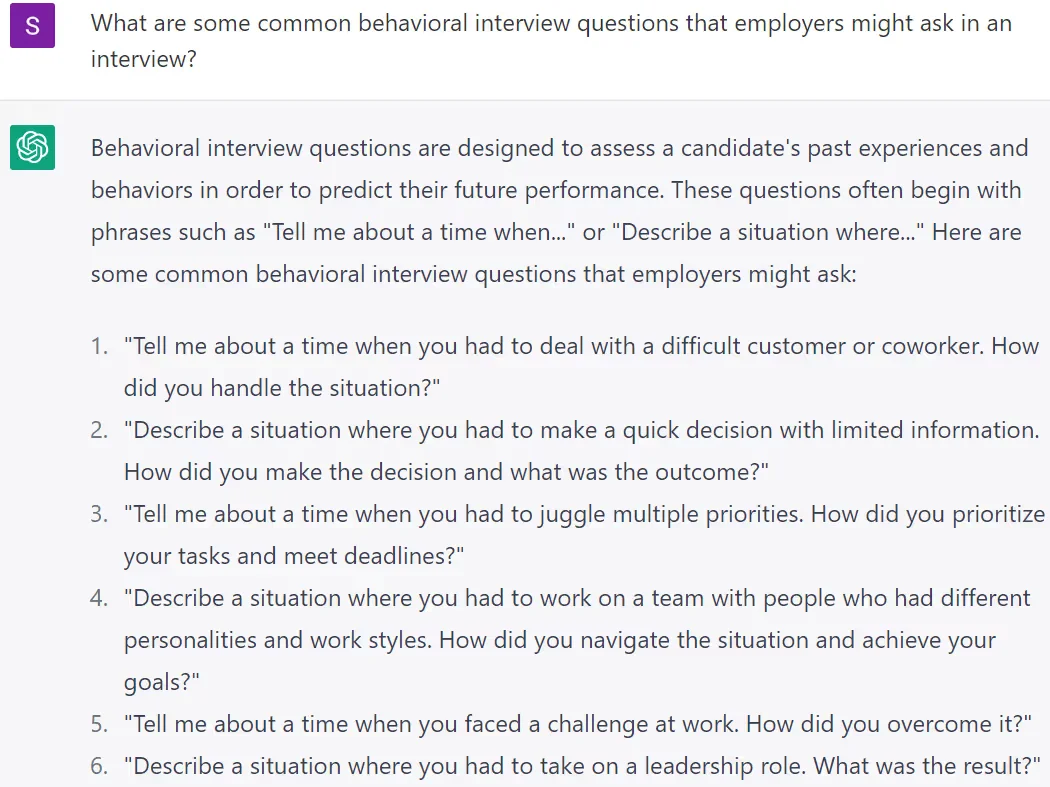
Here are some prompts to help you:
✅ Prompt: Generate role-specific behavioral questions from your resume
✅ Prompt: Generate questions by competency area
✅ Prompt: Generate follow-up questions to a behavioral answer
Bonus Tip 🔉: ChatGPT may take some time and experimentation to give the most accurate answer to your question. So don't be afraid to try asking your questions in different ways. Keep experimenting until you get the most accurate answer from it.
How to write strong STAR method answers with ChatGPT
Ask ChatGPT to generate sample answers to behavioral interview questions. If you have specific requirements, mention them.
- If you want an answer that follows the STAR method, mention it.
- If you want an answer based on your resume, mention it.
- If you want an answer tailored to your experience, mention it.
- If you need an answer in brief and simple words, mention it.
Remember 👉: ChatGPT does not have access to your resume or any other information. So you should provide your resume and details about your experience for ChatGPT to generate personalized answers. You can do this by including specific details in your questions, such as target job titles and tasks you have completed in the past job, and copy-pasting the entire resume. This would allow ChatGPT to generate a more personalized answer based on your previous experience.
Prompts that you can use to get the most appropriate answers through ChatGPT 👇
✅ Prompt: Based on your resume
✅ Prompt: Based on the particular scenario
✅ Prompt: Based on specific career goals
✅ Prompt: Based on specific achievements or accomplishments
The most common mistake in STAR answers is spending too much time on "Situation" and "Task." Interviewers prioritize your specific actions and the resulting outcomes over background context.
Put your energy into explaining what makes you unique and how your work has had a measurable effect. Don't talk about what your team did or what happened to you; instead, talk about what you did.
Use ChatGPT to refine your responses before your interview. Paste your draft answer and use these prompts to audit your performance:
✅ Prompt: Build a STAR answer from rough notes
✅ Prompt: Evaluate a STAR answer for completeness
Sample strong STAR answers by competency
Reviewing real-world examples helps you understand how to structure your own experiences. Notice how each answer below quickly moves past the "Situation" to focus on the "Action" and the measurable "Result."
Leadership
Question: "Tell me about a time you led a team through a difficult situation."
- Sample: "Our team lost our lead engineer two weeks before a major client deliverable. I stepped in as project lead, redistributed work across the remaining engineers, and held daily 15-minute syncs to surface blockers quickly. We delivered on time with no reduction in scope. The client renewed their contract and specifically praised our delivery reliability."
Conflict Resolution
Question: "Tell me about a time you disagreed with a colleague or manager."
- Sample: "My manager wanted to launch a campaign with a one-week turnaround. I disagreed because our testing process takes two weeks, and shortening it previously caused a 23% higher error rate. I presented this data to my manager, proposed a 10-day compromise and personally managed the testing checklist. We launched on the 10-day timeline with zero post-launch errors."
Adaptability
Question: "Tell me about a time you had to adapt to a significant change."
- Sample: "Our department reorganized, and my product roadmap shifted from B2C to B2B overnight, deprioritizing six months of planned work. I spent two weeks conducting customer discovery calls with the new target segment and rebuilt the roadmap and aligned stakeholders on new priorities within a month. The B2B product launched on schedule and hit 110% of our first-quarter revenue target."
How to get feedback on your answers from ChatGPT
Prompts that you can use to get feedback on your answers through ChatGPT 👇
✅ Prompt: Get specific, structured feedback on a behavioral answer
Bonus Tip 🔉: Provide detailed and authentic answers to ChatGPT using examples from your own experience. Take note of any feedback or suggestions provided by it and use them to refine your responses.
How to simulate a behavioral interview with ChatGPT
Now that you've covered the content side, it's time to put it to the test — simulate an actual interview using ChatGPT.
Yes, ChatGPT is capable of doing that as well 😀.
To set up a practice session for a behavioral interview with ChatGPT as a job seeker, follow these steps:
- Start by explaining the purpose of the practice session to ChatGPT. Prepare a prompt to alert ChatGPT, you will be simulating a behavioral interview, and it will play the interviewer's role.
For example: "Hi, I'm John, and I'm preparing for a behavioral interview. Can you act as an interviewer and ask me a question?”
- Identify the common behavioral interview questions that you would like to practice. Ask ChatGPT to pick one of the questions from the list and ask it to you in a conversational manner.
For example: “Can you ask me these questions one at a time? 1. Tell me about a time when you had to deal with a difficult customer. 2. Describe a situation in which you had to work under tight deadlines. 3. How do you handle conflict in the workplace?”
- Respond to the question as if you were in an actual behavioral interview, using examples from your own experiences to illustrate your answers.
- After you have answered the question, ask ChatGPT for feedback on your response. Ask if there were any areas where you could have provided more detail or given a better example.
- Repeat this process with several different questions from the list, allowing ChatGPT to ask each one and provide responses.
A few things to remember while simulating a behavioral interview using ChatGPT
- Engage in a conversation with ChatGPT, following the rules and guidelines of an actual behavioral interview.
- Choose a quiet place for a practice session and don’t get up during the session.
- Be specific and realistic when setting up a practice scenario.
- Provide detailed and authentic answers to ChatGPT's questions, using examples from your own experience.
- Take note of any feedback or suggestions provided by ChatGPT and use them to refine your responses.
Repeat the practice session as needed to improve your skills. Think of these sessions as mock interviews, and do everything possible to make the most of them. However, as of now, you can only submit your answers by typing. But in an actual interview, you have to verbally convey your answer, so working on your spoken delivery is just as important. Practice your delivery with our Mock Interview tool to get AI feedback on structure, clarity and presence.
Bonus Tip 🔉: Update your LinkedIn profile with Careerflow’s completely FREE LinkedIn Optimization Chrome Extension. This tool gives you the best practices for each section of your LinkedIn Profile based on industry experts’ LinkedIn Profiles and boosts your search visibility by 2.5x 🚀.
ChatGPT is an excellent tool for content generation, yet it possesses a fundamental limitation: it operates entirely through text on your own timeline. It provides no video feedback, vocal analysis, or time-sensitive pressure, allowing you to practice indefinitely without experiencing the psychological stress of an actual interview.
Behavioral interviews demand both content and delivery presence. A good STAR answer given with bad eye contact, a lot of verbal fillers, or low confidence will always do worse than a decent answer given with confidence and authority.
- Content Preparation (What you say): AI excels here. Use it to structure your stories, refine your STAR components, and ensure your message is clear.
- Delivery Preparation (How you say it): This requires external practice tools like our AI Mock Interview. You must develop the ability to articulate your points confidently while maintaining professional presence.
AI helps you build the script, but realistic practice—preferably using video recording or mock simulation tools—is essential for refining the performance that actually lands the job.
How to practice behavioral interview delivery with Careerflow
Once you refine your content using ChatGPT, use our Mock Interview Tool to practice delivering your answers under realistic conditions. This platform simulates an actual interview environment, providing AI feedback on response quality, structure and delivery.
Using both tools creates the most effective preparation strategy: ChatGPT develops your content, while Careerflow refines your performance.
Mock Interview Tool (behavioral practice)
Follow these steps to bridge the gap between a written script and a confident spoken answer:
- Select your role: Open the Mock Interview Tool and choose your target position, such as "Product Manager" or "Software Engineer."
- Configure your session: Choose "Behavioral Interview" as your question type, or allow the tool to generate a realistic, mixed-question set.
- Record your responses: Capture your answers using video or audio. This forces you to move beyond reading and into genuine performance.
- Review AI feedback: Analyze the feedback on your structure, clarity and delivery. Compare this assessment against the STAR framework insights you previously gathered from ChatGPT.
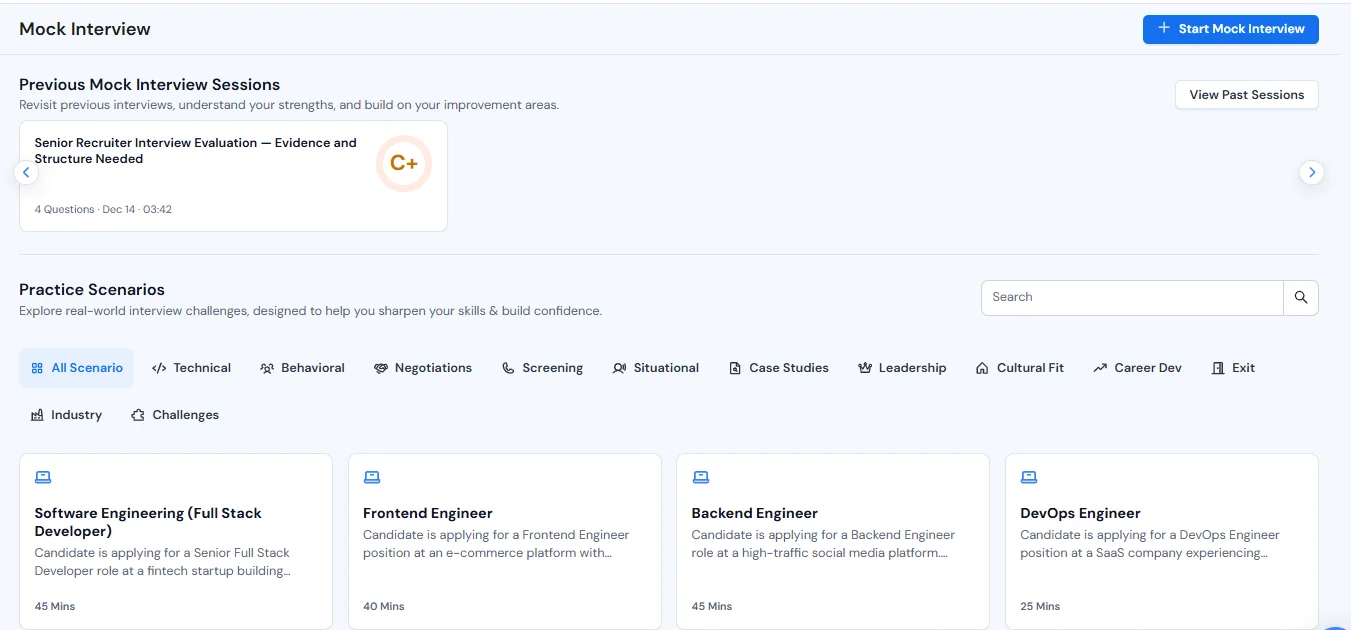
- Iterate: Identify two or three answers that require improvement. Return to ChatGPT to strengthen the content, then record a new practice session in the Mock Interview Tool to test your progress.
.webp)

%20Which%20Should%20You%20Use.webp)
