Resumes
.avif)
.webp)
Every open nursing job gets dozens of qualified applicants. The nurses who get interviews aren't always more experienced. They just have resumes that are properly formatted, keyword-optimized and ATS-compatible so a human recruiter actually sees them.
This guide provides everything you need to make your nursing resume stand out. You’ll learn how to list certifications and licenses, write clinical experience bullets that demonstrate real impact and identify the specialty keywords that matter most for ATS. We'll also show you how to use our AI Resume Builder to accomplish all of this in less time.
Why a nursing resume requires a different approach
Applicant Tracking Systems (ATS) automatically filter out nursing resumes that lack specific keywords, credential formats and precise structure. You must tailor your resume for these systems to ensure a recruiter actually reviews your experience.
Nursing resumes require data absent from corporate resumes, such as active licenses, certifications with expiration dates and specialty experience (ICU, ER, Med-Surg, NICU, Labor and Delivery). You must also include Electronic Health Record (EHR) proficiencies like Epic, Cerner or Meditech. Finally, list unit-specific skills, including IV therapy, medication administration and patient assessment.
The main problem is that most resume tips are for office professionals and corporate job seekers. A marketing manager's structure, language, and keywords won't work for a registered nurse. Follow these nursing-specific rules to ensure your credentials reach a human recruiter.
What to include on a nursing resume
Let’s take a look at some of the most important elements to include in your resume when you’re applying for nursing positions.
✅ Contact information and credentials
Place your credentials immediately after your name, such as Jane Smith, RN, BSN. Display these in the header rather than at the bottom of the document.
Include your active license number, issuing state and expiration date. Many healthcare ATS configurations automatically reject resumes missing this structured license information.
Provide your phone number, professional email, city and state. You don’t need a full street address. Include a current LinkedIn profile URL if you have one.
✅ Professional summary
Write three to four sentences identifying your specialty, years of experience and target role. Be specific so that this high-visibility section is useful to recruiters right away.
Avoid vague phrases like "dedicated and compassionate nursing professional."
👉 Use examples like: "Registered nurse with 5 years of experience in ICU settings, specializing in critical care, ventilator management, and hemodynamic monitoring. Skilled in Epic EHR and ACLS-certified. I am actively looking for an ICU charge nurse position in a Level I or Level II trauma center."
New graduates should highlight clinical rotation settings, patient populations and certifications.
👉 Use this format: "New graduate RN with 600+ clinical hours across Med-Surg and ICU. BLS and ACLS certified. Seeking a role in an acute care setting."
✅ Certifications and licenses
Format this nursing-specific section precisely to make sure an ATS can accurately parse your credentials. Spell out the full certification name, then the abbreviation, issuing body and expiration date.
👉 Use this format: "Basic Life Support (BLS), American Heart Association, Expires: MM/YYYY." Never list only the abbreviation, as an ATS may fail to recognize them.
Order your list based on relevance to your target role. Include common certifications like BLS, ACLS (Advanced Cardiovascular Life Support), PALS (Pediatric Advanced Life Support), TNCC (Trauma Nursing Core Course), CCRN (Critical Care Registered Nurse) and CEN (Certified Emergency Nurse).
✅ Clinical experience
This section is your most important asset. List the employer, hospital system, location, dates and unit size.
👉 Example: "Memorial Regional Medical Center, ICU (32-bed unit), Houston, TX — January 2021 to Present."
Write bullets as achievement statements rather than duty lists.
Use this structure: Action verb + skill + measurable outcome.
👉 Example: "Managed care for 4 to 5 critically ill patients per shift in a 32-bed ICU, administering vasoactive medications and interpreting hemodynamic data to guide treatment adjustments.“ This approach is stronger than "Responsible for patient care in ICU."
Quantify your impact using patient-to-nurse ratios, bed counts, procedure volumes or training contributions. New graduates should treat clinical rotations as experience by including the facility, unit type and total hours.
✅ Education
List your degree, institution, graduation year and GPA if it is 3.5 or higher. If you hold multiple nursing degrees, list in reverse chronological order. Only include relevant coursework or honors if you are a new graduate with limited experience.
✅ Skills
Include a dedicated skills section for EHR systems, specialty competencies and soft skills to optimize ATS keyword matching. Tailor these entries to match the specific keywords in every job description you target.
Common keywords you’ll find in nursing job descriptions:
- Epic
- Cerner
- Meditech
- Patient assessment
- Medication administration
- IV therapy
- Wound care
- Telemetry and ventilator management.
Also, include professional terms like "charge nurse," "precepting," "care planning," "patient advocacy," and "interdisciplinary collaboration."
To Know More 📢: 5 Essential Resume Elements for 2026 (That Make or Break Your Application)
Writing clinical experience bullet points that stand out
Don’t treat your experience section as a generic placeholder. Even though your experience doesn’t change from one application to the next, the wording should be adapted to match what was used in the job description. Hiring managers already understand your basic responsibilities; they need to see your clinical scale, patient acuity and specific technical competencies.
Use this formula for every bullet:
Action verb + clinical task or skill + scope context.
❌ Weak: "Coordinated care for patients."
✅ Strong: "Coordinated care for five patients per shift in a high-acuity ICU, collaborating with physicians and respiratory therapists to manage mechanical ventilation and continuous renal replacement therapy."
Handling travel nursing assignments
List each assignment as a separate entry under your staffing agency. Clearly note the host facility and dates for every contract. Highlight your adaptability to prove you thrive in changing environments.
👉 Example: "Onboarded and reached full clinical productivity within 48 hours at each assignment facility, managing diverse patient populations in Level I trauma centers."
Clinical bullet examples: Before and after
Apply this "Strong" format to every bullet point to differentiate your resume from other applicants.
Medication administration
❌ Weak: "Administered medications to patients."
✅ Strong: "Administered high-alert medications (including vasopressors, anticoagulants and insulin drips) to critically ill ICU patients, performing independent double-checks per hospital policy."
Emergency department care
❌ Weak: "Worked in the emergency department."
✅ Strong: "Triaged and provided care to 20 to 30 patients per shift in a Level II trauma center, managing complex presentations ranging from minor injuries to multi-trauma."
Training and precepting
❌ Weak: "Helped train new nurses."
✅ Strong: "Precepted six new graduate RNs over 18 months, guiding them through orientation, competency checks and skill development in a 24-bed ICU."
ATS keywords for nursing: what to include and where
Healthcare ATS software relies on strict terminology. If a job description requests "telemetry monitoring" and your resume uses "cardiac monitoring," the system won't match your experience.
Always mirror the exact language found in the job posting. If the description lists "Epic EHR," use that exact phrase. If it asks for an "RN," explicitly state "RN" alongside "Registered Nurse."
Specialty-specific keywords to include by unit type
Include these keywords in your skills section or within your clinical experience bullets to ensure high ATS relevance.
ICU and Critical Care
- Hemodynamic monitoring
- Mechanical ventilation
- CRRT
- Vasoactive medications
- Arterial and central lines
- ACLS and CCRN certifications
Emergency Department
- Triage
- Trauma care
- TNCC, ACLS, and PALS
- Moderate sedation
- Rapid sequence intubation
- CEN certification
Labor and Delivery
- Electronic fetal monitoring
- Intrapartum and postpartum care
- Epidural assistance
- Vacuum and forceps deliveries
- Neonatal resuscitation
Med-Surg
- Medication administration
- Wound care
- Patient education
- Discharge planning
- Fall prevention
Pediatrics and NICU
- Neonatal resuscitation
- PALS certification
- Developmental care
- Total parenteral nutrition
- Isolette care
How to build your nursing resume with Careerflow
Use our suite of tools to streamline your nursing job search. Follow these steps to ensure your application bypasses ATS filters and reaches a recruiter.
Job Tracker
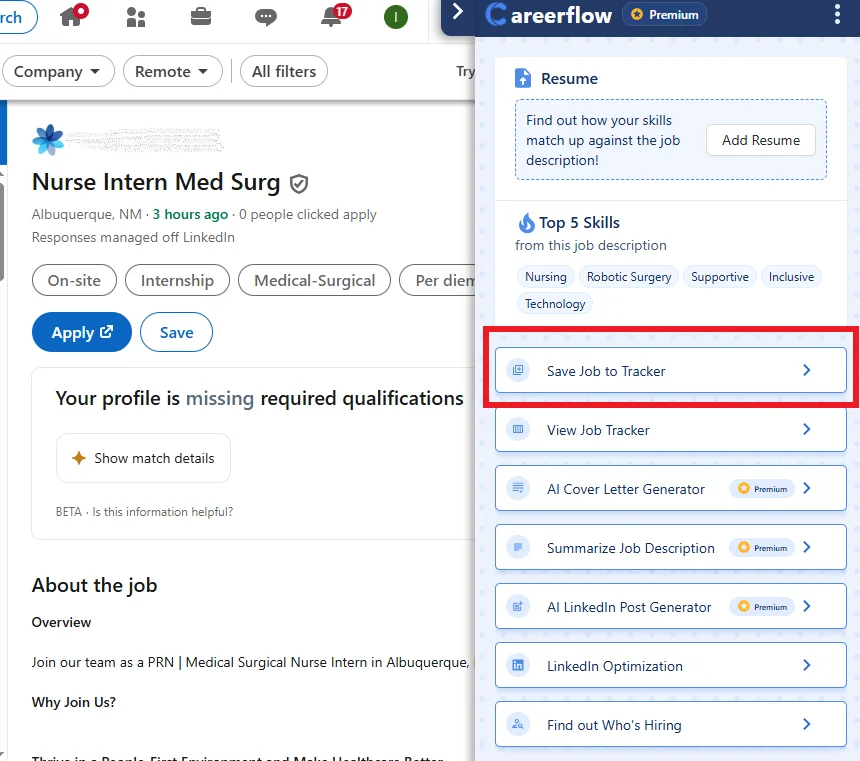
With our sidebar plugin installed, click the Careerflow "C" icon on your LinkedIn profile to save jobs directly into your Job Tracker. This organizes your pipeline and keeps all application status updates in one place.
Resume Builder
Select a blank resume in our Resume Builder. Use a clean, single-column format without graphics, tables or text boxes, as these interfere with ATS parsing.
- Add credentials: Place your nursing credentials immediately after your name in the header, such as Jane Smith, RN, BSN.
- Include certifications: Create a dedicated section for full certification names, issuing bodies and expiration dates.
- Draft your summary: Write a professional summary targeting your desired specialty. Use the AI writing assistant to refine your experience for maximum impact.
- Format clinical experience: Aim for four to six achievement-based bullets per role. Focus on patient acuity, scope of care and technical skills.
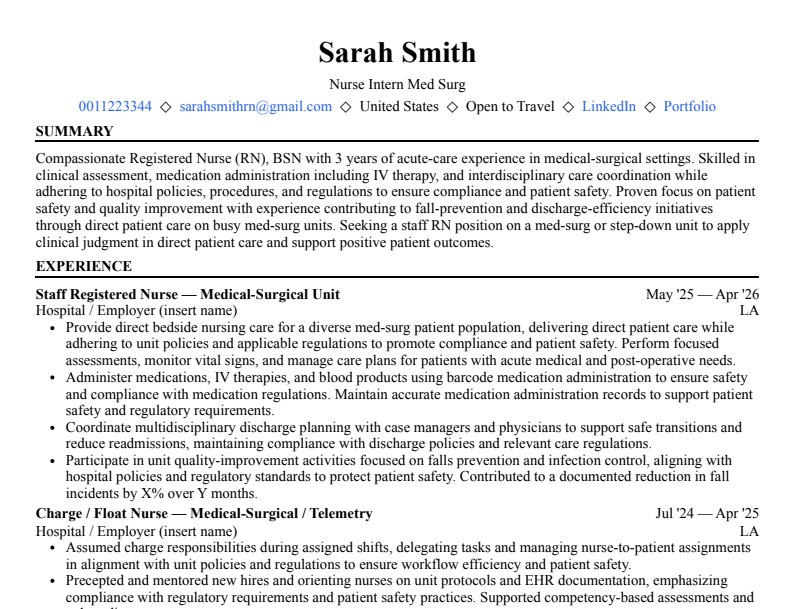
Note: This document is a sample provided for instructional use. Names, dates, and details have been used for illustrative purposes.
Resume Optimizer
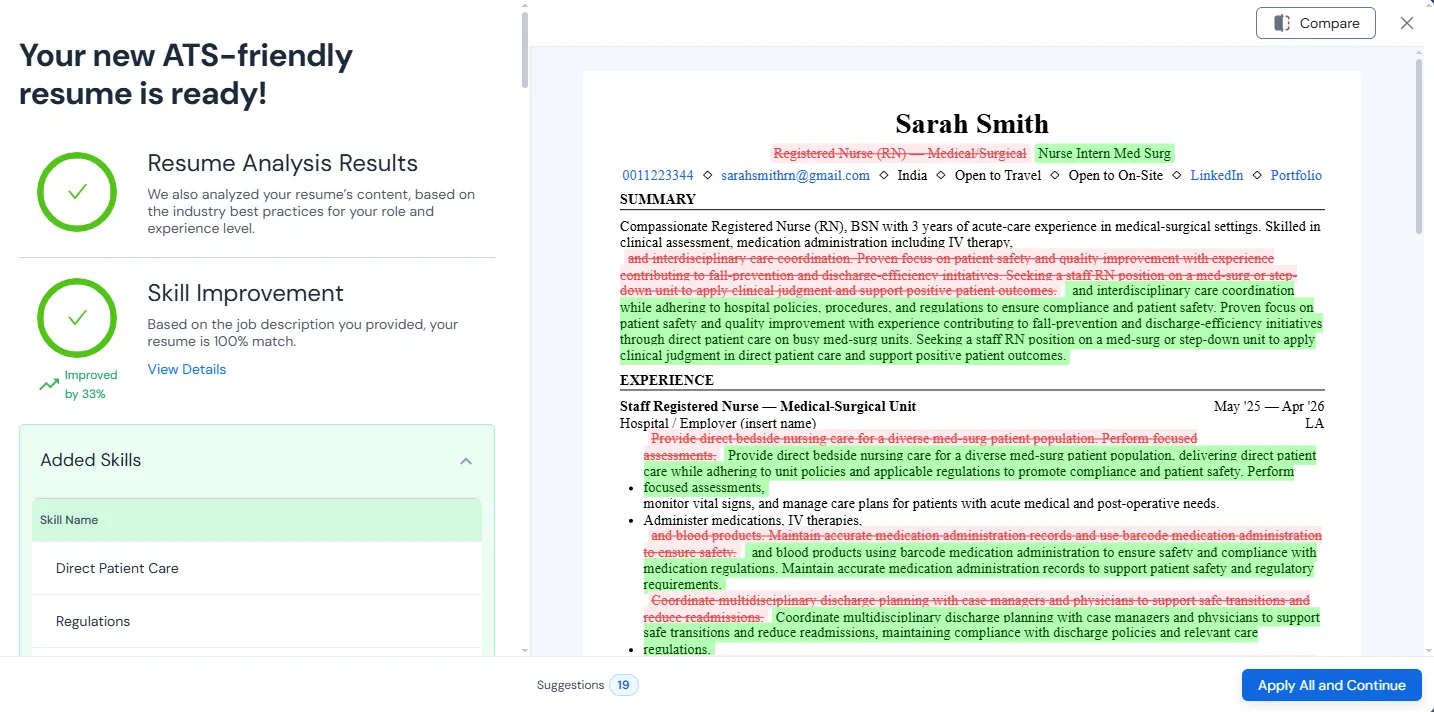
Paste your target job description into the Resume Optimizer. Review the identified keyword gaps immediately.
Focus on missing EHR systems, specialty terminology and required certifications. Add these terms naturally into your experience bullets and skills section. Re-run the optimizer to confirm a high match score before you submit your application.
.webp)
.webp)