Resumes
.avif)
.webp)
Most resume advice tells you to stick to professional achievements and skip the personal details. When hiring managers face two equally qualified candidates, they look for any signal to break the tie. A well-placed hobby can make you a good choice, but use them wisely.
The strategy comes down to a single rule: specificity wins. Writing "hiking" does nothing for your application. Writing "weekend trail running, completed two half-marathons" proves your discipline and follow-through to a hiring manager, but only in the right circumstances.
This guide covers when to include hobbies and which activities make the strongest impression. You'll find 150+ examples organized by category and learn exactly how to format each entry.
Should you include hobbies and interests on your resume?
Yes, you should include a hobbies section on your resume in most cases. Your interests signal personality, cultural fit, and dimensions of your character that professional experience cannot show.
You can skip this section if you have more than fifteen years of experience. When your resume already reaches two pages, use that valuable space for additional accomplishments instead.
A well-crafted hobbies section is beneficial for everyone else, as long as the hobbies and interests are relevant to the job or company. This includes entry-level candidates, career changers, recent graduates, and anyone with open space on page one.
The main risk is including the section poorly, rather than omitting it. Generic hobbies like "reading," "cooking," or "watching movies" waste space and signal nothing to an employer. Specific, relevant hobbies create great talking points and make you human.
If you need a refresher on which sections are non-negotiable, see our guide to essential resume elements.
What makes a good hobby to include
✅ Focus on relevance
A good hobby connects directly to the skills, values, or culture of your target role. For example, a software engineer listing personal coding projects shows immediate technical alignment. A project manager listing their experience running a community tabletop gaming league clearly signals strong organizational skills.
✅ Prioritize specificity
Specific details turn a generic interest into a real data point for hiring managers. Writing "volunteer trail maintenance" always beats a vague phrase like "outdoor activities." Similarly, "amateur landscape photographer with a public Instagram portfolio" is much stronger than just listing "photography."
✅ Ensure it is defensible
You must be able to talk about your hobbies confidently during an interview. Listing an activity that you tried once two years ago becomes a liability rather than an asset. Only include interests that you can discuss with genuine enthusiasm and detail.
✅ Avoid sensitive subjects
Keep your resume free from hobbies that involve political, religious, or divisive subject matter. The only exception is when the target organization explicitly values that specific alignment. For most corporate roles, neutral and universally positive activities work best.
150+ hobbies and interests examples by category
What to avoid
- Generic hobbies: Generic interests like "listening to music," "watching movies," "spending time with family," or "cooking" tell an employer nothing about you. These entries simply waste valuable resume space unless you can add specific, data-driven details.
- Sensitive topics: Avoid hobbies related to partisan politics, religion, or polarizing social movements. These subjects can trigger unconscious bias during the screening process, meaning they carry a massive downside with zero upside for your application.
- High-risk activities: Extreme sports like skydiving, BASE jumping, or competitive motorsports can raise subtle liability or reliability concerns in conservative industries. Use careful judgment before including activities that imply high physical risk.
- Superficial interests: Never list a hobby that you cannot discuss fluently in a live interview. If an interviewer asks about your rock climbing entry and you cannot name a local route, the inclusion backfires and damages your credibility.
- Limit lists: Limit your selection to three to five well-chosen entries that highlight different dimensions of your character. Listing twelve different hobbies looks like resume padding and dilutes the impact of your strongest interests.
How to write a hobbies and interests entry
Each entry must be specific enough to create an immediate image for the recruiter. Keep the formatting concise, as one line is plenty and you do not need full sentences for every item.
You can use a simple bulleted list, a comma-separated inline list, or a brief phrase providing context. Consider these examples of strong versus weak entries:
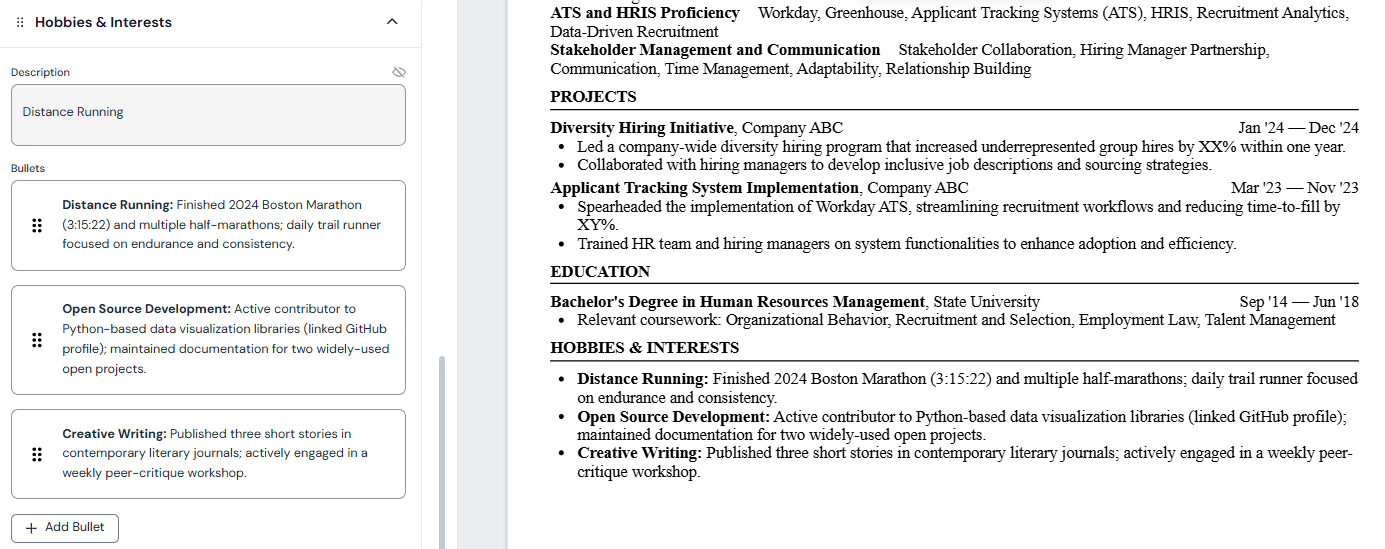
- Strong: "Distance running - Completed Chicago Marathon 2024 and two half-marathons"
- Strong: "Open-source contributor - Active maintainer on three GitHub repositories"
- Strong: "Youth soccer coach, U12 recreational league (four seasons)"
- Weak: "Running, soccer, volunteering"
How to tailor the section to the role
Always research the company's culture before deciding which personal interests to highlight on your resume. A fast-growing startup with a competitive environment responds differently to endurance sports than a community nonprofit does.
Review LinkedIn profiles and Glassdoor employee reviews to see what types of personalities and activities the company celebrates internally. Use these cultural signals to choose your best three to five hobbies.
Where to put the hobbies section on your resume
Always position your hobbies section at the very bottom of your resume, following your work experience, education, and skills. This content serves as supplementary information, meaning it should never overshadow your primary qualifications.
Keep the section brief enough to fit comfortably without pushing essential career history onto a second page. If space becomes tight, always cut your hobbies before reducing your professional experience or education content.
Label the section "Hobbies and Interests," "Interests," or "Activities," as all three options are universally accepted by recruiters. Avoid informal headers like "Personal Life" or "Fun Facts," which sound unprofessional.
For full resume layout guidance, see our best resume format guide.
How to build your full resume with our AI resume builder
AI resume builder
Open the AI resume builder and complete your professional experience, education, and skills sections first. Establishing this foundation ensures your primary qualifications receive the most prominent placement on the page.
Once your core resume is complete, locate the additional information area within the builder tools. Add a brief hobbies and interests section here to highlight your personality and cultural fit.
Use the built-in formatting controls to keep this final section proportional to the rest of your document. Ensure your hobbies occupy no more than four to six lines on the finished resume layout.
.webp)
.webp)