Job search
.avif)
.webp)
A letter of interest introduces your skills to a company before they post an open job. It helps you build direct connections with hiring managers and land unlisted roles. You're not asking for an immediate opening. Instead, you're starting a professional conversation about future opportunities.
Reaching out early shows initiative and sets you apart from other job seekers. You can share your relevant work history, explain why you admire the company and offer immediate value. Many companies hire talent through these early connections instead of public job boards.
This guide covers when to send your letter and how it differs from a cover letter. We'll also provide fill-in templates, proven examples, subject line ideas and common mistakes to avoid.
What is a letter of interest?
A letter of interest is a short message you send to a company before they post an open job. You can send it as a direct email to introduce yourself to hiring managers.
A strong letter answers three simple questions:
- Why do you want to work for this company?
- Why this type of work?
- Why should the hiring manager remember you?
Make sure your message is unique to the employer. Generic emails get ignored quickly because they don't have real focus. Email works best for most modern job searches, but formal organizations may prefer a written letter.
Letter of interest vs. cover letter
The main difference comes down to whether there's an active job opening. A cover letter responds to an existing job post. You use it to match your skills directly to a job description. Use our cover letter examples to utilize various templates based on your skills and job description.
A letter of interest introduces your background before a role opens up. You anchor your message to the company's growth, products or overall mission. Both documents require clear personalization, but letters of interest help you land unlisted roles early.
📢 To Know More: Is a Cover Letter Necessary in 2026? (The Honest Answer)
Letter of interest vs. letter of introduction
A letter of interest comes directly from you, while a letter of introduction usually comes from a mutual contact.
Here's how they differ:
- Letter of interest: You write directly to a hiring manager to share your work background and ask about future roles.
- Letter of introduction: A mutual connection writes to introduce you to someone in their network.
Both help build your network, but an introduction relies on a third party to connect you.
When should you send a letter of interest?
Send a letter of interest when you find a company you love that isn't hiring for your role yet. Reaching out proactively shows initiative and helps you build connections before jobs go public.
Here are the best times to send one:
- No open roles: You admire the company, but they don't have a job opening for your skillset.
- You got a referral: A professional contact suggested you reach out to a specific team leader.
- You met at an event: You connected with an employee during an industry conference or networking event.
- You're switching careers: You want to explain how your transferable skills fit before a job description gets posted.
- You want to stay on their radar: You want to build a relationship before the team expands.
Avoid sending the same mass message to dozens of employers. Generic emails read like spam and get deleted fast.
Always research the company before reaching out. Mention a recent product launch, news article or team goal to show genuine interest. A targeted message stands out and builds real trust.
What to include in a letter of interest
A strong letter of interest stays short and focused. Keep your email brief while covering four essential elements.
1. A specific opening
State your reason for writing in the first sentence. Name the specific team or role type you're targeting.
Avoid generic phrases like "I am writing to express interest in your company." Instead, state your intent clearly.
Example: "I've been following [Company]'s work in [area] and wanted to introduce myself for future [role type] roles."
2. Why this company
Explain why this exact company caught your eye. Mention a recent product release, news article, customer base, growth area or team accomplishment.
Keep this section brief. One or two targeted sentences show genuine research without overwhelming the reader.
Example: "Your recent launch of the open-source developer toolkit caught my attention. I admire how your product team simplified complex API integrations for non-technical users."
3. Relevant skills or proof
Share two or three key strengths that match your target role. Always back your claims with real numbers or project wins.
For example: "In my last role, I helped launch a customer onboarding workflow that reduced setup time by 25%, which is why your work in user activation caught my attention."
4. A clear next step
End with a clear and easy call to action. Ask if they're open to a brief chat or if another person handles hiring.
Avoid pressure requests. Make your message easy to read, reply to or forward to another team member.
Example: "If you're open to it, I'd welcome a brief 10-minute chat this month. Alternatively, please let me know who handles hiring for future product roles."
How to write a letter of interest step by step
Writing an effective letter of interest requires a strategic approach. Follow these six steps to craft a compelling message that gets responses.
Step 1: Target a specific company and reason
Start by selecting an employer you genuinely want to work for. You need a clear reason for reaching out today. Research their current projects, recent news or market expansion. If you can't explain why this exact company matters to you, stop and research more.
Step 2: Define your target role or value
Focus on a specific department, role type or business problem you can help solve. Never say you're open to "anything available." Unfocused requests make hiring managers work harder to place you. Stating a clear focus makes your message memorable and actionable.
Step 3: Draft an intentional opening
Write a direct opening paragraph that explains why you're reaching out today. State your target field or role immediately. Mention a specific connection point like a recent product launch or mutual contact. This approach proves your email is tailored specifically for them.
Step 4: Share strategic proof points
Highlight two or three accomplishments that align with the team's primary goals. Back every claim with measurable metrics, key outcomes or portfolio projects. Data points show your potential impact better than simple adjectives.
Step 5: Include a clear next step
End your letter with a low-pressure request, such as a brief introductory call. Link your LinkedIn profile or attach your resume for quick review. Keep the next step easy for the recipient to answer or forward.
Step 6: Apply the swap test
Review your complete draft before pressing send. Replace the employer name with a competitor's name in your text. If the letter still makes sense, your message is too generic. Rewrite your draft until it applies only to that specific company.
Letter of interest examples
Explore these practical templates to craft your own proactive outreach messages. Customize each sample to fit your professional background and target company.
Short email-style letter of interest
Use this concise template when reaching out to busy recruiters or hiring managers who prefer direct communication.
Subject: Future product marketing roles at [Company Name]
Hi [Hiring Manager Name],
I've followed [Company Name]'s growth and loved your recent product update on [Feature/Product]. Your focus on user-centric design really stands out.
I'm a product marketer with over four years of experience driving adoption for SaaS platforms. In my last role, I launched a go-to-market campaign that increased active users by 35% in six months.
I know you aren't actively hiring for marketing roles right now. However, I'd love to connect if you expect future openings on your team.
Are you open to a quick 10-minute chat next week?
Best regards,
[Your Name]
[LinkedIn Profile Link]
Career-change letter of interest
Use this template to highlight transferable skills when transitioning into a new industry or department.
Subject: Customer success inquiry – [Your Name]
Hi [Hiring Manager Name],
I'm reaching out because I greatly admire [Company Name]'s commitment to customer education and seamless onboarding.
After five years as an educator, I'm transitioning into customer success. In my previous role, I designed training programs that improved student engagement by 40%. I also managed daily communications for over 200 stakeholders. My background in conflict resolution and client training translates directly to managing SaaS customer accounts.
I'd love to discuss how my skills can support your retention goals as your team grows.
Do you have 10 minutes for a brief call next week?
Best regards,
[Your Name]
[LinkedIn Profile Link]
Recent graduate letter of interest
Use this format to leverage academic projects, internships and campus leadership when seeking entry-level opportunities.
Subject: Data analyst interest – [Your Name]
Hi [Hiring Manager Name],
I recently graduated from [University Name] with a degree in Data Analytics. I've tracked [Company Name]'s data initiatives, and I love your focus on predictive modeling.
During my senior capstone project, I analyzed 50,000 customer records to build a churn prediction model with 88% accuracy. I also completed a data analyst internship where I built automated dashboards for executive reporting.
I know you might not have open roles today. Still, I'd love to learn more about your data operations for future opportunities.
Would you be open to a brief introductory chat?
Best regards,
[Your Name]
[LinkedIn Profile Link]
Referral-based letter of interest
Use this approach when a mutual contact suggests you reach out directly to a hiring manager.
Subject: Referred by [Referral Name] – [Your Role/Field] opportunities
Hi [Hiring Manager Name],
[Referral Name] suggested I reach out to you directly. She mentioned your team is working on expanding your infrastructure, and I wanted to introduce myself.
I'm a DevOps engineer with six years of experience building scalable cloud solutions. At my last company, I led an infrastructure migration that cut cloud spending by 25% while maintaining 99.9% uptime.
I'd love to connect and learn more about your upcoming infrastructure goals for this year.
Are you open to a quick 10-minute chat next week?
Best regards,
[Your Name]
[LinkedIn Profile Link]
Letter of interest template
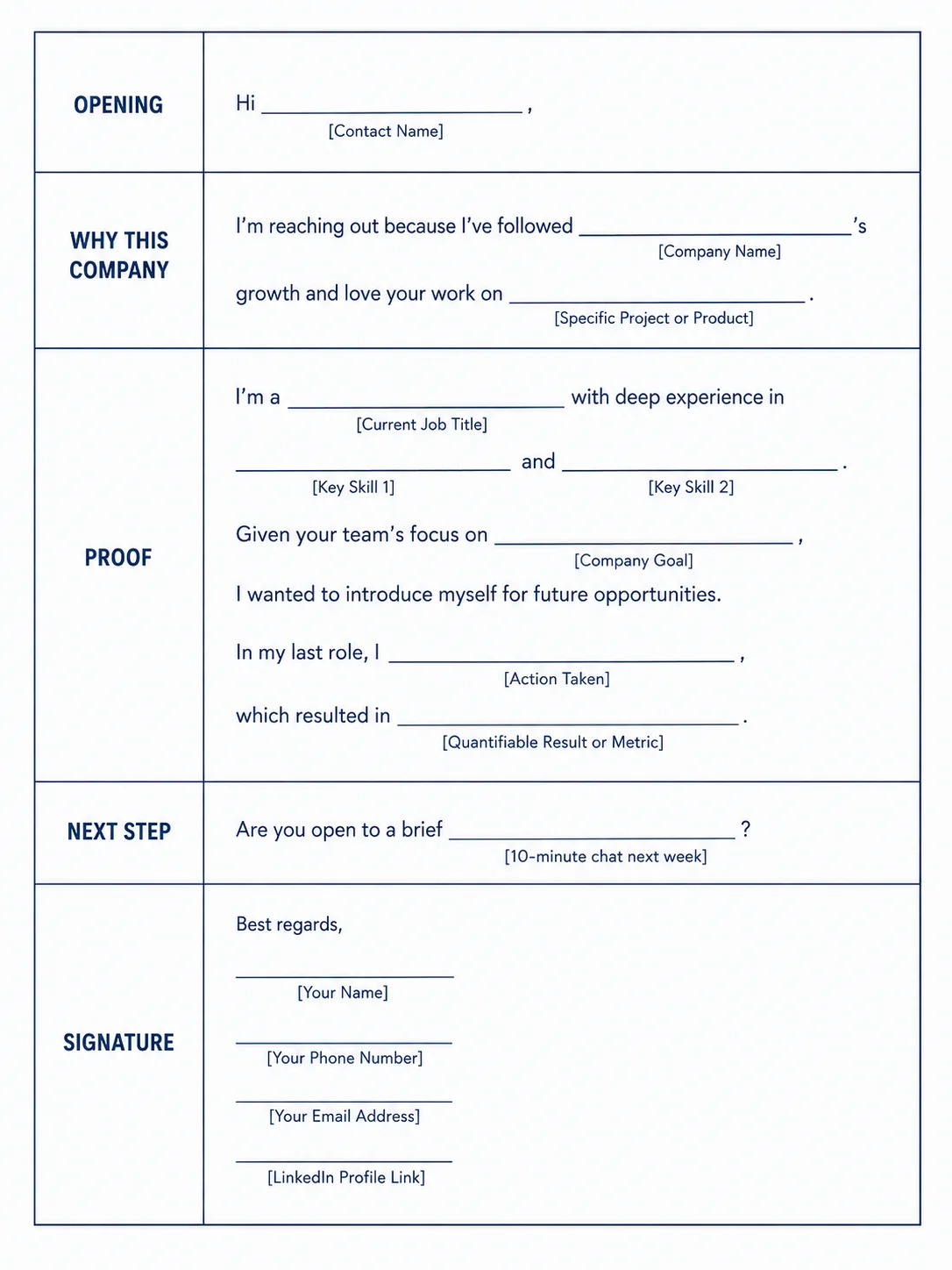
Use this fill-in-the-blank template to quickly draft a targeted letter of interest for any company.
Subject: Future [Target Job Title] opportunities – [Your Name]
Hi [Contact Name],
I'm reaching out because I've followed [Company Name]'s growth and love your work on [Specific Project or Product].
I'm a [Current Job Title] with deep experience in [Key Skill 1] and [Key Skill 2]. Given your team's focus on [Company Goal], I wanted to introduce myself for future opportunities. In my last role, I [Action Taken], which resulted in [Quantifiable Result or Metric].
Are you open to a brief 10-minute chat next week?
Best regards,
[Your Name]
[Your Phone Number]
[Your Email Address]
[LinkedIn Profile Link]
Subject lines for a letter of interest email
A strong subject line determines whether a hiring manager opens your message. Keep your subject line clear, specific and under 60 characters so it reads easily on mobile devices.
Use these proven subject line templates for your outreach:
- Interest in future [Role Type] roles at [Company Name]
- Referred by [Name] – interest in the [Team Name] team
- Exploring future [Department] opportunities at [Company Name]
- [Field] professional interested in [Company Name]'s [Area/Project]
- Future [Job Title] inquiry – [Your Name]
- Connecting regarding future growth on the [Team Name] team
- Experienced [Job Title] interested in [Company Name]
- [Your Name] – inquiry about future [Department] roles
- Admirer of [Company Name]'s [Product/Project] – [Your Name]
- Introduction and interest in [Company Name]'s [Department] team
Common mistakes to avoid
Avoiding key pitfalls ensures your message lands well with busy hiring managers. Avoid these common mistakes when writing your letter of interest.
Sending generic messages
Don't send the same email to multiple companies. Generic notes read like spam and get deleted fast. Tailor every letter to show real interest in the company's specific goals.
Confusing it with a cover letter
Don't write a letter of interest as a response to an active job posting. Cover letters address open roles directly. Letters of interest focus on potential future opportunities and overall company growth.
Overexplaining your career history
Avoid listing your entire work history in one email. Focus on two or three relevant achievements with clear numbers. Short messages respect the recipient's time and highlight your best wins.
Sounding entitled
Never demand a job or ask for extensive time right away. Frame your message around adding value to their team. A respectful approach opens doors faster than demanding immediate attention.
Leaving out a next step
Don't end your message without a clear request. Ask for a brief introductory call or inquire about future hiring plans. A concrete next step makes replying effortless for the contact.
Expecting guaranteed responses
Remember that cold outreach doesn't guarantee a response from every employer. Tools and templates help you craft clear content, but you must send the message and manage follow-ups yourself.
How Careerflow can help
Now that you know how to write a letter of interest, it's time to build your outreach. Careerflow helps you draft, personalize and organize your message in one place.
Here's how you can streamline your job search outreach:
- AI Cover Letter Generator: Generate a polished first draft tailored to your target company.
- AI Email Writer: Craft professional outreach messages and subject lines in seconds.
- Job Tracker: Track who you contacted, save key notes and set follow-up reminders.
Building professional connections takes consistency. Careerflow gives you the tools to stay organized and land unlisted opportunities faster.