


Resumes
.avif)
.webp)
Your work experience section is where hiring decisions are made. Recruiters scan applications quickly, and ATS filters out a significant share before a human ever sees them. Getting this section right is the difference between landing interviews and landing in the rejection pile.
In 2026, simply listing your past duties isn't enough to stand out in a tech-driven market. Recruiters are no longer looking for a list of what you did; they are looking for proof of what you achieved. This guide covers everything you need to know about writing a work experience section that passes ATS filters and impresses hiring managers.
We’ll break down the exact format to use and the accomplishment formula that transforms weak bullets into interview-winning statements. You’ll also learn how to handle remote work, employment gaps, career changes, and freelance experience. We’ve even included 10+ industry-specific examples you can adapt for your own use.
Whether you're writing your first resume or refreshing one with 20+ years of experience, you'll learn how to present your work history strategically. Stop writing a chronological biography and start building a high-impact document that lands more interviews in the competitive 2026 job market.
What to include in your work experience section
The work experience section of your resume is the most important part. It gives proof of your professional claims. Each entry must have five important parts: the job title, the name of the company, the location, the dates of employment, and three to five bullet points about accomplishments.
This part usually comes after your resume summary and before your education. But if you're changing careers, consider putting a skills section first to highlight your transferable skills.
The five essential elements
To pass both the ATS and earn a closer read from a recruiter, each entry needs to be consistent and easy to scan at a glance.
✅ Job Title: Use your official title. If your company used internal jargon like "Associate III," use a more common term like "Software Engineer" so that recruiters can find you.
✅ Company Name: Include the full name. If the company is a smaller startup, add a quick descriptor like "Acme Corp (B2B SaaS startup)" to provide context on your environment.
✅ Location: List the city and state. For modern roles, list "Remote" or "Hybrid," as these are now standard search filters for recruiters in 2026.
✅ Dates: Use the month and year format (e.g., "January 2022 – Present"). Consistency is key here to avoid confusing the ATS.
✅ Bullet Points: Aim for 3–5 achievement statements. Your most recent roles should have more detail, while older positions can be trimmed to 2–3 bullets.
What NOT to include
Cluttering your work history with unnecessary details makes it harder for recruiters to find your wins. Keep your entries lean by avoiding these common mistakes:
❌ Personal pronouns: Never start a bullet with "I" or "Me." Always lead with a strong action verb like "Managed," "Developed," or "Accelerated."
❌ Duty lists: Avoid "Responsible for" or "Duties included." These describe what was asked of you, not what you actually delivered.
❌ Confidential data: Never share trade secrets or proprietary metrics. Use percentages instead of raw dollar amounts if the data is sensitive.
❌ Irrelevant history: If you have 10+ years of experience, your college retail job no longer needs to be on your resume.
❌ Salary info: Never list your previous pay. Save compensation talks for the later stages of the interview process.
How to format work experience on your resume
Formatting your resume isn't just about making it look good; it's also about making it easy for humans and ATS to read. A clean, logical layout is the minimum requirement for passing ATS and earning a closer look from a recruiter.
Avoid creative graphics and multi-column designs. These scramble your data for ATS parsers, which can push your application out before a human ever sees it. Use a single-column, professional layout that naturally leads the reader's eye from your most recent wins to your earlier career milestones. If you pick a standard format, your accomplishments will stay the focus of your application instead of your design choices.
The standard work experience format
Use this template for each position:
Job Title
Company Name, City, State (or Remote)
Month Year – Month Year (or Present)
• Achievement statement with specific metric or outcome
• Achievement statement demonstrating skill relevant to target role
• Achievement statement showing scope or scale of responsibility
• Achievement statement highlighting collaboration or leadership
1. List positions in reverse chronological order
Resumes are filtered by ATS before a recruiter sees them. List your positions in reverse chronological order so the software can parse your experience correctly. This not only helps in ATS shortlisting but also allows employers to quickly see your most relevant skills and experience.
Why it works
Recruiters form first impressions fast. They want to see your career progression and current impact without having to hunt for it. This format provides a clear "story" of your professional growth, making it easy to see how each role prepared you for the one you are applying for now.
Below is an example of a work experience section in reverse chronological order.

When to use an alternative
While reverse chronological is the default, there are rare exceptions where a functional or combination (hybrid) resume might be appropriate:
- Career Changers: If you are moving from teaching to software engineering, a hybrid resume allows you to lead with your "Technical Skills" while keeping your work history secondary.
- Significant Gaps: A functional layout focuses on skills over dates, which can help mask long periods of unemployment.
📢Note: Most recruiters view functional resumes as a red flag. They often assume you are trying to hide something, like a lack of experience or a difficult departure. Use these formats sparingly and only if a traditional layout truly doesn't tell your story.
To Know More, Check Out 👉: How Far Back Should a Resume Go in 2026?
2. Create a dedicated work experience section
Start by creating a dedicated "Work Experience" section in your resume to showcase your professional journey. Choose an appropriate title like "Professional Experience", "Experience" or "Work Experience".
- "Professional Experience": This is the standard for mid-career and senior professionals. It suggests a history of career-track roles and established expertise.
- "Work Experience": This is a universal, safe choice that works for every level, from recent graduates to seasoned professionals.
- "Experience": Clean and minimalist. This works best for design-forward resumes or when you are fighting for every millimeter of white space.
- "Relevant Experience": A strategic choice for career changers. It tells the recruiter you have curated this list specifically to show why you match this job, even if your background is non-traditional.
3. Format job information consistently
Before listing your achievements, display this job information consistently for each role.
For each job, follow a consistent format that includes:
- Job Title: Clearly state the title you held.
- Company Name: Include the company's name and location (city and state).
- Dates of Employment: List your start and end dates (month and year).
Below is an example of formatting the job information correctly.

Option A: Title-first (Recommended)
This format is the standard format as shown above. It highlights your level of seniority and specific expertise immediately. If you are applying for a role that matches your current title, this is the most effective choice.
Senior Marketing Manager
Acme Corporation, New York, NY
March 2021–Present
Why it works: Recruiters look for "title matches" first. Leading with your role makes it impossible for them to miss that you are already performing at the required level.
Option B: Company-first
This format is ideal if you have worked for "blue-chip" companies or industry leaders (e.g., Google, Amazon, Goldman Sachs). It leverages the brand equity of your employer to grab attention.
Acme Corporation, New York, NY
Senior Marketing Manager
March 2021–Present
Why it works: High-growth startups and competitive firms often look for candidates who have been "vetted" by top-tier global companies. Leading with a recognizable name can act as an immediate seal of quality.
4. Tailor your work experience to match the job description
Most people don't tailor their resume to match their job description. Hiring managers use the applicant tracking system (ATS) to discover qualified candidates by entering keywords (words and phrases) extracted from the job description. Your resume will be seen by the hiring manager more frequently if it includes these keywords. Next time, carefully review the job description and highlight skills and experiences directly relevant to the position you're applying for. This creates a targeted and impactful impression.
In order to cross this hurdle, Careerflow Resume Builder uses a job description to draft your resume, as shown in the image below.

How to tailor your work experience
In 2026, a "generic" resume is basically an empty resume. You need to change your work history for each application so that modern AI filters and busy recruiters can see it. Tailoring isn't about changing what you did; it's about changing how you talk about it.
Follow this workflow to ensure your resume matches the specific needs of the hiring manager:
- Highlight the job posting: Save the job description as a PDF or print it. Highlight every required skill, specific software, and key qualification mentioned.
- Match your experience: For every highlighted item, find a specific moment in your career that proves you have done it. If the job asks for "conflict resolution," find the bullet point where you mediated a team dispute.
- Reorder bullets: Put your most relevant wins at the top of each role. If a job is 80% "data analysis," your data-related bullet points should be first, even if that wasn't your primary daily task.
- Mirror the language: Use the exact terminology the company uses. If the posting asks for "Project Management," don't use "Program Coordination." The ATS is looking for a direct match.
Before/After Example:
Notice how the tailored version moves from a vague task to a data-backed achievement that uses industry-standard tools.
Generic bullet (not tailored):
Managed team projects and delivered results on time.
Tailored for the project manager role:
Led a cross-functional team of 8 through Agile sprints, delivering 12 software releases on schedule and 15% under budget using Jira and Confluence.
Why this works
The tailored example does three things the generic one doesn't: it quantifies the impact (15% under budget), it names the tools (Jira/Confluence), and it identifies the methodology (Agile). This gives the recruiter concrete evidence that you can hit the ground running.
5. Use bullet points for impact
Once you are set with the overall layout of your experience section, it is time to concentrate on the content you are going to use in the section. Use clear and concise bullet points to highlight your accomplishments at each job. Aim for 3-5 impactful points per role, depending on the position and your accomplishments.

Are you struggling with creating bullet points that include all the relevant metrics and achievements for your work experience? If so, you'll be pleased to know that our AI-powered resume builder can help. Our innovative AI feature can generate bullet points for you, as demonstrated in the image below.

How many bullet points per position:
Length of bullet points: Each bullet should be no more than 1-2 lines long. If a bullet goes to a third line, either break it into two bullets or make the language more concise.
The accomplishment formula: Writing bullet points that get interviews
Most resumes fail because they list job duties instead of accomplishments. Hiring managers aren't looking for what you were "responsible for"—they want to see the specific impact you made. A list of duties tells a recruiter what was asked of you; a list of accomplishments tells them what you actually delivered.
Use the Action + Context + Result formula to transform vague responsibilities into high-impact statements that prove your value.
The formula: Action + Context + Result
By structuring every bullet point with these three elements, you ensure that every line of your resume justifies your seat at the table.
- Action: Start with a strong, past-tense action verb. Avoid "Worked on" or "Helped with." Instead, use "Led," "Developed," "Increased," or "Streamlined."
- Context: Add the scope or scale of the project. Mention your team size, the specific tools you used, or the difficulty of the challenge you faced.
- Result: End with a measurable outcome. This is the "so what?" of your bullet point. Use percentages, dollar amounts, or time saved to give your work weight.
Quick tips for maximum impact
- Leading with numbers: Aim for at least one metric in 70% of your bullet points. If you can't find a hard number, use frequency (e.g., "Managed 5+ projects simultaneously").
- Power verbs: Use "Architected" for technical wins, "Orchestrated" for complex management, and "Surpassed" for sales or performance goals.
- The "So What?" Test: After writing a bullet, ask yourself "So what?" If the answer isn't in the bullet, add the result.
Before/After Transformations
❌ Weak (duty-focused):
Responsible for managing social media accounts.
✅ Strong (accomplishment-focused):
Managed company social media presence across 4 platforms, growing follower engagement by 40% and driving 200+ weekly website visits through strategic content calendars.
❌ Weak:
Handled customer service inquiries.
✅ Strong:
Resolved 50+ customer inquiries daily with a 95% satisfaction rating, reducing average response time from 24 hours to 4 hours through improved ticketing workflows.
❌ Weak:
Worked on the sales team to meet quotas.
✅ Strong:
Exceeded quarterly sales quotas by an average of 18% ($240K in new revenue), ranking #2 of 15 sales representatives for three consecutive quarters.
❌ Weak:
Assisted with project management duties.
✅ Strong:
Coordinated a $1.2M website redesign project across 5 departments, delivering 2 weeks ahead of schedule and 10% under budget.
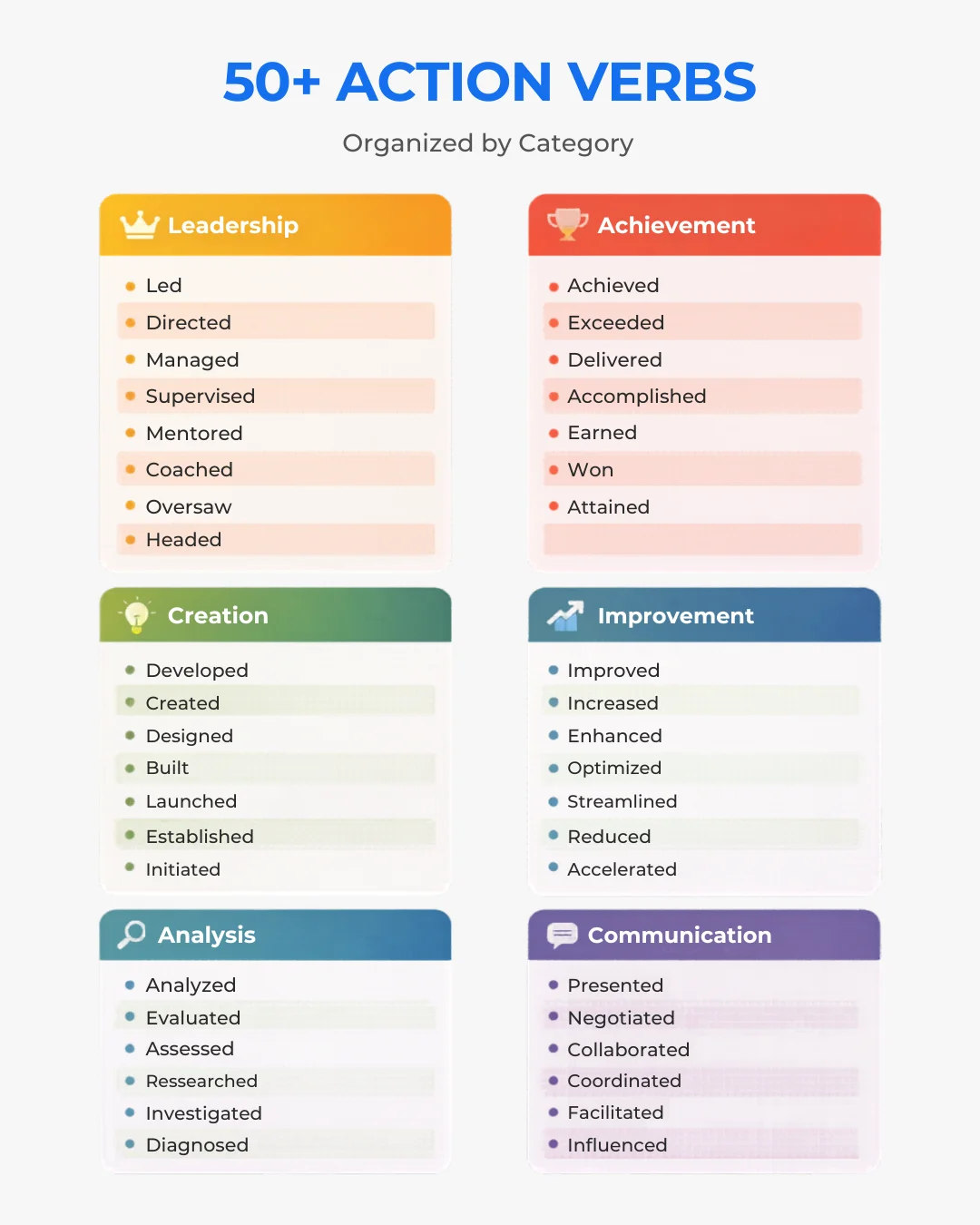
50+ action verbs by category
✅ Leadership: Led, Directed, Managed, Supervised, Mentored, Coached, Oversaw, Headed
✅ Achievement: Achieved, Exceeded, Delivered, Accomplished, Earned, Won, Attained
✅ Creation: Developed, Created, Designed, Built, Launched, Established, Initiated, Founded
✅ Improvement: Improved, Increased, Enhanced, Optimized, Streamlined, Reduced, Accelerated
✅ Analysis: Analyzed, Evaluated, Assessed, Researched, Investigated, Identified, Diagnosed
✅ Communication: Presented, Negotiated, Collaborated, Coordinated, Facilitated, Influenced
Using numbers to tell the story
Numbers add credibility and weight to your accomplishments. They transform a vague statement into a powerful impact story. Here's how:
- Vague: "Increased sales."
- Impactful: "Implemented a new sales strategy that increased monthly sales by 12% and exceeded quarterly targets."
The second statement, with a specific number and timeframe, showcases your success and quantifies your contribution to the company's bottom line.
If you don't have exact numbers, estimate conservatively:
- "Managed a team" → "Managed a team of 6 direct reports"
- "Increased sales" → "Increased sales by approximately 15%"
- "Handled multiple projects" → "Managed 8-10 concurrent projects"
- "Improved efficiency" → "Reduced processing time by ~30%"
Metrics that impress hiring managers:
- Revenue generated or saved
- Percentage improvements (efficiency, satisfaction, conversion)
- Team size or scope of responsibility
- Project budgets managed
- Customer/client numbers
- Time saved or deadlines met
How to list remote work on your resume
Remote and hybrid work are common these days, but if you don't format them correctly, it can mess up Applicant Tracking System (ATS) data or leave hiring managers guessing. To stand out, you need to show that you are doing well in a distributed environment, not just "working from home."
Three ways to indicate remote work
Consistency is the most important rule. Choose one of these three options and apply it to every remote role in your history.
Option 1: Add "(Remote)" to location
Best if the company is fully remote or you want to emphasize your location independence.
Marketing Manager
Acme Corporation, Remote
January 2022–Present
Option 2: List company location with remote note
Best if the company has a prestigious headquarters or you want to show you were tied to a specific office.
Marketing Manager
Acme Corporation, San Francisco, CA (Remote)
January 2022–Present
Option 3: Note in first bullet point
Best if you want to highlight the skills required for remote work rather than just the status.
Marketing Manager
Acme Corporation
January 2022 – Present
- Led a fully remote marketing team of 6 across 3 time zones, maintaining a 95% project delivery rate through asynchronous workflows in Slack and Asana.
Remote work skills to highlight
To get a remote job, you need to show that you are a "self-starter" who can communicate well without being in an office. Use these words in your achievement bullets:
- Asynchronous collaboration: Mention tools like Notion, Slack, or Loom to show you can work effectively across time zones.
- Virtual communication: Detail your proficiency with Zoom, Microsoft Teams, and high-level project management.
- Self-direction: Use metrics to show you delivered results with minimal supervision.
- Distributed leadership: If you managed people, highlight how you handled onboarding and mentoring in a digital-first environment.
Example: Remote work experience entry
Senior Product Manager (Remote) TechStart Inc. | Austin, TX March 2021 – Present
- Lead a fully distributed product team of 8 across US, UK, and India time zones, delivering 4 major feature releases in 2025.
- Established asynchronous communication protocols using Notion and Loom, reducing weekly meeting time by 40%.
- Managed a $500K product development budget remotely, delivering all initiatives on schedule and 12% under budget.
To Learn More, Check Out 👉: How to Write a Resume
How to handle employment gaps
There are more and more job gaps, and they are more accepted than ever, especially in the 2026 market. The most important thing is to deal with them ahead of time. If you don't explain a gap in your work history, recruiters might guess what it is. But if you do, you control the story.
Be honest but strategic
You don't need to provide a medical history or a deep dive into personal struggles. You simply need to account for the time.
- Avoid fabrication: Never "stretch" your employment dates. Background checks will catch discrepancies, and you will be immediately disqualified for dishonesty.
- Keep it brief: Your resume is for your wins, not your explanations. Save the nuance for the interview.
- Address it directly: A one-line entry prevents a recruiter from thinking you have something to hide.
How to list gap periods
Choose the option that best fits the length of your break and what you did during that time.
Option 1: Include a brief entry
Best if you spent your time upskilling, volunteering, or caregiving.
Career Break | Jan 2023 – Aug 2023
- Completed Google Project Management Certificate.
- Provided pro bono marketing consulting for a local nonprofit.
Option 2: Use years instead of months (for gaps under 12 months)
Best for gaps under 12 months that fall within a single calendar year.
Marketing Manager, Acme Corp | 2021–2023 Marketing Coordinator, Beta Inc | 2019–2021
Option 3: Address in cover letter or summary
Best for explaining a pivot or a long-term hiatus.
"After a planned career break for family caregiving, I am now returning to the workforce with refreshed [Skill A] and [Skill B]..."
Acceptable gap explanations
In 2026, a lot of reasons for a break are thought to be normal. Use these professional names:
- Family caregiving: "Career break for family caregiving."
- Health: "Medical leave" (Note: You are never required to provide specific medical details).
- Education: "Full-time graduate studies" or "Professional development."
- Layoff: "Position eliminated due to company restructuring" (Very common; carries no stigma).
- Entrepreneurship: "Freelance consulting" or "Independent contractor."
What to do during an active gap
If you're not working right now, think of your "gap" as a time to take care of your career. This makes your eventual entry much stronger:
- Online certifications: Earn badges from Google, HubSpot, or AWS to show your skills are current.
- Freelance projects: Even a one-week gig counts as professional experience.
- Volunteer leadership: Managing a nonprofit’s social media or budget proves you still have "the muscle."
- Side projects: Build a portfolio piece or contribute to an open-source project to show initiative.
Work experience for career changers
When you change careers, you don't have to start over. Instead, you just need to change your background to show off your transferable skills. The goal is to show that your past successes have already made you ready for the challenges of the job you want.
Lead with transferable skills
If you're changing careers, a standard chronological resume can sometimes hurt you by hiding your relevant skills. Think about a hybrid (combination) resume instead. This format starts with a strong "Skills" section that helps the recruiter understand your qualifications before they even look at your job titles.
Skills Section:
- Project Management: 5+ years leading cross-functional teams to meet strict deadlines.
- Data Analysis: Proficient in translating complex datasets into actionable insights using SQL and Tableau.
- Stakeholder Communication: Experience presenting strategic updates to C-suite executives and external partners.
Reframe your experience for the new field
To succeed in a career change, you must "translate" your previous industry jargon into the language of your new field.
Example: Teacher transitioning to corporate training
- Before (Education-focused): Taught 10th-grade English to classes of 30 students.
- After (Corporate-focused): Designed and delivered curriculum for 150+ learners annually, achieving a 92% course completion rate and measurable skill improvements through pre/post assessments.
Example: Military transitioning to project management
- Before (Military jargon): Served as Platoon Leader for a 40-person infantry unit during deployment.
- After (Civilian-focused): Led a 40-person team through high-stakes operations with $2M+ equipment responsibility, maintaining 100% accountability and zero safety incidents.
Career change work experience example
This example shows how a former teacher can market their first role in EdTech by leaning on their previous classroom experience.
Customer Success Manager (Career Transition from Teaching)
EdTech Startup, Remote
June 2025–Present
- Leveraged 8 years of classroom experience to onboard and support 50+ enterprise clients, achieving a 95% retention rate.
- Created customer training materials and webinars reaching 500+ users monthly.
- Collaborated with the product team to translate customer feedback into 12 feature improvements.
High School English Teacher
Lincoln High School, Chicago, IL
August 2017–May 2025
- Managed an annual "client base" of 150+ students, achieving a 90% pass rate on standardized assessments.
- Developed differentiated instructional materials for diverse needs, reducing the failure rate by 25%.
- Led stakeholder management and parent communications, conducting 100+ strategic progress conferences annually.
How to list freelance and contract work
Working as a freelancer, on a contract basis, or in the gig economy is real work experience. The key is to show this work in the same way as a full-time job, with the same level of authority and structure. This will show that your career is growing, not that your job is unstable.
Two ways to format your independent work
Depending on the length and nature of your projects, choose the format that best highlights your seniority.
Option 1: Group under one "umbrella" entry
Best for those with multiple smaller clients or a long-term freelance business. This keeps your resume clean and prevents a "choppy" look.
Freelance Marketing Consultant
Self-Employed, Remote
March 2022–Present
- Provided content strategy and social media management for 8+ small business clients simultaneously.
- Grew client engagement by an average of 200% within six months of strategy implementation.
- Generated $75K+ in annual revenue through organic referrals and repeat business.
Key Clients: [Company A], [Company B] | Industries: E-commerce, Health & Wellness, B2B SaaS
Option 2: List significant contracts individually
Best for long-term, full-time contracts (3+ months) with well-known companies where the specific brand name adds value.
Contract Content Strategist
Fortune 500 Retail Company (via Creative Agency), Remote
January 2024 – June 2024
- Developed a comprehensive content strategy for a national product launch reaching 2M+ customers.
- Created 50+ pieces of high-converting marketing collateral across email, social, and web.
Making freelance work look professional
To ensure your independent work carries the same weight as a traditional role, follow these industry standards:
- Use professional titles: Lead with "Strategic Consultant" or "Freelance [Your Role]" instead of just "Self-employed."
- Use a business name: If you have an LLC or a DBA, use it. "ABC Consulting" sounds more established than a list of tasks.
- Quantify your client base: Instead of saying you worked for "various people," say you "served 15+ clients across 3 distinct industries."
- Name-drop (with permission): If you worked for a recognizable brand, list them as a key client to build immediate credibility.
- Show business results: Being able to run a business, keep track of budgets, meet deadlines, and increase revenue shows that you are a good project manager.
Work experience examples by experience level
A strong work experience section is the heart of a compelling resume. Below are examples tailored to different career levels you can adapt for your own role.
1. Entry-Level (0-3 Years of Experience)
- Focus on skills and accomplishments: As a recent graduate or someone new to the workforce, you might have a limited work history. Highlight relevant coursework, volunteer experiences, or internships. Showcase your acquired skills and how you applied them to achieve results.
Learn: How To Write A New Graduate Resume in 2024
👉 Example:
Marketing Assistant
ABC Company, Chicago, IL
May 2023 – Present
- Supported the marketing team in competitor analysis, directly informing three successful campaign strategies.
- Executed social media calendars for Instagram and LinkedIn, driving a 15% increase in follower engagement.
- Managed email campaigns for product launches, achieving a 10% open rate—2% above the industry average.
2. Mid-Level (3-7 Years of Experience)
- Demonstrate progressive responsibility: At this stage, showcase how your skills have grown and your ability to take on more responsibility. Highlight project management, leadership qualities, and contributions to team success.
👉 Example 1:
Project Manager
XYZ Tech Solutions, San Francisco, CA
July 2020 – June 2023
- Led a cross-functional team of eight developers and designers, delivering three software projects on time and within a $500K budget.
- Developed and implemented Agile project management methodologies, improving team efficiency by 20%.
- Mentored three junior team members, with two receiving promotions within 18 months.
- Reduced project delivery time by 15% through process optimization and improved stakeholder communication.
👉 Example 2:
Registered Nurse, Medical-Surgical Unit
Regional Medical Center, Austin, TX
March 2021 – Present
- Provided direct patient care for 5-7 patients per shift on a 32-bed unit, maintaining 98% patient satisfaction scores.
- Precepted and trained six new graduate nurses annually, reducing onboarding time by two weeks through a structured orientation.
- Led a unit quality improvement initiative that reduced medication errors by 40% via barcode scanning compliance.
- Coordinated care with an interdisciplinary team of 15+ providers, ensuring seamless discharge planning for 200+ patients monthly.
3. Senior Level (7+ Years of Experience)
- Quantify impact and strategic thinking: Senior roles demand strategic thinking and demonstrably impactful achievements. Highlight leadership initiatives, problem-solving skills, and contributions to significant business goals.
👉 Example 1:
Director of Sales
DEF Consulting, New York, NY
August 2018 – Present
- Developed and implemented a sales strategy that increased annual revenue by 25% ($4M) within two years.
- Negotiated an enterprise partnership with a Fortune 500 company, expanding market reach by 30%.
- Built and led a high-performing sales team of 12, consistently exceeding quarterly targets by an average of 15%.
- Established a sales enablement program that reduced new hire ramp time from six months to three months.
👉Example 2:
VP of Engineering
Growth-Stage SaaS Company, Remote
January 2020 – Present
- Scaled the engineering organization from 15 to 65 engineers across eight teams while maintaining less than 10% annual attrition.
- Oversaw an $8M annual engineering budget, delivering all strategic initiatives within 5% of the projected budget.
- Led a platform migration that reduced infrastructure costs by 35% ($1.2M annually) while improving uptime to 99.95%.
- Established an engineering career ladder and promotion process, resulting in a 40% internal promotion rate.
👉Example 3:
Director of Engineering
Mid-Stage Startup, San Francisco, CA
March 2016 – December 2019
- Built and managed an engineering team of 20, delivering a B2B product from MVP to $5M ARR.
- Implemented a CI/CD pipeline that reduced deployment time from two weeks to two hours.
- Partnered with product and design teams to ship 50+ features, achieving a #1 product ranking in the G2 category.
Work experience examples by industry
Customer Service
Customer Service Representative
E-commerce Company, Phoenix, AZ
June 2023 – Present
- Resolved 60+ customer inquiries daily via phone, email, and chat, maintaining a 4.8/5.0 satisfaction rating.
- Processed returns and exchanges totaling $50K+ monthly, reducing refund processing time by 30%.
- Identified a recurring product issue through call pattern analysis, reducing related complaints by 45% after escalation.
- Trained four new hires on ticketing systems and company policies, reducing onboarding time by one week.
Software Engineering
Software Engineer
Fintech Startup, New York, NY
August 2022 – Present
- Developed and maintained payment processing microservices handling $10M+ daily transactions using Python and AWS.
- Reduced API response time by 40% through database query optimization and caching strategies.
- Led integration with three third-party payment providers, expanding platform capabilities and adding $500K in ARR.
- Conducted code reviews for a team of six, improving code quality metrics by 25% through consistent standards.
Healthcare
Physical Therapist
Outpatient Rehabilitation Clinic, Denver, CO
January 2021 – Present
- Evaluated and treated 40+ patients weekly across orthopedic, sports, and post-surgical populations.
- Achieved a 92% patient goal attainment rate through evidence-based treatment protocols and patient education.
- Supervised two physical therapy assistants and coordinated care with referring physicians for holistic treatment.
- Developed a fall prevention program for senior patients, reducing fall incidents by 60% among participants.
Marketing
Digital Marketing Manager
D2C Brand, Los Angeles, CA (Hybrid)
April 2022 – Present
- Managed a $500K annual paid media budget across Meta, Google, and TikTok, achieving a 4.5x average ROAS.
- Grew the email subscriber list from 50K to 200K through lead magnet campaigns and website optimization.
- Led an influencer marketing program generating $1.2M in revenue through 50+ creator partnerships.
- Executed A/B tests on landing pages and ad creative, improving conversion rates by 35% over 12 months.
Finance/Accounting
Senior Financial Analyst
Manufacturing Company, Detroit, MI
September 2020 – Present
- Prepared monthly financial reports and variance analysis for a $50M business unit for executive leadership.
- Built a financial forecasting model in Excel that improved budget accuracy from 85% to 95%.
- Led the annual budgeting process, coordinating inputs from eight department heads to consolidate a $50M+ budget.
- Identified $200K in cost savings through vendor contract renegotiation and process efficiency improvements.
ATS optimization for your work experience section
Applicant Tracking Systems (ATS) filter out a large share of applications before a human ever reviews them. Your work experience section must be optimized for both software parsing and human readability to ensure your resume actually reaches a recruiter’s screen.
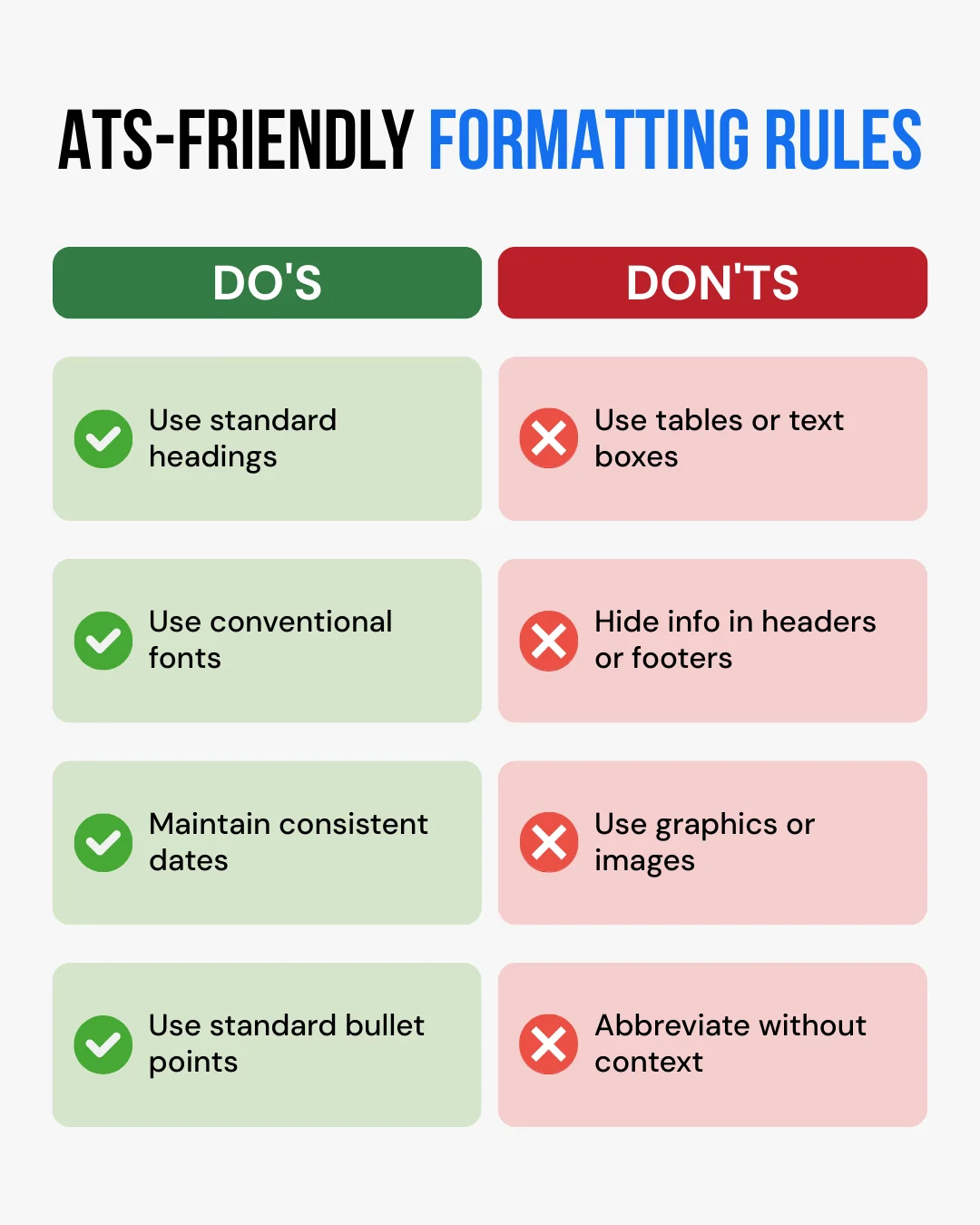
ATS-friendly formatting rules
The best way to pass an ATS scan is to keep your layout simple and predictable. Complex designs often "mess" with your data, causing the system to reject your application.
Do:
- Use standard headings: Stick to "Work Experience" or "Professional Experience."
- Use conventional fonts: Choose Arial, Calibri, or Times New Roman.
- Maintain consistent dates: Use the "Month Year – Month Year" format.
- Use standard bullet points: Stick to simple dots (•) rather than icons or arrows.
- Save as .docx or .pdf: Check the job posting for a specific preference; otherwise, these are the safest options.
Don't:
- Use tables or text boxes: These often become unreadable when parsed by older ATS software.
- Hide info in headers or footers: Most systems skip these sections entirely.
- Use graphics or images: They add no value to the software and can cause parsing errors.
- Abbreviate without context: Write out the full term first, then Keyword optimizationTo rank high in an ATS search, your work experience must mirror the specific language of the job description.how
Keyword optimization
To rank high in an ATS search, your work experience must mirror the specific language of the job description.
- Extract keywords: Identify the required skills, specific software (e.g., Salesforce, Python), and certifications mentioned in the posting.
- Use exact matches: If the posting asks for "Project Management," use that exact phrase rather than "PM" or "Lead Coordinator."
- Sprinkle naturally: Don’t "keyword stuff" at the bottom of the page. Incorporate these terms into your achievement bullets to show how you used the skill.
- Use the "Dual Format": Include both the full term and the acronym, such as "Search Engine Optimization (SEO)," to ensure you appear in searches for either term.
How our Resume Builder helps with work experience
One of the hardest things about looking for a job is writing about what you've done well. Our Resume Builder uses AI to handle the formatting and optimization for you.
Generate achievement-focused bullets in seconds
Writing bullets that focus on accomplishments takes a lot of time and often feels like "bragging." Using the Action + Context + Result formula, our AI automatically turns your basic job duties into achievement statements that have a big impact.
How it works:
- Enter your job title and a few basic responsibilities.
- The AI generates 3–5 achievement-focused bullet options.
- The tool suggests relevant metrics and places to add quantification.
- You choose the bullets that best match your experience and customize the final details.
Match keywords from job descriptions
The Skills Match feature analyzes job postings in real time and shows you exactly which keywords are missing from your work experience section.
- Drop the job description into the builder.
- See a live score showing how well your experience aligns with the role.
- View highlighted keywords and get suggestions on where to add them.
- Use the AI to rewrite existing bullets to include missing keywords naturally.
Import from LinkedIn
Don't spend hours copying and pasting from your profile. Our builder allows you to import your LinkedIn data directly to get a head start.
- Sync your LinkedIn account to pull in your work history.
- All company names, titles, and dates populate instantly.
- Once imported, you can run each entry through the AI enhancer to turn your old LinkedIn descriptions into interview-winning achievements.
- When finished, export your resume as an ATS-optimized PDF.
Common work experience mistakes to avoid
Even if you have the best accomplishments, small mistakes in formatting or strategy can ruin your application. To keep your resume in the "yes" pile, stay away from these six common mistakes.
Mistake 1: Listing duties instead of accomplishments
Hiring managers already know what a "Sales Manager" does; they want to know how well you did it.
- Wrong: "Responsible for managing customer accounts."
- Correct: "Managed a portfolio of 50+ enterprise accounts, generating $2M in annual recurring revenue."
Mistake 2: Using a "one-size-fits-all" resume
Sending the same resume to every employer is a fast track to rejection. Tailoring your bullets to a specific job description takes 10–15 minutes but can have a positive impact on your interview rate.
Mistake 3: Including irrelevant history
A summer lifeguard job from a decade ago doesn't belong on a senior software engineer's resume—unless you're applying to a pool company.
Mistake 4: Going back too far in time
For most professionals, 10–15 years of history is the limit. If you have valuable older experience, condense it into an "Earlier Career" section without bullet points to save space.
EARLIER CAREER
Sales Associate, Retail Company | 2008–2012
Customer Service Representative, Call Center | 2005–2008
Mistake 5: Inconsistent formatting
If one entry uses bold titles and the next uses italics, it signals a lack of attention to detail. Ensure every date, city, and company name follows an identical style throughout the document.
Mistake 6: Lying or exaggerating metrics
Integrity is non-negotiable. Background checks and reference calls are highly thorough and will catch fabrications. If you don't have an exact number, provide a conservative estimate (e.g., "Approximately 20%") rather than making one up.
.webp)

%20Which%20Should%20You%20Use.webp)
