
.webp)
Blink, built by Nanite Foundry, is a browser-use agent designed to handle the hardest parts of the open web. It opens any website, reads what is on the screen, reasons through what to do next, and completes multi-step tasks the way a person would. It navigates unfamiliar interfaces, fills out forms, handles logins, works through filters, and runs all the way to checkout. The web is messy and unpredictable, and Blink is built to keep going when a page behaves in a way no one planned for.
The team has pushed the agent a long way. Blink can complete real purchases end to end, and it is the first browser-use agent to operate with its own debit card. It runs e-commerce operations on Amazon and Shopify, handles repetitive enterprise work in finance, logistics, and procurement where no clean API exists, and shops across the web by finding the best price, applying real coupons, and finishing the checkout on its own. For every run, it produces structured reasoning traces and sequential screenshots, so teams can see exactly how it planned, acted, and corrected itself.
A product that capable invites an obvious question: can it actually do what its creators say it can? To answer that in public, the team set out to conquer Online Mind2Web, the leading benchmark for browser-use agents.
Online Mind2Web is difficult by design. It runs agents against real websites with real interfaces and real ambiguity: sites like Airbnb, Booking.com, and Target, where filters fail, modals interrupt, pages shift between runs, and the correct answer is rarely the obvious one. The benchmark's harder tasks demand precise navigation, careful form handling, and the ability to work through dynamic content that does not behave the same way twice. These are the same problems that show up in real enterprise and consumer work, which is what makes the benchmark meaningful in the first place.
That difficulty is also why a benchmark score is only as strong as the evaluation behind it. Automated scoring is fast, and it is useful, but it cannot catch everything. It can read a task as complete when there is more nuance to it, and it can miss a valid path the agent took to reach the right result. On a benchmark this hard, a confident score needs human judgment confirming it, task by task.
So the requirement was specific. Review the full Online Mind2Web trajectory set. For every task, have skilled human reviewers confirm whether the agent genuinely completed it, and bring careful judgment to the cases that need a closer look. And do it quickly, because the team was moving fast toward a public announcement and every day mattered.
From the first day, Careerflow worked as part of the team. The two sides got on a shared channel and went back and forth on the details that decide whether an evaluation is sound: how the agent's thoughts mapped to its actions, how each screenshot lined up with each step, how to treat tasks with no clear final answer, and how to handle trajectories where the data and the screenshots needed reconciling.
Careerflow went further than the brief. The team built custom evaluation tooling for the project and sent Blink daily reports on the review as it progressed, so the team always had a current view of the work rather than waiting for a single hand-off at the end. Careerflow also worked with Blink on a schema format that made the data easy to ingest on their side. When the screenshot data carried a coordinate offset, Careerflow caught it. When the mapping between steps and images needed adjusting, Careerflow flagged it and rebuilt the structure before a single label was produced. Getting that foundation right before annotation started mattered, because the quality of the labels depends entirely on it.
That is why the relationship deepened the way it did. Blink chose Careerflow for the speed and the human review, and stayed because Careerflow kept solving problems before they became blockers. As Ric put it, Careerflow built custom tooling and a dashboard that let Blink see exactly what the evaluators were doing and what their conclusions were, and provided suggestions on how Blink could improve the agent's handling of certain situations.
Careerflow designed the human review as a triple-opinion process: every trajectory was reviewed independently by multiple evaluators, with QA verification and a final review before anything was recorded. As an unbiased third party with no stake in the result, Careerflow gave Blink a check on the agent's performance that the team could trust and publish.
This is where careful human review showed its value. On one task, the agent answered from a "top buys 2026" list while the task asked for "top buys 2025," a subtle mismatch worth a second look that a Careerflow reviewer caught and flagged for the team to decide on. On another, the agent completed the task correctly but the final chart the task asked for sat just below the visible area, so the reviewers noted it for a re-run rather than letting it pass automatically. These are the kinds of edge cases where a human eye adds confidence to the result, and they are exactly why Blink wanted people reviewing every trajectory.
Careerflow also delivered more than the brief required. The reviewers captured additional metadata on each task, the kind of detail Blink could use to locate and refine specific trajectories, and surfaced practical suggestions on where the agent could improve. None of that was asked for. Ric described it as going over and above.
Blink reports a perfect score on Online Mind2Web, clearing every easy, medium, and hard task. It was the first agent to do so, and it cleared tasks that agents from Google, Anthropic, and OpenAI did not. The human evaluation standing behind that claim was Careerflow's, which is what let Blink put the result in front of the public with confidence.
The work also led to something larger than a single project. The maintainers of Online Mind2Web, the OSU NLP Group, now name Careerflow as their official human evaluation partner for the benchmark. Any team submitting an agent to the leaderboard can have it reviewed through Careerflow's standardized, multi-annotator process.
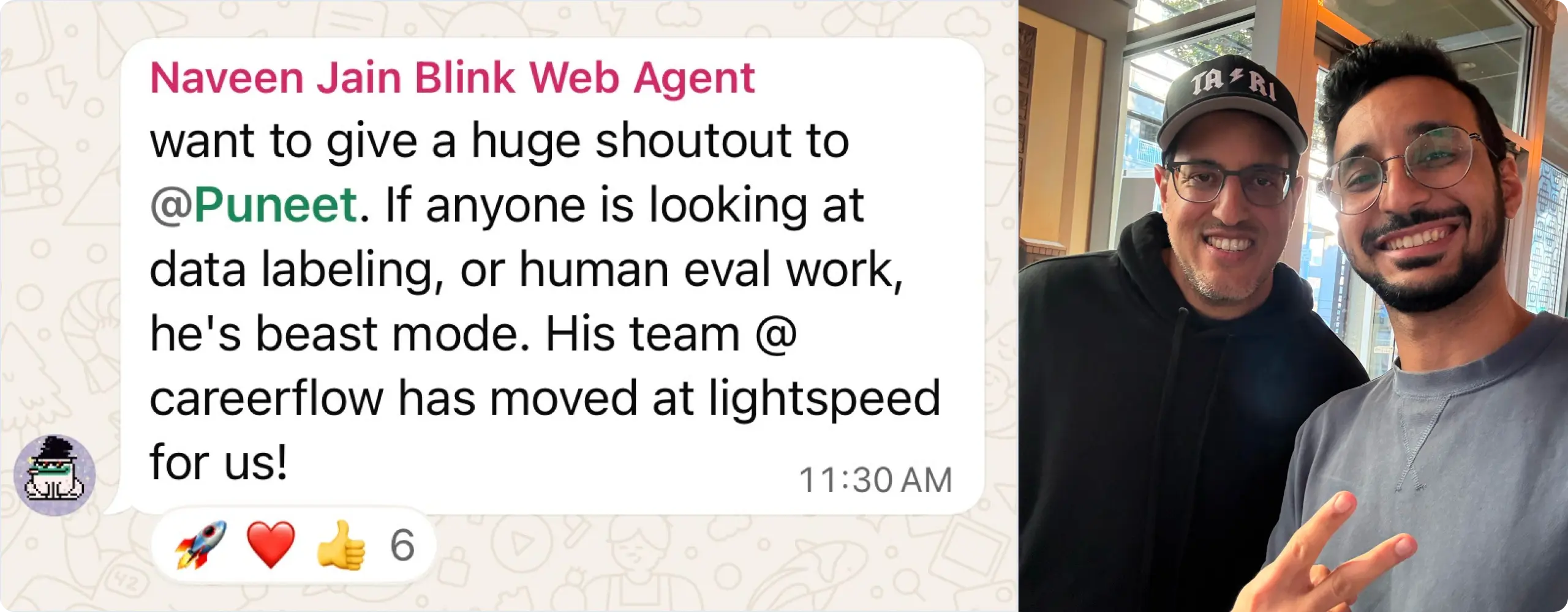
Blink needed evaluation it could put in front of the public, measured against the most capable agents in the world. Careerflow provided a vetted, unbiased human review team, custom tooling and daily reporting built for the project, a triple-opinion review process, and metadata and suggestions the team never had to request. The result was a benchmark claim Blink could stand behind, and a partnership that outlasted the project that started it.




